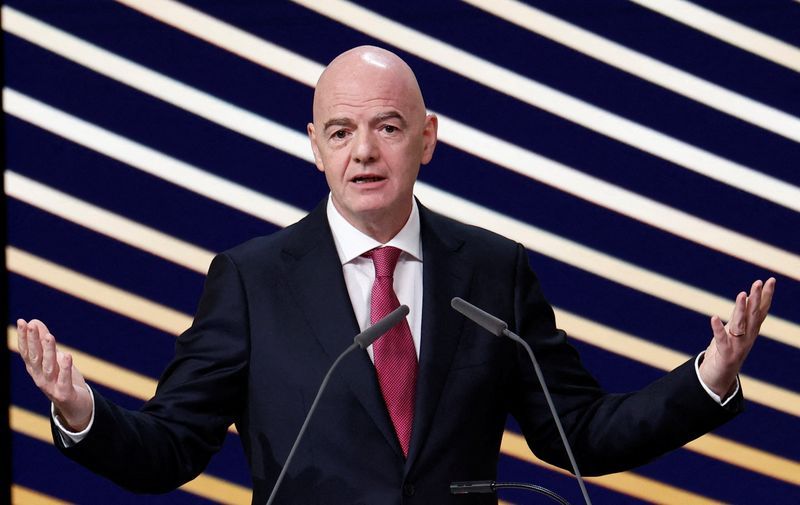
The Oceania Football Confederation has expressed cautious optimism about FIFA's decision to scrap its contested private investment initiative, even as cracks widen within the world governing body's regional membership. New Zealand, the confederation's most prominent football nation, has broken ranks to oppose President Gianni Infantino's bid for another term, signalling deepening divisions that threaten the sport's administrative cohesion ahead of next year's FIFA Congress elections.
The OFC, representing just 11 full member nations across the Pacific, publicly welcomed FIFA's withdrawal of the FFE (FIFA Forward Enterprise) proposal after an executive meeting on Wednesday. In a formal statement, the confederation acknowledged that the region had gained substantially from FIFA's stewardship over the previous decade and encouraged the governing body to use the review process to identify structural improvements. This measured response reflected the economic realities facing smaller confederations, which depend heavily on FIFA's development funding and technical support.
However, New Zealand Football's decision to withdraw its endorsement of Infantino for the forthcoming presidential election represents a significant challenge to the incumbent leader. As the only Oceania member to qualify for the most recent World Cup, the New Zealand federation carries disproportionate influence within the regional bloc and commands respect in broader FIFA circles. The organisation's reversal signals that Infantino's authority has fractured even among traditionally aligned members who might have been expected to maintain solidarity.
The underlying dispute centres on the failed FFE scheme, a controversial initiative designed to inject private capital into FIFA competitions including the World Cup. The proposal had promised member associations substantial financial incentives to participate, including a baseline grant of $20 million for the next funding cycle that would potentially double upon signing. Yet the scheme's architectural flaws and the opacity surrounding its development sparked unprecedented criticism from three major confederations—UEFA, the AFC, and CONCACAF—which jointly demanded a leadership review.
New Zealand Football's statement articulated concerns that extend beyond the investment proposal itself. The federation declared that decisions and actions within FIFA had generated a broader erosion of trust and intensified divisions across international football. This diagnosis suggests that confidence in Infantino's stewardship has become fundamentally compromised, not merely over a single failed initiative but across the scope of his administrative conduct. The federation therefore insisted on an independent inquiry into the development process of the FFE scheme, positioning external oversight as essential to restoring legitimacy.
Infantino, who faces reelection next year, has found himself in an increasingly precarious position. The coordinated challenge from Europe, Asia, and North America demonstrates that opposition to his leadership transcends geographic boundaries and reflects substantive governance concerns. His administration's handling of the private investment proposal—or more precisely, the miscommunication and apparent mismanagement surrounding it—has become emblematic of broader questions about decision-making transparency and accountability within FIFA's highest echelons.
FIFA's response to the crisis has included a formal apology to all 211 member associations for errors in how the FFE proposal was developed and presented. Senior leadership has publicly reaffirmed their backing for Infantino, attempting to stabilise the situation through expressions of internal solidarity. Yet such declarations have done little to persuade federations like New Zealand that the fundamental problems have been adequately addressed. An apology for procedural mistakes does not necessarily resolve doubts about the strategic wisdom or governance framework that produced such a flawed initiative.
For Southeast Asian football bodies observing these developments, the implications warrant careful attention. The AFC and ASEAN members have substantial interests in FIFA's direction and in ensuring that future development schemes are subjected to rigorous scrutiny before implementation. The OFC's relatively muted response, despite welcoming the review, may reflect the economic vulnerabilities of smaller confederations whose development depends on FIFA funding. By contrast, New Zealand's willingness to defy regional consensus in pursuit of institutional accountability suggests that larger or more financially secure members may possess greater independence to challenge problematic governance.
The electoral dynamics surrounding the FIFA presidency will likely intensify over coming months as member federations determine their positions. New Zealand's decision could embolden other nations harbouring similar concerns but hesitant to break openly with their continental confederations. The December FIFA Congress meeting will provide the pivotal moment when Infantino either commands sufficient support for reelection or faces serious electoral jeopardy. The fracturing of bloc voting patterns—evident in Oceania's internal split—indicates that traditional regional cohesion can no longer be assumed, a structural shift that complicates prediction of outcomes.
The episode also illuminates persistent governance weaknesses within FIFA, where major strategic decisions affecting hundreds of millions of dollars have historically been shaped by relatively small leadership circles with limited transparent consultation. The independent review that multiple federations are now demanding represents an opportunity to establish more robust institutional checks on executive power. For Malaysian football stakeholders and regional observers, the unfolding situation underscores the importance of engaging actively in confederation discussions and FIFA forums to ensure that Asia's interests are protected as global football governance undergoes potential reformation.

