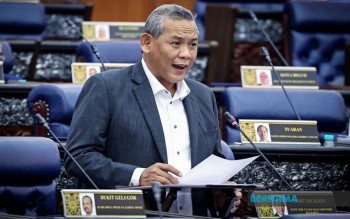
Parliament's recent examination of the Royal Commission of Inquiry report on Tabung Haji has revealed sharply divergent views on how to interpret the institution's troubled investment history and chart its course forward. Port Dickson Member of Parliament Datuk Seri Aminuddin Harun brought a measured perspective to the debate, cautioning against sweeping assumptions that all financial setbacks stem from improper conduct. Speaking during today's special sitting on the RCI findings in the Dewan Rakyat, Aminuddin emphasised the critical importance of distinguishing between losses attributable to ordinary market dynamics and those arising from negligence, conflicts of interest, or breakdowns in governance oversight.
The former Negeri Sembilan menteri besar's intervention comes as Parliament examines a 211-page RCI report unveiled on July 29 that documented significant institutional weaknesses spanning the 2014 to 2020 period. The commission's investigation, initiated by government announcement in 2021 with members appointed in January 2022, presented its findings to the Yang di-Pertuan Agong in August last year. Importantly, the RCI advanced 25 distinct recommendations for institutional improvement, with three-quarters already implemented by Tabung Haji as of late July, suggesting the pilgrimage fund is responding to scrutiny with concrete remedial action.
Aminuddin's framing of the investment losses question carries particular weight given the sensitive nature of Tabung Haji's role as custodian of pilgrim savings. The institution manages funds collected from Malaysian Muslims preparing for the hajj, making governance lapses not merely financial matters but issues touching on trust and religious responsibility. His insistence on fair discussion reflects awareness that public confidence in the institution depends on transparent, nuanced analysis rather than reflexive blame-assignment. The distinction he draws between market-driven losses and those stemming from decision-making failures or governance inadequacies is fundamental to understanding what reforms will genuinely prevent future problems.
Central to Aminuddin's reform agenda is wholesale transformation of how Tabung Haji selects its leadership. He contends that board appointments and senior management positions should rest exclusively on demonstrable expertise and investment acumen rather than political patronage or personal connections. This represents an implicit critique of past practices, suggesting that well-connected individuals lacking relevant qualifications have previously ascended to positions of institutional authority. His call to end regarding such posts as rewards for political loyalty signals recognition that merging political interests with fiduciary obligations creates inherent conflicts destructive to sound investment decision-making.
The former state leader sketched an ambitious personnel standards framework, proposing that every board candidate undergo rigorous screening across multiple dimensions: integrity, investment experience, Islamic finance expertise, risk management competency, accounting and auditing knowledge, legal proficiency, corporate governance understanding, and hajj operations familiarity. This multidisciplinary approach acknowledges that modern institutional management demands breadth of knowledge and oversight capacity. Equally significant is his emphasis on mandatory declaration of conflicts of interest, a procedural safeguard that makes competing loyalties transparent and manageable.
Aminuddin also endorsed the RCI's recommendation that active politicians be prohibited from serving as Tabung Haji chairman or board members, either at the parent institution or its subsidiary entities. This exclusion addresses fundamental governance principles: elected politicians necessarily bear accountability to constituents and party structures that may conflict with their fiduciary duties to pilgrims. Separating political office from institutional stewardship creates cleaner lines of authority and reduces reputational risk to both spheres. The recommendation acknowledges that Tabung Haji requires insulated professional leadership capable of making unpopular decisions when investment returns suffer or operational efficiency demands difficult choices.
Yet parliament's engagement with the RCI report revealed substantial gaps that Aminuddin's proposals alone cannot address. Datuk Mohd Isam Mohd Isa, a Tampin backbencher and Public Accounts Committee member, highlighted what he characterised as the RCI's temporal limitations. The commission's investigation concluded at 2020, leaving a five-year management window from 2021 through 2025 entirely unexamined. Mohd Isam argued that significant Tabung Haji developments occurred after the RCI's cutoff, making its conclusions potentially incomplete for understanding the institution's contemporary trajectory. This observation suggests that institutional problems are not historical curiosities but ongoing challenges requiring continuous monitoring.
Mohd Isam accordingly proposed establishing a successor RCI encompassing the 2021 to 2025 period, allowing investigators to examine more recent developments with the same systematic rigour applied to 2014-2020. He further suggested that parliamentary oversight mechanisms, particularly the Public Accounts Committee, should scrutinise Tabung Haji's governance and management practices through 2026. This layered approach to institutional accountability reflects awareness that single-point-in-time investigations, however thorough, cannot sustain the continuous vigilance required for institutions managing public religious trust.
The Malaysian context makes these governance debates particularly significant. Tabung Haji represents not merely a financial institution but a crucial mechanism through which the state facilitates religious observance for citizens of modest means who might otherwise struggle to afford pilgrimage. Investment losses directly reduce the number of Malaysians able to perform hajj, making fiduciary management a matter touching on religious freedom and social equity. Furthermore, Tabung Haji's governance challenges have broader implications for Southeast Asian institutional design, signalling to other nations managing religious trust funds the importance of insulating such bodies from political capture and ensuring professional management standards.
The debate also reflects evolving Malaysian standards for institutional accountability. The RCI process itself, including public presentation of findings and parliamentary examination, demonstrates commitment to transparent investigation. The relatively rapid implementation of three-quarters of RCI recommendations suggests institutional responsiveness. Yet the discussion of ongoing monitoring and potential successor commissions indicates recognition that accountability must remain permanent, not episodic. For Malaysian pilgrims and the broader Muslim community that Tabung Haji serves, these governance improvements carry profound significance extending well beyond financial metrics to encompass institutional trustworthiness and effective stewardship of religious obligations.

