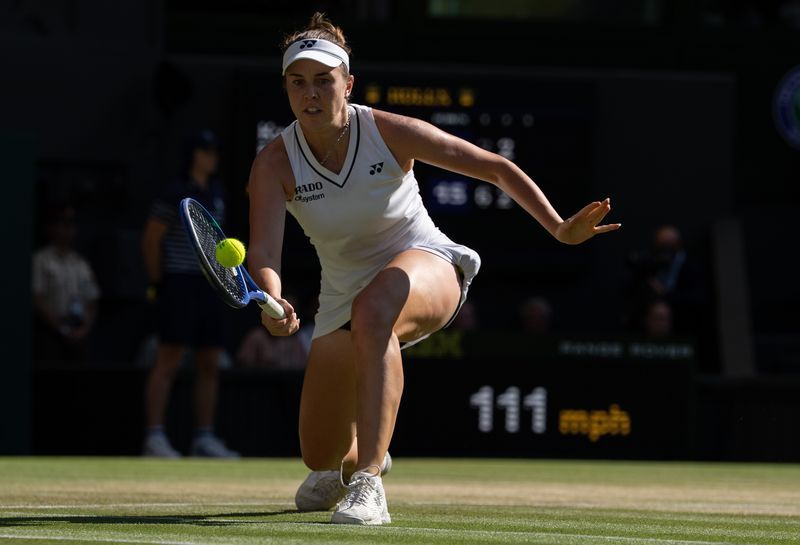
At 21 years old, Linda Noskova faced a moment that could have defined her career for all the wrong reasons. Leading 5-2 in the second set against fellow Czech Karolina Muchova at Wimbledon, the ninth seed appeared destined to lift the Venus Rosewater Dish on Centre Court. Instead, she squandered five consecutive match points in what would have been a catastrophic collapse for most players at that stage of their careers. Yet Noskova demonstrated a mental fortitude rarely seen in players so young, regrouping to eventually claim a 6-2 5-7 6-3 victory in Saturday's final. Her triumph marks a significant moment for Czech tennis, adding another major title to a nation that has produced an extraordinary succession of elite women players in recent seasons.
The match's dramatic arc revealed itself as Muchova engineered one of the most improbable comebacks imaginable. After losing the opening set convincingly, Muchova clawed her way back when Noskova's nerve began to fray. The ninth seed's grip on victory loosened with each passing game—first losing the chance to end matters at 5-2, then at 5-3 when a double fault on another match point revealed the pressure mounting in her body. A fifth match point disappeared in the ninth game of the set, and suddenly Muchova had reeled off five consecutive games to force a decider. By the time she sent the final into that third set, Noskova walked back to her chair visibly shell-shocked, her hands covering her ears to muffle the crowd's roar as the mental toll became apparent.
What happened during that pivotal comfort break proved crucial to the trajectory of the remainder of the match. According to Noskova's own account to reporters, a moment of clarity struck her as she walked towards the facilities. She glimpsed the championship trophies displayed nearby—the smaller plate and the larger Venus Rosewater Dish—and made a conscious decision that would reshape her mindset. "I was just telling myself that the match is starting over," she explained. "I just splashed some cold water on me, started over again. But what really helped me, the first step I took off court, the trophies were there. I was like, I'm not going to take the small one, I'm taking the big one." This moment of visualization and renewed determination proved transformative, suggesting that Noskova possesses psychological resources uncommon in someone of her age and experience level.
The turning point came in the opening game of the third set, when Noskova somehow managed to hold her serve despite everything stacked against her. She later acknowledged how crucial this single game proved to her ultimate victory. "Let's say I'm brave enough to say that the third set would not have been the same if maybe I would have lost the first game," she reflected. "I lost five games in a row in the one before it, so it was very, very important to start off great." Once she secured that hold, a visible switch flipped. Her timing on groundstrokes returned to its earlier sharpness, her footwork regained its crispness, and her confidence rebuilt itself game by game. When she reached match points again at 5-3 in the third set—more than an hour after her first opportunity—this time she converted, securing the title that had seemed within her grasp only moments earlier.
At 21, Noskova becomes the third Czech to win the women's singles title in just four years, underlining her nation's remarkable dominance in women's tennis at the elite level. She is also the youngest women's champion since her fellow Czech Petra Kvitova won the first of her two Wimbledon titles in 2011. This succession of Czech champions reflects a well-developed system for nurturing female talent and a cultural tradition of excellence in the sport that extends back decades. The significance of Noskova joining this illustrious line extends beyond mere statistics—it positions her as part of a generational wave that shows no signs of slowing.
What distinguishes Noskova beyond her tennis abilities is a maturity and worldview that extends far beyond the confines of a court. She wears a nose ring, projects a distinctive personality, and possesses an unusual degree of introspection for someone her age. Her perspective has been shaped by personal tragedy—her mother Ivana died from cancer two years ago—an experience that has evidently contributed to her composed demeanor in high-pressure moments. Rather than allowing such losses to define her negatively, Noskova has channeled them into a broader commitment to social responsibility and personal growth that speaks to her character.
During her off-season the previous year, rather than pursuing the typical recovery and training regimen favored by elite athletes, Noskova chose to volunteer in Zanzibar for a charity organization working with schools. Upon her return from that experience, she reported feeling "definitely more appreciative of everything that I have." This commitment to stepping outside her professional bubble and engaging with broader human concerns reveals a player who views her tennis career within a larger life context. She has expressed deep concern for environmental issues and already maps out plans for a post-tennis career focused on nature conservation and volunteering, demonstrating that her ambitions extend beyond accumulating trophies.
Growing up in a village within a Czech forest profoundly shaped Noskova's values and perspective. Her early environment instilled in her a deep connection to nature and an understanding of broader environmental challenges that influence her worldview today. She has been vocal about her intentions to dedicate herself to environmental causes once her competitive tennis career concludes, suggesting that her Wimbledon victory represents one achievement among many she hopes to accomplish in a life oriented toward meaningful contribution.
Noskova's emotional connection to her accomplishment became evident in her post-match reflections. "It was all worth it, so I will definitely never forget this week, these two weeks," she said, acknowledging the intensity and significance of the tournament run. Her ability to maintain perspective even at the moment of her greatest professional achievement speaks to the grounded nature that has evidently served her well throughout her career. Rather than becoming consumed by the enormity of winning a Grand Slam at 21, she places the victory within the broader context of her life journey and future aspirations.
For Malaysian and Southeast Asian readers, Noskova's victory offers instructive lessons about resilience and mental strength that transcend tennis. In a region increasingly focused on developing elite athletes across multiple sports, her comeback from the brink of devastating failure demonstrates that technical ability alone does not determine outcomes at the highest levels of competition. The psychological capacity to reset, refocus, and execute under extreme pressure represents a quality that can be cultivated and developed. Her story also underscores the importance of maintaining perspective beyond sport—her volunteering experiences and environmental commitments suggest that athletes who engage meaningfully with the world beyond competition may develop the emotional maturity that enables them to handle pressure more effectively.
Looking forward, Noskova enters a new phase of her career with her maiden Grand Slam title secured and her ranking and confidence substantially elevated. The question now becomes whether she can build on this breakthrough and establish herself as a consistent contender at major tournaments, or whether the breakthrough victory will prove to be the peak of her career. Her maturity, perspective, and demonstrated ability to overcome adversity suggest that she possesses the foundations for sustained success. However, the pressure that now accompanies Grand Slam champions often proves more burdensome than the hunger that preceded their breakthrough victory. How Noskova navigates this transition will significantly influence her trajectory over the coming years and whether her Wimbledon triumph represents the beginning of a dominant era or a singular career highlight.

