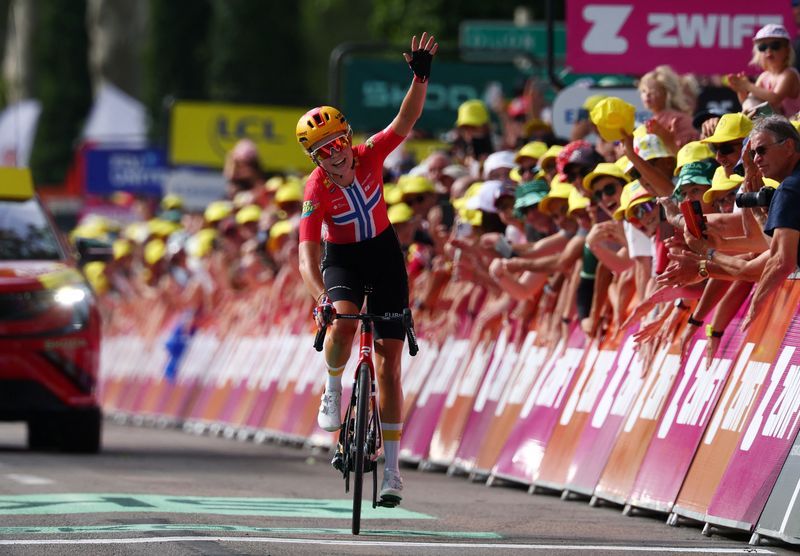
Sigrid Haugset made cycling history on Monday when the 27-year-old Norwegian crossed the finish line in Poligny to claim the first stage victory by a rider from her country at the Tour de France Femmes. The breakthrough moment also propelled her into the race lead, unseating Dutch cyclist Lorena Wiebes and making Haugset the inaugural wearer of the yellow jersey for Norway at this prestigious women's event. Riding for Uno-X Mobility, Haugset's combination of tactical acumen and physical resilience on a demanding 156.5-kilometre mountain stage exemplified the calibre of competition that has transformed professional women's cycling in recent years.
The stage unfolded across the rolling terrain between Switzerland and France, with early chaos setting the tone when multiple riders tumbled during the category-one climb to Col de la Faucille. Among those caught in the incident were defending world champion Magdeleine Vallieres and former Tour champion Demi Vollering, though both recovered and continued racing without apparent lasting damage. The peloton remained disciplined thereafter, with no significant breakaway attempts materialising during the gruelling 11.4-kilometre ascent, suggesting that the terrain itself posed sufficient challenge to the field's equilibrium.
Haugset made her decisive move during the subsequent climb to Col de la Savine, slipping away from the main bunch with characteristic timing. Belgian rival Lotte Kopecky responded to the threat within minutes, initiating a chase that would define the remainder of the stage. The contest between these two European climbers developed into a compelling duel as the race entered France proper, with each woman testing the other's reserves while the main peloton gradually lost touch with the leaders. Wiebes, defending the yellow jersey she had worn into the stage, found herself increasingly isolated, ultimately trailing Haugset by thirteen minutes at the twenty-kilometre mark.
Kopecky's persistence nearly proved decisive in the closing kilometres, bridging the gap to within ten seconds as the riders entered the final ten kilometres. At this critical juncture, with exhaustion threatening to overwhelm her, Haugset discovered the mental fortitude to counter-attack. The Norwegian accelerated sharply with three kilometres remaining, decisively distancing Kopecky once more and building a lead approaching one minute by the time she crossed the finish line. Haugset's refusal to ease off the pace in the closing metres underscored her professional approach, though she later revealed in interviews that her physical exhaustion had been so complete that she lacked the strength to celebrate properly.
The scale of Haugset's achievement extends beyond the immediate stage victory. By accumulating time on her rivals, she established an overall advantage of two minutes and twenty-two seconds over second-placed Kimberly Le Court of Mauritius, assuming control of the race with several stages remaining. This margin suggests real vulnerability among her competitors rather than a mere fortunate breakaway, indicating that Haugset possesses the sustained climbing power and tactical intelligence to mount a credible campaign for the overall title. For Norwegian cycling, the historical significance cannot be overstated—Haugset joins an elite cohort of women climbers who have demonstrated the capacity to compete at the sport's highest level across a three-week stage race.
Haugset's emotional reaction at the finish revealed the weight of expectation she had carried into the stage. In her post-race comments, she acknowledged having doubted whether victory was achievable even as she attacked, and admitted that Kopecky's relentless pursuit had tested her resolve repeatedly. The reference to supporters cheering from Norway provided insight into her motivational framework—the knowledge that her performance carried symbolic importance beyond individual glory drove her to dig deeper when the physical and psychological toll mounted. This connection between personal achievement and national pride has become increasingly prominent in women's professional cycling as coverage and investment have expanded.
The crash on Col de la Faucille, while not ultimately decisive to the stage outcome, underscored the inherent risks that riders accept when competing in mountain stages. That both Vallieres and Vollering, despite their elite status and accumulated championship credentials, could find themselves on the ground highlighted the unpredictable nature of cycling at speed on challenging terrain. The rapid regrouping of the peloton suggested that the severity of the incident was limited, yet such moments often determine overall race narratives when margins prove narrow later in the competition.
Kopecky's second-place finish, concluded one minute and twenty-four seconds behind Haugset, represented a strong performance that nonetheless fell short of maintaining her earlier position in the standings. The Belgian had ridden intelligently and aggressively, demonstrating that she possessed the capacity to match Haugset on the climb. The gap ultimately separating them reflected the Norwegian's superior physical conditioning on this particular terrain and occasion, rather than any fundamental tactical error by the Belgian. For Kopecky, the stage represented a platform for future attempts, suggesting that the race's remaining mountain stages would likely offer comparable opportunities.
The Tour de France Femmes has evolved dramatically since its relaunch as a three-week Grand Tour in 2023, attracting increasingly deep fields of professional cyclists and generating substantial media attention across Europe and beyond. Haugset's breakthrough performance contributes to the narrative of competitive depth and unpredictability that has characterised the modern era of women's professional cycling. That a Norwegian rider could seize the yellow jersey reflects the sport's genuine internationalisation and the reduced dominance of traditionally strong cycling nations, a pattern that extends Southeast Asian interest in the competition as a benchmark for evaluating elite athletic performance globally.

