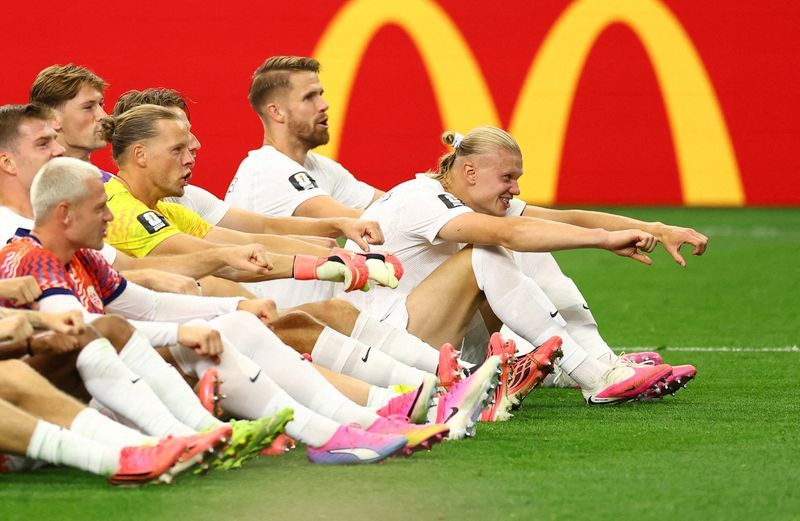
Norway's extraordinary journey at the World Cup has ended in heartbreak, but not in shame. The Scandinavian nation's compelling tournament run came to a close in Miami on Saturday when they fell 2-1 to England after extra time in the quarter-finals. Yet under manager Stale Solbakken, Norway demonstrated that their 28-year absence from the world's premier football stage was merely an intermission rather than a permanent exit, and they return home with their reputation substantially enhanced across global football circles.
The Norwegian narrative throughout this tournament centred on redemption and cultural pride. Before the competition began, the squad participated in a striking photoshoot portraying themselves as Viking warriors, a deliberate embrace of Scandinavian heritage that transcended mere theatre. With Erling Haaland leading their charge through the knockout rounds, the Norwegians proved this was far more than a marketing exercise. They progressed methodically through the group stage, then dismantled Ivory Coast 2-1 in the last 32 with Haaland scoring twice, before delivering one of the tournament's most memorable upsets by outplaying Brazil 2-1 to reach the last eight.
The Vikings' followers became synonymous with the competition's atmosphere, transforming the "Viking row" celebration into an iconic image of the tournament itself. Haaland's towering presence and irreverent sense of humour captivated American audiences, lending the Norwegian contingent a compelling charm that extended far beyond their football. Yet beneath the pageantry lay serious technical excellence. Norwegian football, long dismissed as a kick-and-rush outlier in European football, has undergone a profound transformation.
Bodo/Glimt's sustained success in European club competitions over recent years signals a fundamental shift in how Norwegian talent is being developed and deployed. The emergence of Haaland as a genuine world-class striker, coupled with captain Martin Odegaard's assured midfield leadership under Solbakken's composed direction, reflects a footballing culture now producing players capable of competing against the sport's elite. This generation embodies a Scandinavian temperament that balances self-deprecating wit with unwavering competitive intensity.
Solbakken's post-tournament reflection, delivered with characteristic Norwegian understatement, captured this philosophy perfectly. "I think that when some time passes in a week or two, everyone will be able to agree that the summer of '26 has been fairly OK," the manager remarked, a characteristically measured assessment of a campaign that transcended initial expectations. Expectations themselves had been modest yet sturdy. With Haaland's prolific form during qualifying, navigating the group stage represented the baseline objective, but the Norwegian squad possessed the ambition and capability to exceed such benchmarks considerably.
They achieved that ambition in devastating fashion against Brazil, arguably the tournament's finest display by a non-traditional contender. That victory sparked genuine conversations about potential semi-final appearances or even improbable championship dreams. However, the physical and mental toll accumulated over successive knockout encounters ultimately proved decisive. Against England, Norway conceded their initial defensive advantage when Jude Bellingham's double in extra time turned the match and sent the Three Lions into the semi-finals. The fatigue visibly afflicting Haaland and Odegaard underscored the demands placed upon even exceptional athletes across multiple successive high-stakes encounters.
Yet this setback represents merely a waypoint in Norway's footballing trajectory rather than a terminal destination. The self-assurance radiating from Solbakken, Odegaard, and Haaland reflects something deeper than temporary tournament success. Each embodies the kind of quiet confidence characteristic of the broader Norwegian national identity, perpetually comfortable laughing at themselves while remaining utterly serious about competitive objectives. This psychological balance proves particularly valuable in football, where emotional regulation often determines outcomes as much as technical proficiency.
Solbakken articulated the tournament's deeper significance when discussing his squad's collective mindset moving forward. "I think that we have players who are left with a feeling that they can more or less match the best teams in the world. That's good to take on board," he explained. This represents something qualitatively different from conventional tournament consolation, instead reflecting a genuine reorientation of Norwegian football's competitive self-perception. Players who previously might have approached encounters with traditional powerhouses from a position of psychological disadvantage now carry the concrete experience of defeating Brazil and competing credibly against England.
For Malaysian and Southeast Asian observers, Norway's trajectory offers instructive parallels regarding long-term football development strategies. The Norwegian example demonstrates that sustained investment in youth development systems, combined with coaching excellence and the cultivation of distinctive tactical identities, can produce genuine competitive breakthroughs even for smaller football nations. Bodo/Glimt's European exploits particularly exemplify how domestic club success can generate international player development pathways.
The road ahead for Norwegian football now branches in multiple directions. Solbakken himself noted that "many players now believe that they belong in the company that we have in this World Cup," suggesting a competitive confidence that extends throughout the squad rather than depending upon individual superstars. This diffusion of excellence across multiple players and positions should sustain Norwegian competitiveness through subsequent tournament cycles. While the 2026 World Cup fairytale concluded earlier than some dared hope, it simultaneously established foundations for sustained success that could reshape Scandinavian football's standing within the global game.

