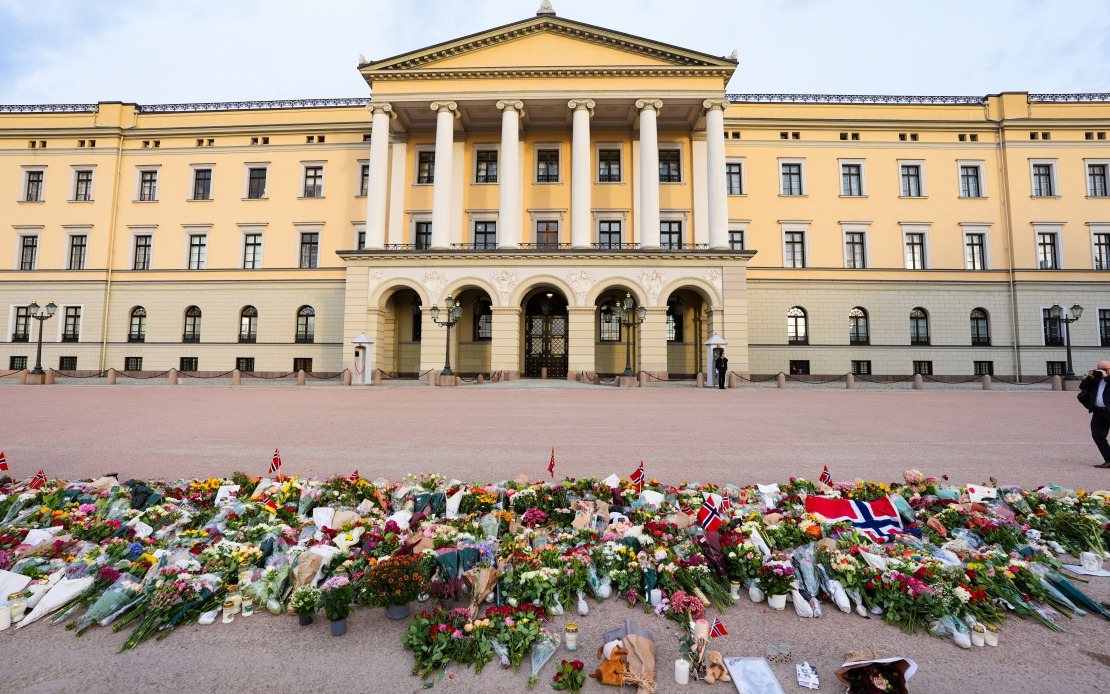
King Harald V of Norway, who had held the throne for more than three decades as Europe's oldest reigning monarch, died Friday morning at the National Hospital in Oslo. The 89-year-old sovereign passed away peacefully at 6:35 am local time, the Royal Palace announced, bringing an end to an era that had defined modern Norwegian monarchy. The lowering of the royal flag at the palace to half-mast marked the formal acknowledgment of the nation's loss, signalling the transition to a new chapter in Scandinavia's constitutional governance.
The king had been admitted to hospital on August 17 following a medical examination, but his condition deteriorated significantly in the weeks that followed. The palace disclosed that Harald had been undergoing cortisone treatment for hemolytic anemia, a blood disorder that causes the body's red blood cells to break down prematurely, leading to fluid accumulation in his tissues. This chronic condition, which had required ongoing medical management, became compounded when he developed a serious bacterial infection in his bloodstream, according to reporting from Norwegian public broadcaster NRK. The infection accelerated his decline, ultimately proving fatal.
Crown Prince Haakon immediately assumed the throne following his father's death, becoming King of Norway under the nation's established constitutional succession framework. Unlike many European monarchies that retain ceremonial coronation traditions, Norway dispensed with such formal investiture ceremonies decades ago, allowing the transfer of power to occur swiftly and administratively. The government is scheduled to meet the new sovereign during an extraordinary Council of State at the Royal Palace, where his official royal name and regnal number will be formally announced and confirmed. This procedural step, while ceremonial in nature, represents an important constitutional formality in Norwegian governance.
The transition adheres strictly to Norwegian constitutional requirements governing royal succession. Beyond the Council of State meeting, the new monarch will be obligated to take a formal oath before parliament, reaffirming his commitment to the Norwegian Constitution and the principles of parliamentary democracy that have characterized the kingdom's governance. This dual affirmation—before the government and before parliament—underscores the constitutional monarchy's fundamental commitment to democratic institutions rather than absolute monarchical authority. The new king's path to formal recognition thus reflects Norway's mature constitutional traditions.
Harald's reign, which began on January 17, 1991, following the death of his father King Olav V, spanned more than 35 years of continuous service to the Norwegian nation. During this extended period, he witnessed extraordinary transformations in Norwegian society, from technological revolutions to shifts in international relations and social values. His longevity as a reigning sovereign extended well beyond typical expectations in the modern era, and by the time of his death, he held the distinction of being Europe's longest-serving living monarch—a position of considerable symbolic weight in the continent's royal landscape.
The implications of this succession extend beyond Norway's borders, particularly for Nordic and broader European monarchical institutions. Harald's passing represents a generational shift in Scandinavian leadership, occurring at a moment when European monarchies are navigating evolving public expectations regarding relevance, accessibility, and institutional evolution. The peaceful transition of power, achieved through established constitutional mechanisms without controversy or disruption, demonstrates the stability that mature democratic institutions can provide. For Malaysia and other Commonwealth and constitutional monarchy nations in Southeast Asia, the Norwegian example offers instructive lessons about how hereditary succession can function within robust constitutional frameworks that protect democratic principles.
Crown Prince Haakon, who now assumes the kingship, has been extensively prepared for this responsibility throughout his life. His assumption of the throne marks a generational change in Nordic leadership that observers will watch closely as he charts his own course while respecting the institutional traditions and constitutional limits that define Norwegian monarchy. The new king inherits a nation with strong democratic traditions, robust social institutions, and a firmly established place within Western alliance structures. His early decisions and priorities will likely signal continuity while potentially introducing fresh perspectives aligned with contemporary challenges.
Harald's death arrives at a time when European royal institutions face persistent questions about their contemporary relevance and necessity. Norway's handling of the succession, characterized by constitutional propriety and institutional calm, stands in contrast to the disruptions that have affected other European royal houses in recent years. The seamless transfer of authority, achieved without regency councils or constitutional crises, reflects decades of careful institutional management and public confidence in the monarchy's role as constitutional guardian rather than wielder of executive power. This model of succession demonstrates that hereditary monarchy can coexist peacefully with democratic governance when properly constrained by constitutional limitations.
For observers in Southeast Asia and the broader Commonwealth, the Norwegian succession offers relevant examples of how constitutional monarchies manage institutional transitions. Malaysia and other nations with hereditary monarchies have their own succession protocols and traditions, yet the Norwegian experience demonstrates principles of constitutional clarity, institutional stability, and respect for democratic processes that transcend national boundaries. The smooth passage of power following Harald's death, executed through established legal and constitutional procedures, provides a textbook example of how institutional maturity can facilitate orderly governance even during moments of significant change and loss.

