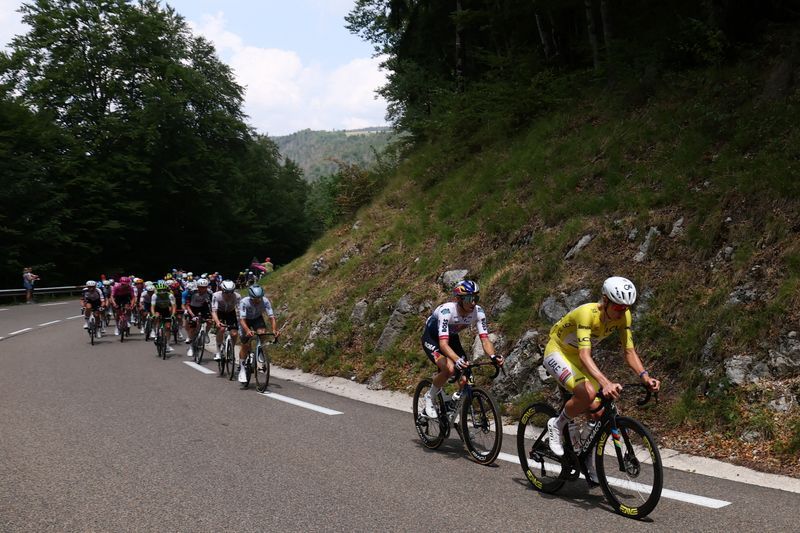
Jonathan Vaughters, a veteran of professional cycling and current leader of the Cannondale-EF team, has entered a heated debate over early-morning doping controls at this year's Tour de France, defending the controversial practice as a crucial safeguard against performance-enhancing drug use. His intervention carries substantial weight given his insider position within cycling's anti-doping movement and his own transparency about past infractions.
The controversy erupted following unannounced doping checks conducted in the pre-dawn hours before the 15th stage of the race, when riders including race leader Tadej Pogacar and stage favourite Jonas Vingegaard were roused from sleep for testing. These surprise inspections sparked immediate pushback from competitors who argued that sleep disruption posed unfair disadvantages and potentially compromised their safety during demanding mountain stages. The complaints highlighted a fundamental tension in modern anti-doping enforcement: the balance between effective detection and athlete welfare.
Vaughters used social media to articulate his perspective, suggesting that peptide micro-dosing—the practice of administering small, carefully timed doses of banned substances like EPO and human growth hormone that can leave the body within hours—would be nearly impossible to conceal if rigorous night-time testing had been routinely conducted in previous decades. His assertion that the UCI would have suspended virtually every professional cyclist in the peloton had such testing existed in 2001 represents a striking acknowledgement of how widespread doping was during cycling's darkest period.
The credibility of Vaughters' position stems partly from his candour about his own involvement in doping. As a teammate of Lance Armstrong on the U.S. Postal Service team during the late 1990s and early 2000s, Vaughters subsequently admitted to using EPO and other performance-enhancing drugs during his racing career. He later became a crucial witness for the U.S. Anti-Doping Agency's investigation that resulted in Armstrong's historic downfall, with Armstrong stripped of his seven Tour de France titles in 2012 after USADA determined he had orchestrated what it characterized as the most elaborate doping conspiracy in professional sports history.
Vaughters' journey from complicit participant to anti-doping advocate has defined much of his post-racing career. After retiring from competition, he founded the team now operating as Cannondale-EF, deliberately positioning the organization as a champion of clean racing and establishing it as a counterpoint to the systematic cheating that had plagued the sport. This positioning gives his defence of controversial testing methods particular resonance, as he has genuine credibility in claiming that comprehensive night-time surveillance would have prevented the crisis that ultimately threatened cycling's credibility.
The riders competing in this year's Tour have articulated serious objections to the current testing regime. Vingegaard, who was tested at 2 a.m., reported losing approximately 40 minutes of sleep before a crucial mountain stage where he subsequently suffered a crash that fractured his collarbone—an outcome he implicitly attributed to the testing disruption. Pogacar, tested at 5 a.m., managed only four hours of rest. Remco Evenepoel, who won that stage, characterized the practice as inhuman, reflecting the broader athlete sentiment that such controls cross an ethical line.
The International Testing Agency, which administers doping enforcement for the Union Cycliste Internationale, has acknowledged the disruptive impact of night-time testing on athletes' sleep and recovery. However, the agency maintains that effective anti-doping work occasionally requires testing schedules that fall outside conventional daytime hours, particularly in limited and justified circumstances. This position reflects the organization's commitment to combating the substances that have most plagued modern cycling.
The scientific foundation for night-time testing centres on a fundamental pharmacological reality: many performance-enhancing drugs, particularly EPO and human growth hormone, can be metabolized and eliminated from the bloodstream within hours of administration. This rapid clearance window means that athletes using these substances through micro-dosing protocols—taking small amounts frequently rather than single large doses—can evade detection through testing conducted only during predictable daytime hours. This vulnerability has long preoccupied anti-doping authorities, who recognize that without random night-time sampling, a determined athlete with pharmaceutical knowledge can time doses to pass every scheduled test.
The controversy reflects a broader evolution in how sports enforcement addresses technological advancement in doping. Where earlier eras relied on crude testing of obvious violations, contemporary anti-doping enforcement must contend with increasingly sophisticated methods that exploit the pharmacokinetics of banned substances. Vaughters' argument essentially suggests that accepting temporary sleep disruption represents a reasonable trade-off for eliminating the systematic cheating that once contaminated cycling's results and reputation.
For Southeast Asian cycling enthusiasts and observers of the sport's governance, this debate carries implications beyond professional cycling's elite level. The tour's authority and credibility rest substantially on public confidence that its results reflect genuine athletic achievement rather than pharmaceutical manipulation. Night-time testing, while uncomfortable for competitors, serves as a visible commitment to that credibility. Vaughters' willingness to defend such measures—despite his acknowledged complicity in the era they would have prevented—suggests that meaningful institutional reform requires embracing oversight mechanisms that competitors may experience as inconvenient.
The tension between athlete comfort and competitive integrity remains unresolved, with both positions resting on legitimate foundations. Yet Vaughters' historical perspective and acknowledged past violations give his argument particular force: someone who benefited from the absence of rigorous surveillance in 2001 is now advocating that such surveillance would have been preferable, both for the sport and, implicitly, for the athletes who competed within it.

