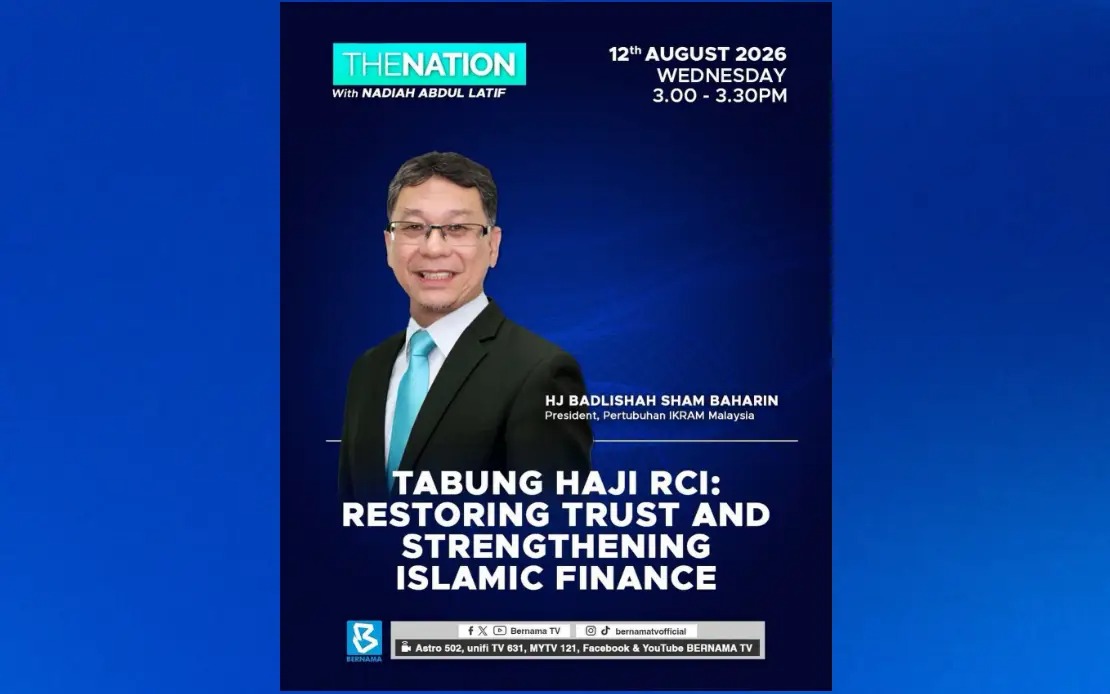
The president of Islamic financial advocacy group Pertubuhan IKRAM Malaysia has rejected calls from lawmakers across the political spectrum for a fresh royal commission to investigate Tabung Haji, contending that existing investigations by enforcement agencies are adequate to address the fund's governance failures. Badlishah Sham Baharin made his position clear during a television appearance discussing trust and integrity in Islamic finance, positioning himself against pressure from both Barisan Nasional and Pakatan Harapan representatives seeking deeper parliamentary scrutiny into the pilgrimage fund's operations.
The debate centres on temporal boundaries that have become contentious in the aftermath of the Royal Commission of Inquiry report released in late July. The existing inquiry documented weaknesses spanning 2014 to 2020, but lawmakers have argued that investigating only this six-year window leaves a critical gap, particularly given that the fund continued to operate and potentially accumulate liabilities through 2025. This temporal limitation has prompted bipartisan calls for an expanded mandate to cover the 2021-2025 period, a request that Badlishah has now challenged on principled grounds rather than defending the fund's management.
Badlishah's core argument rests on institutional preservation—an often-overlooked consideration in Malaysian governance discussions. By overusing royal commissions, he suggests, the government risks rendering these high-level investigative bodies routine rather than extraordinary, thereby weakening their deterrent effect and public perception of seriousness. Royal commissions command significant resources and carry symbolic weight; deploying them indiscriminately could cheapen their currency in the eyes of both the public and wrongdoers contemplating regulatory violations. This perspective reflects international best practices where formal inquiries are reserved for systemic failures of national consequence rather than deployed as catch-all investigative mechanisms.
The advocate for Islamic finance has instead thrown his support behind investigation by the Malaysian Anti-Corruption Commission, arguing that professional law enforcement bodies possess sufficient statutory powers to examine wrongdoing and bring charges when warranted. This position implicitly raises questions about public confidence in MACC capabilities and independence, particularly given the complexity of TH's investment failures and the political sensitivities surrounding fund management. For Malaysian readers familiar with the fund—which serves nearly 10 million depositors and represents a cornerstone of Islamic finance infrastructure—the choice between a public royal commission and administrative investigation carries real implications for transparency and public trust restoration.
Finance Minister II Datuk Seri Amir Hamzah Azizan provided context for the scope of investigation needed by disclosing that the fund incurred nearly RM13 billion in losses through 14 problematic investments between 2014 and 2020, with seven ventures recording complete capital loss. Breaking down the damage, the government absorbed RM10.2 billion through a 2018 bailout mechanism involving Urusharta Jamaah Sdn Bhd, while TH itself carried RM2.6 billion in impairment losses on investments still under management through 2025. These staggering figures illuminate why some lawmakers view the existing inquiry as insufficient—the losses continued accumulating well beyond the RCI's examination window.
The most egregious case exemplifying management failures involved the Al-Rawda property investment, which consumed approximately RM1.5 billion—1.4 billion Saudi riyals paid to an intermediary—for hotel lease agreements supposedly serving pilgrims in Makkah and Madinah between 2015 and 2017. When the operator defaulted on rental payments starting in early 2019, TH found itself holding worthless contracts and eventually took a complete RM1 billion impairment loss in 2024. This sequence of events suggests that due diligence procedures failed catastrophically, raising uncomfortable questions about whether enforcement action alone can prevent recurrence without structural reforms and clearer accountability mechanisms.
Badlishah did acknowledge the merit in one proposal emerging from the TH debate—the establishment of a multi-agency task force to scrutinise investments before approval and prevent future losses of similar magnitude. He emphasised that rigorous due diligence conducted before capital deployment, coupled with ethical compliance checks aligned with Islamic finance principles, could substantially reduce operational risk. This position allows him to appear supportive of improved governance while maintaining opposition to a new RCI, offering a middle ground that recognises the fund's previous failures without endorsing expanded parliamentary inquiry.
The finance minister's disclosure that approximately 75 per cent of the RCI's 25 recommendations had been implemented by late July suggests that institutional reforms are underway. However, implementation of recommendations does not necessarily address systemic governance weaknesses that may have persisted beyond the inquiry's temporal scope. The gap between documented compliance with RCI suggestions and actual prevention of future losses remains unclear, particularly given that investments continued generating liabilities well into 2025, suggesting that reforms had either not fully taken effect or had not addressed underlying structural problems.
During parliamentary debate on the RCI report, the walkout by opposition lawmakers drew sharp criticism from Badlishah, who characterised the action as abandoning the representatives' primary responsibility to scrutinise executive performance and protect the interests of nearly 10 million depositors. His rebuke highlights the tension between political positioning and institutional duty—MPs who oppose the government on ideological grounds still carry constitutional obligations to engage substantively with matters affecting millions of constituents. For Malaysian readers tracking accountability mechanisms, the quality of parliamentary engagement directly determines whether investigations translate into meaningful reform or become symbolic exercises.
The RCI process itself, despite its limitations, documented systemic weaknesses in TH's investment governance, risk management, and board oversight during the 2014-2020 period. Without an extension covering subsequent years, critical questions about whether board composition changes, management turnover, or procedural reforms actually prevented additional losses remain unanswered. MACC investigation could theoretically provide such answers, but administrative probes typically lack the public transparency and formal hearing mechanisms that royal commissions provide, potentially limiting public confidence that genuine accountability has been achieved.
For Southeast Asian readers, the TH controversy illustrates broader challenges facing Islamic finance institutions operating across multiple jurisdictions and managing complex cross-border investments. When intermediaries fail to deliver promised services and institutional oversight proves inadequate, depositors bear the ultimate cost through depleted savings intended for pilgrimage. The question of whether existing investigation powers suffice or whether enhanced parliamentary scrutiny is necessary ultimately reflects different philosophies about institutional checks and balances—and about whether public commissions or administrative agencies better serve accountability objectives in religiously sensitive financial matters where public trust remains crucial to institutional legitimacy.

