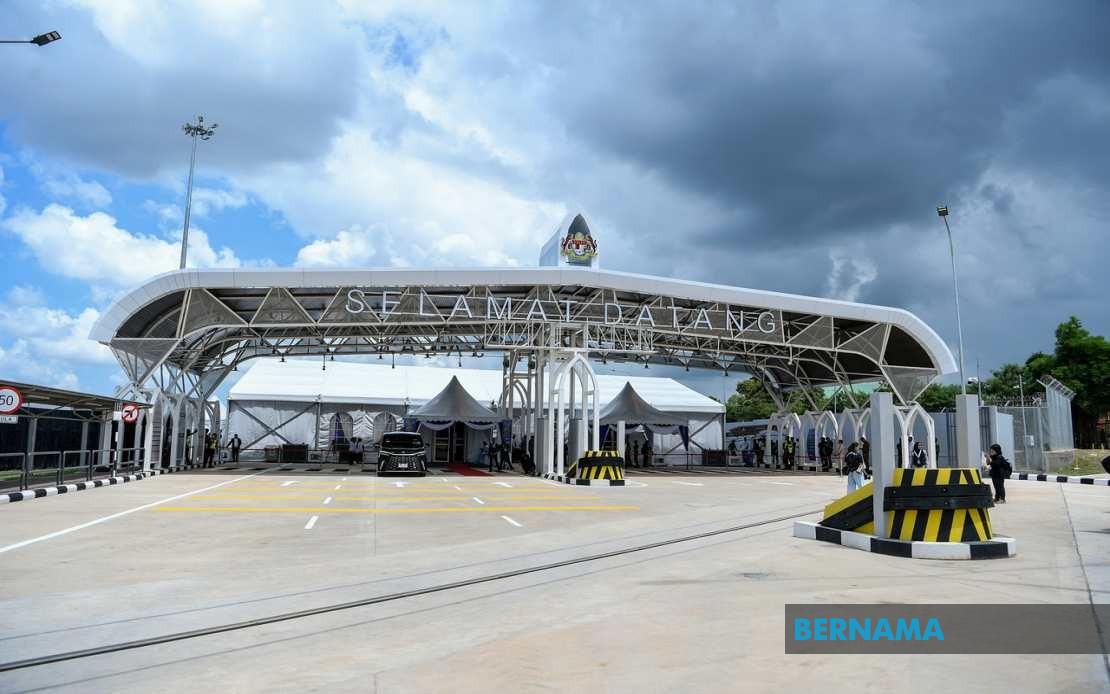
The opening of the Bukit Kayu Hitam-Sadao border crossing in mid-July has delivered tangible improvements to one of Southeast Asia's busiest trade corridors, with preliminary data showing substantial increases in bilateral commerce and significantly faster processing times for vehicles and cargo. Officially inaugurated jointly by Thai Prime Minister Anutin Charnvirakul and Malaysian Prime Minister Datuk Seri Anwar Ibrahim on July 10, the 900-metre facility connects the Bukit Kayu Hitam Immigration, Customs, Quarantine and Security Complex in Kedah with the Sadao Customs, Immigration and Quarantine Complex on the Thai side, representing a major logistical upgrade after years of planning and coordination between the two governments.
The scale of adoption among commercial transporters has been remarkable, with Sadao Customs director Buntoon Oucharoen reporting that nearly every logistics lorry, bus, and van has migrated to the new thoroughfare within weeks of its July 11 launch. This near-total shift has fundamentally altered traffic patterns at the border, effectively redistributing vehicle flows away from congested pathways that previously created bottlenecks during peak hours. The displacement of such concentrated traffic volume represents not merely an incremental improvement but a structural realignment of how goods physically transit between the two nations.
At the heart of this efficiency gain lies technological modernisation in cargo inspection. The deployment of advanced X-ray scanning equipment branded as "Fast Scan" has dramatically compressed processing timelines, reducing container examination duration from five minutes to under sixty seconds. This acceleration compounds across thousands of daily transactions: officials estimate the new route processes more than 1,000 commercial lorries each day, meaning the technology has collectively reclaimed hours of productivity that were previously absorbed in queuing and waiting periods. Complementing this hardware upgrade, integrated computer systems enable customs personnel to retrieve cargo documentation directly through digital networks, eliminating the need for vehicles to halt in secondary inspection bays.
The immediate commercial impact is visible in July's trade statistics. Import valuations into Thailand during the first three weeks of operation reached 19 billion baht, approximately RM2.35 billion, nearly 60 percent higher than the comparable 12 billion baht recorded in the identical period last year. Export flows proved even more dynamic, climbing to just over 24 billion baht—equivalent to RM2.97 billion—against 13 billion baht twelve months earlier. These gains reflect not only the mechanical efficiency of the new route but also the confidence it generates among trading enterprises, which can now plan shipments with greater predictability about transit times and clearance reliability.
For Malaysian businesses reliant on Thai markets, these improvements carry particular weight. The broader Malaysia-Thailand trade relationship has shown consistent strength, with bilateral commerce during the first quarter of 2026 valued at RM31.33 billion against RM27.35 billion in the corresponding quarter of 2025. Both nations have established an ambitious target of achieving US$30 billion in annual bilateral trade by 2027, a milestone that infrastructure improvements like the Bukit Kayu Hitam-Sadao corridor actively support. As the two countries approach their 70th anniversary of diplomatic relations in 2027, such infrastructure investments carry symbolic weight beyond their practical utility, demonstrating sustained commitment to deepening economic interdependence.
The facility's design encompasses 11 inbound and 11 outbound lanes, architecture explicitly intended to accommodate not just freight traffic but also passenger movements. This dual-purpose configuration has proved particularly valuable for tourism flows, with the Hatyai-Songkhla Hotel Association acknowledging the improved facilitation of cross-border visitors, particularly during weekends and public holidays when leisure travel typically peaks. For Southern Thailand's tourism-dependent economy, and for Malaysian holidaymakers seeking beach destinations and shopping experiences, the smoother passage creates tangible quality-of-life improvements alongside the commercial benefits.
The broader context for this border project reflects evolving approaches to ASEAN regional integration. Rather than pursuing grand multinational infrastructure schemes, Malaysia and Thailand focused on upgrading a specific congested point in an existing transit corridor—a pragmatic strategy that delivers demonstrable value to their economies relatively quickly. The Bukit Kayu Hitam-Sadao crossing sits within the larger landscape of Southeast Asian land trade routes that channel goods between ASEAN's industrial heartland and global markets via ports in Malaysia and Thailand. By reducing friction at this specific junction, both governments have multiplied the efficiency of downstream supply chains extending far beyond their bilateral relationship.
Operational data from Sadao Customs indicates the new route has essentially achieved complete market penetration among eligible transport operators within its first month. This unanimous adoption suggests the improvements are substantial enough to overcome the inconvenience and adjustment costs that typically accompany infrastructure transitions. Transport companies evidently calculate that the time savings and reduced congestion justify modifying established routing patterns, a decision that accumulates into millions of dollars in annual productivity gains across the sector.
Looking forward, the project's success creates momentum for considering similar upgrades at other congestion points in the Malaysia-Thailand border network. Officials on both sides have implicitly validated the investment thesis: that modernised inspection technologies combined with intelligent facility design can simultaneously accelerate trade flows, maintain security standards, and accommodate the growing complexity of contemporary supply chains. For Malaysian policymakers evaluating comparable infrastructure investments in logistics and border facilitation, the Bukit Kayu Hitam-Sadao corridor provides convincing evidence that such expenditures deliver returns measurable in weeks rather than years, supporting the economic case for continued investment in regional connectivity.

