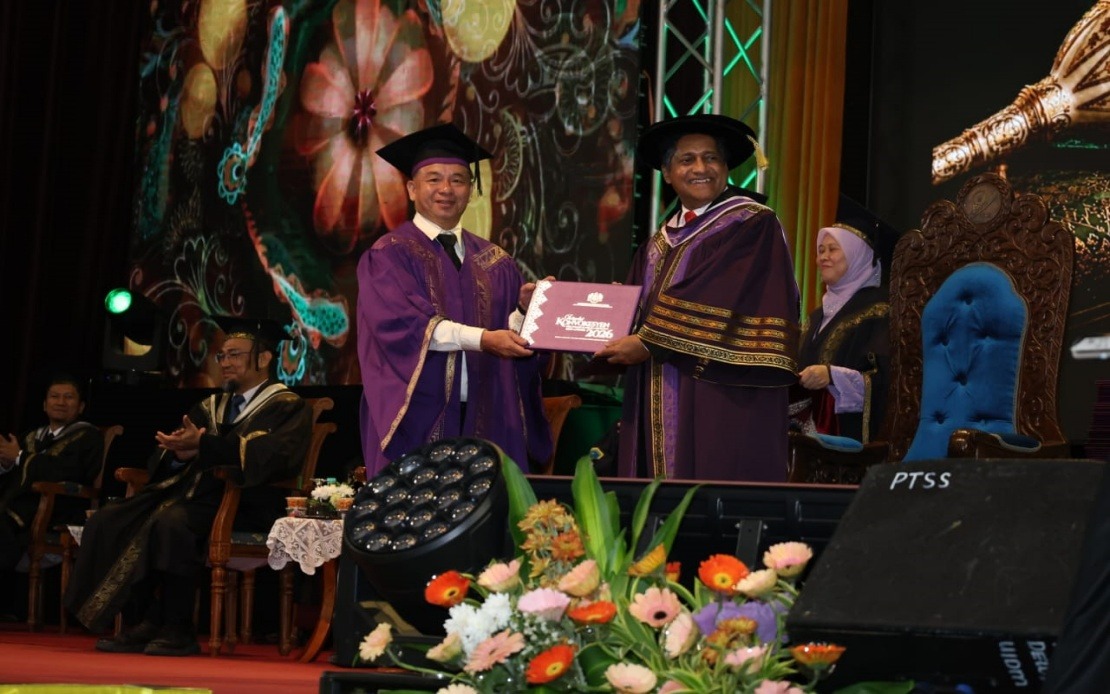
Heng Meng Lai has shattered age-related assumptions about higher education, becoming Seberang Perai Polytechnic's oldest graduate at 57 after receiving his Diploma in Electrical and Electronic Engineering at the institution's 2026 Convocation Ceremony in Bukit Mertajam. His accomplishment represents far more than a personal milestone—it exemplifies the accessibility of skills development and the growing recognition in Malaysia that learning trajectories need not follow conventional timelines. Heng's journey, delayed by nearly half a century due to professional and personal obligations, underscores a transformative shift in how polytechnic institutions are embracing lifelong learning principles across diverse demographic groups.
The circumstances that shaped Heng's early life instilled within him a determination to seek educational advancement despite formidable obstacles. Raised as the third of seven children, he experienced the premature loss of his father at age nine, after which his mother assumed the family's economic burden through employment at a sewing factory. Rather than allowing these hardships to extinguish his aspirations, Heng channelled the resilience demanded by his childhood into a long-term commitment to self-improvement through formal education. For decades, work commitments and familial responsibilities eclipsed opportunities to pursue structured learning, yet he retained a conviction that returning to studies remained possible regardless of how much time had elapsed.
Heng's selection of Electrical and Electronic Engineering as his field of specialisation emerged organically from his extensive practical experience. Having worked progressively through roles as a storekeeper and subsequently as a production line supervisor at an electronics manufacturing facility, he accumulated substantial hands-on knowledge of industrial processes and technical systems. This foundation of experiential learning complemented his classroom instruction at PSP, enabling him to engage with theoretical concepts through a lens informed by real-world application. His transition from worker to student in a domain directly connected to his professional history demonstrates how polytechnic education can serve as a formal credentialisation pathway for individuals already possessing significant tacit knowledge.
The adaptation to student life presented inevitable challenges for someone whose peers were typically three or four decades younger. Yet Heng's account of his time at PSP reveals an institutional environment fundamentally committed to inclusive pedagogy. Faculty members consistently provided patient guidance and sustained encouragement, actively working to facilitate his integration into learning communities where he represented a statistical anomaly. Critically, Heng reports never experiencing marginalisation despite his distinctive age profile—a testament to PSP's professed commitment to fostering supportive educational spaces that transcend conventional demographic expectations. This receptiveness from instructors likely contributed significantly to his successful programme completion and may serve as a model for other Malaysian polytechnics seeking to genuinely accommodate non-traditional student cohorts.
Looking ahead, Heng's trajectory does not terminate with his diploma. He envisions returning to employment to consolidate his newly acquired technical competencies before pursuing further advancement through a bachelor's degree programme. This sequenced approach—applying knowledge in professional contexts before subsequent academic progression—reflects a pragmatic understanding of skill development and credential accumulation. For an individual who delayed formal education for nearly five decades, the prospect of continuing advancement signals both psychological investment in lifelong learning and recognition that Malaysia's increasingly competitive knowledge economy rewards continuous professional development. His articulated intention to persist with further studies suggests that age-related barriers to educational progression may be diminishing as institutional frameworks evolve.
PSP Director Mohd Ruzi Hamzah characterised Heng's accomplishment as a source of institutional pride, framing the achievement within the broader context of educational accessibility. By highlighting Heng's career trajectory—from storekeeper through supervisory roles to diploma holder—Hamzah emphasised that formal credentials represent achievable destinations regardless of labour market entry point or temporal delays. This institutional acknowledgment carries symbolic weight in a Malaysian context where questions of educational equity and social mobility remain contested. The polytechnic sector, which historically served as a technical pathway for students not pursuing university-track programmes, is increasingly positioned as a mechanism for upskilling existing workers and enabling mid-career transitions for those seeking to formalise competencies developed through years of professional practice.
The broader implications of Heng's achievement extend beyond PSP's institutional boundaries to intersect with Malaysia's national aspiration toward lifelong learning frameworks. PSP's formal commitment to quality education provision "regardless of age or background" articulates a principle increasingly embedded in Malaysian educational discourse, particularly as demographic ageing and rapid technological change demand continuous workforce adaptation. The polytechnic's emphasis on producing "highly skilled human capital" positioned against a backdrop of inclusive admission practices suggests recognition that Malaysia's competitive positioning depends on mobilising talent pools extending well beyond conventionally-defined student cohorts. Institutions that successfully accommodate mature learners while maintaining academic rigour establish competitive advantages in demonstrating educational responsiveness.
Heng's personal narrative also illuminates the intersection between individual agency and systemic support structures. His personal belief that "learning has no age limit" provided motivational sustenance across decades of deferred aspiration, yet this conviction required external validation through PSP's receptive institutional culture to translate into actual achievement. The diploma in his hands represents not merely personal triumph but evidence that Malaysian polytechnics are progressively dismantling practical barriers to educational access. For potential mature learners throughout Malaysia contemplating return to formal education, Heng's completion of technical studies at 57 provides concrete proof that age need not constitute an insurmountable impediment.
The timing of Heng's graduation in 2026 occurs within Malaysia's broader context of skills shortage discourse, particularly in technical sectors including electrical and electronic engineering. A mature graduate bringing both formal qualifications and decades of industrial experience represents precisely the labour market profile increasingly sought by employers navigating technological transitions. Unlike younger graduates with conventional credentials but limited workplace exposure, Heng combines academic knowledge with demonstrated commitment to professional contexts. This distinctive profile may position him advantageously within employment markets where employer demand for experienced technical personnel continues expanding.
PSP's celebration of Heng's achievement simultaneously reflects and potentially accelerates cultural shifts in Malaysian attitudes toward educational timing and life course sequencing. Traditional narratives depicting education as temporally bound to youth are gradually being displaced by recognition that professional development and credential acquisition occur across expanded life spans. Whether measured in media coverage, institutional policies, or programme accessibility, evidence suggests Malaysian polytechnics are increasingly embracing mature learner populations. Heng's record as oldest graduate will likely remain temporary—future cohorts may produce older graduates—yet his immediate significance lies in demonstrating that institutional readiness for inclusive education exists within Malaysia's polytechnic sector.
For Malaysian society more broadly, Heng's story offers reassurance that educational aspirations need not be permanently relinquished when circumstances prevent early realisation. His completion of technical studies despite decades-long deferral challenges fatalistic narratives about educational opportunity windows permanently closing. As Malaysia seeks to enhance workforce capabilities and transition toward higher-value economic activities, enabling mature workers like Heng to formalise competencies through accessible polytechnic pathways represents strategic policy alignment. The institution and individual have together demonstrated that determination, institutional support, and formal educational access can converge powerfully, regardless of the temporal distance separating aspiration from achievement.

