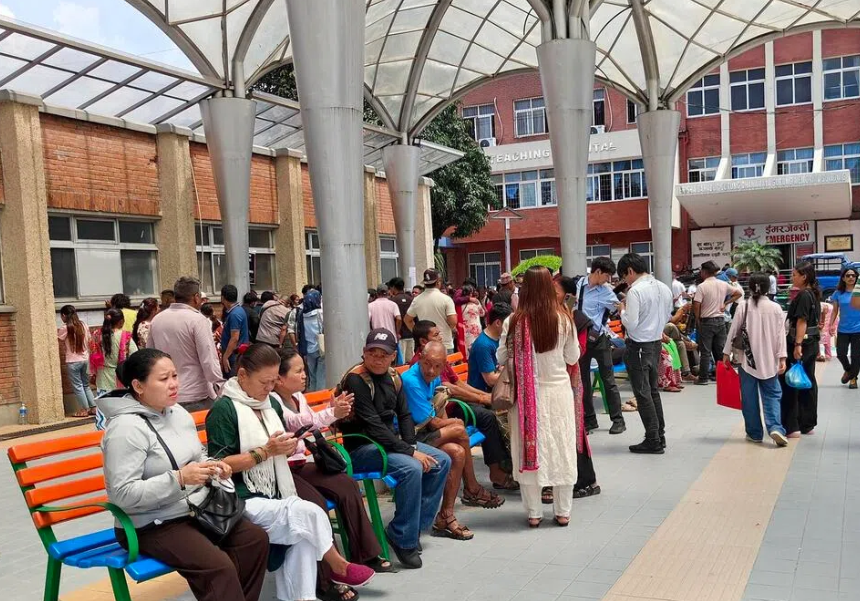
The human cost of Nepal's catastrophic flash flood on August 26 has become impossible to ignore in Kathmandu's hospitals. Tribhuvan University Teaching Hospital has become an unofficial centre for identification, with photographs of unidentified corpses displayed on its gates so families can search for their missing relatives. What began as a routine day in the Himalayan nation transformed into a national tragedy when waters surged through border regions, leaving death tolls that continue to climb and an overwhelming sense of desperation among those seeking answers about their loved ones.
Three days after the disaster struck, the full scope of the tragedy remains unclear. Official figures indicate that deaths in northern Nepal have exceeded 500, though hundreds more remain unaccounted for. Search and rescue operations continue across the Bhotekoshi river system and downstream areas, yet the pace of discovery has slowed as teams grapple with challenging terrain and unstable conditions. The barrier lake that formed in the aftermath of the flood briefly halted rescue efforts on August 28 when officials feared another breach could trigger secondary flooding, compounding the existing catastrophe.
The personal stories of those searching for loved ones paint a portrait of a nation paralysed by loss. Dolma Tamang, a 36-year-old woman, has spent three days travelling between hospitals in Kathmandu hoping to find any information about her sister and brother-in-law. They were driving a truck through Rasuwa district on the morning of August 26, transporting goods from the Chinese border, when communications ceased abruptly. The only search tool available to Tamang and thousands of others like her is a desperate examination of photographs displayed across hospital gates and walls. She expressed the emotional toll of her search, noting that the constant anxiety has left her emotionally drained.
At the identification wall outside TUTH, many family members have resorted to carrying printed photographs and digital images on their phones, walking from hospital to hospital in hopes of recognising a familiar face among the deceased. This haunting practice has become the primary method through which relatives attempt to locate their family members. The hospital's list of missing persons grew to more than 1,500 by the afternoon of August 28, an expansion that reflects both the ongoing discovery of missing persons and the tragic reality that many may never be found. For those like Bikesh Shrestha, who came searching for his cousin, the emotional burden of viewing the photographs became too much to bear, forcing him to look away repeatedly.
The international dimensions of the tragedy add another layer of complexity. Nine Singaporeans remain missing, while the Nepal Tourism Board reported that 121 foreign tourists have been rescued, including 85 Indians and 16 Chinese nationals. However, approximately 288 Indian nationals are still unaccounted for, many of whom were either embarking on or returning from the Kailash-Mansarovar pilgrimage to Mount Kailash and Lake Manasarovar in Tibet. This sacred route passes through Rasuwa district, one of the areas most severely impacted by the flood. Relatives of the missing pilgrims have begun arriving in Kathmandu from India, with groups from Tamil Nadu landing on early morning flights on August 28. One Tamil Nadu resident, attempting to help his friend trace his wife and son who were part of a travel group returning from Tibet, arrived at the airport and offered emotional support to his companion, saying they must face whatever comes with strength and unity.
The geographical focus of the disaster is the Gyirong border crossing between Nepal and Tibet, where viral photographs have captured mudslides and torrential floodwaters engulfing the port infrastructure. This critical crossing point, severely damaged in the flood, has become symbolic of the disaster's scale and ferocity. The destruction at Gyirong has effectively severed one of the major routes for the Kailash-Mansarovar pilgrimages that attract thousands annually, and the pilgrims who were in transit when the flood struck find themselves among those missing or stranded.
Government response has been substantial, though constrained by strategic considerations. More than 4,400 police personnel have been deployed across search and rescue zones, while the Nepali Army and Armed Police Force have also been mobilised. Prime Minister Balen Shah has deliberately declined offers from China, India and other nations to deploy their own search and rescue teams, basing this decision on Nepal's experience following the 2015 earthquake, when the presence of multiple international rescue teams created coordination difficulties rather than streamlining efforts. Instead, the government has requested financial assistance through a single centralised mechanism that officials announced they would soon establish, indicating a preference for resources over personnel.
International humanitarian support has commenced, though in limited forms. India initially sent 47 tonnes of assistance including temporary shelters, blankets, hygiene kits, solar lamps, medicines and food packets via military transport aircraft. New Delhi has additionally offered prefabricated truss bridges to Nepal, recognising that dozens of bridges spanning small and large water crossings have been destroyed by the flood, effectively isolating communities and hampering both rescue operations and eventual reconstruction efforts. These offers underscore the ripple effects of the disaster, which extends beyond immediate loss of life to encompass the infrastructure that communities depend upon for survival and connectivity.
Downstream districts have been hit with particular severity. Chitwan, a district known internationally for its national park and elephant sanctuary, lies further downstream along the Bhotekoshi system and adjoins the Indian border. By the afternoon of August 28, 186 bodies had been recovered in Chitwan alone, yet hospitals throughout the district collectively possessed morgue capacity for only 30 to 50 bodies. Roads have been blocked with massive accumulations of debris and silt, further complicating both recovery and rescue operations. The Kathmandu Post reported that hospitals across several districts have begun experiencing shortages of storage space for deceased victims, a grim indicator of the scale of mortality and the system's capacity limitations.
For those still hoping for miracles, uncertainty provides a fragile foundation for optimism. Sushila Shrestha, a 23-year-old woman searching for her 21-year-old brother Bir Bahadur Shrestha, a truck driver heading to the Chinese border when the flood struck Rasuwa district, has chosen to interpret the absence of news as a positive sign. Her conviction that her brother will return alive reflects the psychological coping mechanisms many families adopt when faced with overwhelming loss. Similar patterns can be observed across Kathmandu, where relatives cling to hopes of miraculous survival even as body counts rise and the probability of finding survivors diminishes with each passing day.
The tragedy underscores Nepal's vulnerability to natural disasters and the particular risks faced by regions bordering Tibet and India, where monsoon patterns and geographical features create conditions for catastrophic flooding. For Southeast Asian countries including Malaysia with shared exposure to extreme weather events, the Nepali experience offers sobering lessons about disaster preparedness, international coordination, and the psychological and logistical challenges of managing large-scale humanitarian crises. The border regions of Nepal, which have historically served as trade and pilgrimage routes connecting the subcontinent to Tibet and China, have become zones of particular vulnerability where natural forces can disrupt not only local communities but also regional commerce and religious observance.

