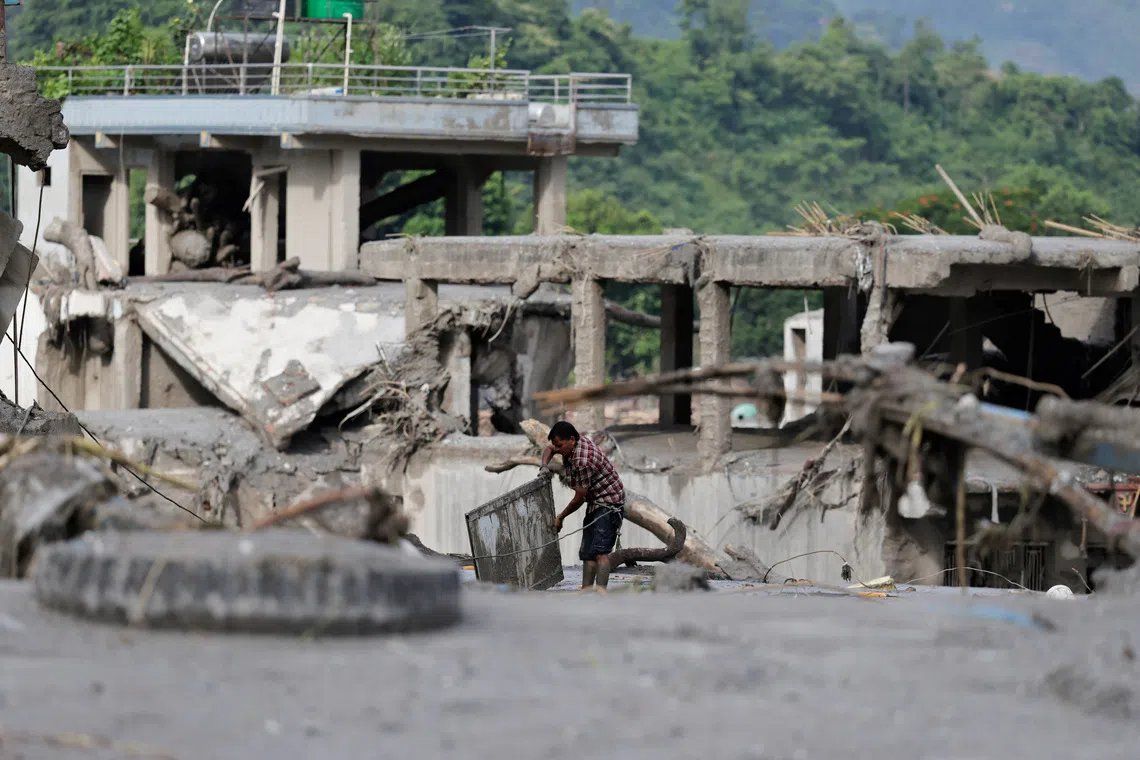
Authorities in Nepal and China are racing against time to prevent a humanitarian crisis compounding an already devastating week, as two massive lakes created by the debris from a glacier collapse threaten to breach and unleash secondary waves of destruction across their shared border in the Himalayas. The initial disaster on Wednesday killed at least 362 people and left over 1,000 unaccounted for as the collapse pushed rock, ice, and debris into mountain river systems, creating what both nations believe was a unprecedented natural catastrophe in the high-altitude region.
The immediate aftermath has created a treacherous situation where the very mechanisms that formed during the initial disaster now pose escalating threats. On the Nepali side of the border, water has accumulated behind natural dams created when vast amounts of debris clogged river channels at the flood's origin point. Nepal's disaster authority issued a formal notice on Thursday alerting residents and rescue workers that this impoundment is swelling at a rate that makes rupture increasingly likely. The warning extended to all populations living downstream, passengers transiting through affected valleys, and the thousands of search and rescue personnel still operating in the debris-strewn terrain.
China faces an even more acute situation on its side of the frontier. According to assessments from the Chinese water resources ministry, approximately three million cubic meters of water—a volume equivalent to roughly 1,200 Olympic-sized swimming pools—is expected to flow into an artificial reservoir already behind a constructed dam over the next seventy-two hours. This massive influx arrives during a period when the dam is already strained by the week's extraordinary precipitation and runoff. Ministry specialists predict peak discharge conditions around September 1, creating what officials characterize as a genuinely high-risk scenario for dam failure or uncontrolled spillage.
The timing coincides with deteriorating weather forecasts across the region. Chinese state media, citing water resources ministry analysis, reported that additional rainfall expected throughout the coming week will substantially worsen conditions. Zhu Jinfeng, a hydrologist with the ministry's hydrology department, acknowledged the compounding pressures in comments to state broadcaster CCTV, noting that the continuously rising water volume correlates directly with mounting rupture probabilities. This assessment reflects deep concern within China's technical establishment about their capacity to manage a situation where natural processes are overwhelming engineered infrastructure.
The secondary threat posed by these unstable lakes creates a nightmarish scenario for disaster response officials. Rescue teams operating in the initial flood zone now confront not only the logistical challenges of recovering bodies and locating survivors in extremely difficult mountain terrain, but also the immediate danger of sudden catastrophic flooding that could sweep away rescue infrastructure, personnel, and any survivors or recovered remains. The threat transforms every moment spent searching debris fields into an escalating gamble with environmental conditions that remain fundamentally unstable.
This situation exemplifies how major natural disasters frequently generate cascading secondary hazards that can prove as lethal as initial impacts. The glacier collapse itself represented a rare geological event, but the creation of natural and artificial dams of water backed up behind debris and existing infrastructure has introduced a new class of danger. Historical precedent from other mountain regions demonstrates that such secondary floods frequently strike with minimal warning and devastating force, occasionally exceeding the violence of the primary disaster that initiated the sequence.
Recognizing these dangers, rescue operations underwent tactical adjustments on Thursday as responders began relocating to elevated positions and safer staging areas. Among those who repositioned was Pawan Koirala, leading a team of thirteen rescue workers who withdrew from riverside locations following the official warnings. Koirala characterized their movement as a necessary precaution driven by the fundamental logic that personnel dedicated to rescue operations cannot themselves become casualties of the very environmental forces they are attempting to manage. This pragmatic decision reflects an understanding among ground-level operators that maintaining rescue capacity depends on ensuring that rescue workers remain alive and operational.
The bilateral coordination between Nepal and China assumes critical importance given that the threat zones are distributed across the shared border. Information sharing between the two nations' water management authorities and disaster agencies could mean the difference between populations receiving adequate warning and being caught unaware by rapidly advancing floodwaters. Both countries have established monitoring systems and early warning protocols, yet the unprecedented scale of this event means that forecasting models and historical baselines may prove unreliable.
For the broader Southeast Asian region, this crisis carries implications beyond the immediate humanitarian tragedy. The Himalayas represent crucial water sources for South and Southeast Asia, with major river systems including tributaries feeding into rivers that sustain millions downstream in Nepal, India, Bangladesh, and ultimately the Mekong system affecting Southeast Asia. Understanding how climate patterns and glacial dynamics are producing increasingly dramatic events in this region should inform regional water management and disaster preparedness strategies. The vulnerability exposed by this crisis extends well beyond Nepal and China's immediate territories.

