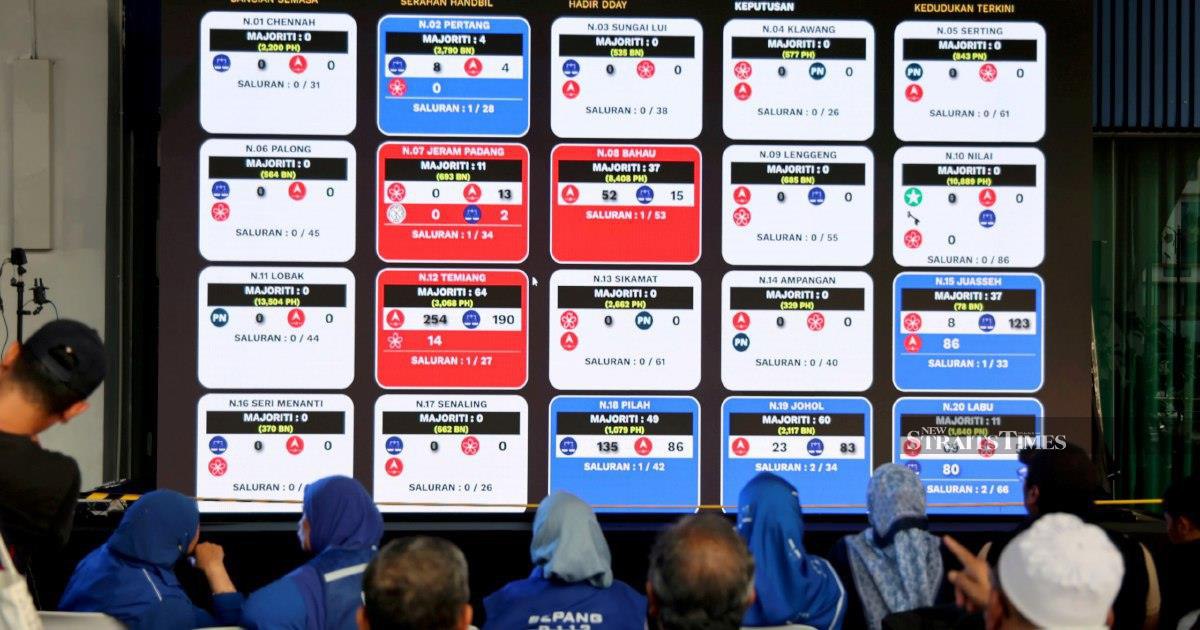
The recently concluded Negri Sembilan state election has laid bare uncomfortable truths about Pakatan Harapan's position within Malaysia's electorate, particularly among Malay communities whose political allegiance remains contested territory. While the coalition maintains presence across several states, its performance in Negri Sembilan indicates that capturing and consolidating support among the country's largest demographic group presents persistent structural challenges that electoral machinery alone cannot easily resolve.
Malay voters have historically formed the backbone of Malaysian electoral politics, and their support remains decisive in determining which coalition governs the nation. Pakatan Harapan's struggles in this crucial demographic segment cannot be dismissed as merely a temporary setback or an isolated incident confined to a single state. Rather, the Negri Sembilan results suggest systematic difficulties in the coalition's messaging, positioning, and ability to address concerns that resonate most deeply with Malay-speaking constituencies across the peninsula.
The coalition's challenge extends beyond simple vote-counting mechanics. Pakatan Harapan must contend with perceptions of religious identity, cultural values, and constitutional matters that carry particular weight within Malay Muslim communities. These voters often prioritize issues that touch upon their sense of identity and belonging within the Malaysian federation, and political parties seeking their support must navigate these sensitivities with considerable sophistication and authenticity.
For Malaysian observers and political analysts, the implications stretch beyond Negri Sembilan's state borders. The state serves as a microcosm of electoral dynamics that play out across multiple constituencies in Selangor, Pahang, Perak, and other regions where Malay majorities determine electoral outcomes. If Pakatan Harapan cannot effectively compete for these votes in a state where it maintains institutional presence and administrative machinery, questions naturally arise about the coalition's capacity to improve its standing in more hostile political terrain.
The coalition comprises parties with varying appeals and constituencies. While some component parties within Pakatan Harapan maintain stronger connections to specific Malay communities, others struggle to overcome historical perceptions or ideological positioning that certain Malay voters find distant or uncongenial. Bridging these internal differences while presenting a unified message to Malay voters requires political leadership and strategic coherence that has proven elusive.
Negri Sembilan's electoral arithmetic also reflects broader demographic and migration patterns affecting Malaysian politics. Urban migration, generational shifts, and economic anxieties have reshaped voting patterns in ways that political parties often struggle to anticipate or respond to effectively. Younger Malay voters, in particular, may prioritize different issues than their parents' generation, yet Pakatan Harapan's messaging does not always reflect these evolving concerns with sufficient clarity.
The opposition coalition has successfully mobilized other segments of the Malaysian electorate in previous contests, demonstrating that victory remains achievable even without overwhelming Malay support. However, this approach contains inherent limitations. Relying predominantly on non-Malay voters and urban constituencies creates a political coalition that, while numerically sufficient in certain circumstances, lacks the broader social mandate and long-term stability that comes from commanding support across all major ethnic communities.
Regional dynamics further complicate Pakatan Harapan's position in Negri Sembilan and similar states. The Federal Territories maintain different political characteristics than states with substantial non-urban areas where agricultural and traditional livelihoods remain important. Negri Sembilan contains both metropolitan areas and more rural constituencies, requiring political strategies that address diverse economic conditions and social priorities within a single state framework.
For the governing coalition, these election results provide both challenge and opportunity. The challenge lies in determining how to refine messaging and policy approaches to reconnect with Malay voters who have drifted toward alternatives. The opportunity emerges from recognizing that Malay electoral support, while complex to secure, is not immutable or predetermined. Strategic investment in addressing core concerns within these communities, combined with authentic engagement and demonstrated commitment to shared values, can gradually rebuild political bridges.
Pakatan Harapan's future in Malaysian politics depends substantially on resolving this Malay voter question. Without progress in this critical area, the coalition risks remaining perpetually dependent on coalition arithmetic that, while occasionally sufficient, cannot sustain long-term political viability or provide the broad-based legitimacy that effective governance requires. The Negri Sembilan outcome serves as a stark reminder that Malaysian electoral politics, despite rapid modernization and urbanization, continues to turn fundamentally on the question of Malay political preferences and community concerns.

