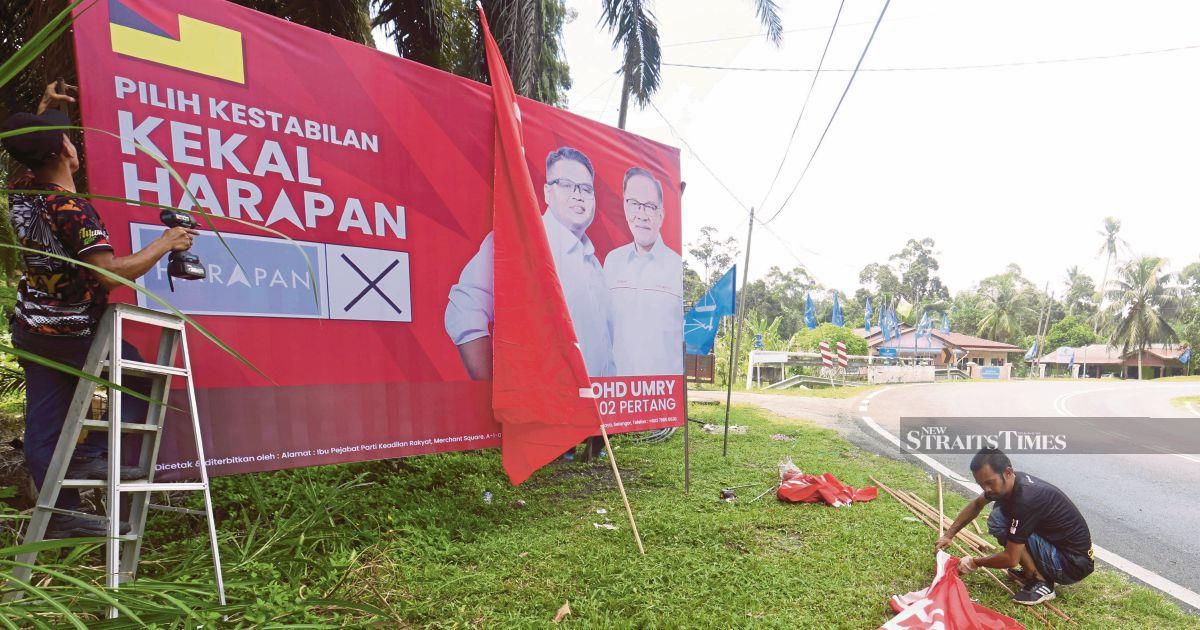
The Negri Sembilan state election looms as a significant test of political alliances in Malaysia, with 103 candidates contesting for 36 state assembly seats in what promises to be a closely contested race. This election carries particular weight for Bersatu, the party founded by former Prime Minister Mahathir Mohamad, as it faces a critical juncture in defining its political future amid the complicated cooperation between Barisan Nasional and Perikatan Nasional at the national level.
For months, the relationship between BN and PN has been marked by strategic cooperation on federal legislation alongside persistent tensions over state-level competition. Negri Sembilan represents one of the clearest manifestations of this contradiction, where two coalitions that support the government in Parliament are effectively competing against each other for control of the state. This dynamic has created uncertainty for parties within both blocs, particularly for Bersatu, which must navigate between maintaining its partnership with PN allies whilst managing its own electoral prospects.
Bersatu's predicament stems from its position as a swing partner whose allegiance has shifted multiple times since its formation. The party entered into the PN coalition, which currently dominates federal politics through its supply-and-confidence arrangement with the government. However, its electoral viability in several states remains questionable, particularly in Negri Sembilan where the party's grassroots presence and voter support have historically been limited. The state election effectively tests whether Bersatu can establish itself as a genuine electoral force or whether it remains dependent on coalition dynamics for political relevance.
The BN coalition, which dominated Malaysian politics for decades until its 2018 collapse, continues to view state elections as opportunities to reclaim ground lost during Pakatan Harapan's brief federal rule. In Negri Sembilan, where BN maintains residual strength from its historical dominance, the coalition sees a realistic prospect for restoration. The party's traditional supporters, particularly among older voters and rural communities, remain potentially recoverable despite recent electoral shifts. BN's strategy appears focused on leveraging these demographic advantages whilst emphasizing governance competence and economic recovery.
PN's approach reflects the coalition's broader ambition to consolidate gains made during Muhyiddin Yassin's tenure as Prime Minister and extend its influence through state-level victories. The coalition brings together Bersatu, the Pan-Malaysian Islamic Party (PAS), and other smaller parties. However, the alliance contains inherent tensions, particularly regarding resource allocation and candidate selection. In Negri Sembilan, these internal negotiations have likely proven contentious, as parties compete for winnable seats whilst attempting to maintain coalition solidarity.
For Bersatu specifically, the Negri Sembilan contest raises fundamental questions about its survival as an independent political entity. Since leaving Pakatan Harapan in 2020, the party has struggled to maintain organizational coherence and electoral appeal outside its core support base in Kedah and certain communities attracted by Mahathir's personal appeal. Without significant electoral victories, the party risks becoming a perpetual junior partner dependent on coalition arrangements rather than commanding independent bargaining power. A disappointing performance in Negri Sembilan would reinforce perceptions of Bersatu's declining relevance.
The electoral geography of Negri Sembilan presents distinct challenges for all participating coalitions. The state encompasses mixed urban, semi-urban, and rural constituencies with varying demographic compositions. Seremban's city seats attract younger, more educated voters potentially responsive to development and services messaging. Outer constituencies comprise a mix of traditional agricultural areas and newer suburban developments, presenting more volatile swing-voter populations. These divisions mean no coalition can rely on uniform messaging or organizational approaches; instead, each must tailor its campaign strategies to local conditions whilst maintaining coalition coherence.
Economic conditions provide additional context for voter calculations. Negri Sembilan's economy depends partly on manufacturing, agriculture, and increasingly on its proximity to Kuala Lumpur's metropolitan zone. Rising cost of living concerns, employment prospects, and infrastructure development feature prominently in voter consciousness. Coalitions promoting credible economic management strategies possess inherent advantages over those perceived as focused primarily on political positioning. This favorability extends particularly to parties that can demonstrate state-level development achievements or propose convincing plans for addressing economic challenges.
The timing of the election within Malaysia's broader political cycle also deserves consideration. With federal stability maintained through the confidence-and-supply arrangement, state elections assume greater importance as proving grounds for coalition strength and policy execution capability. Success in Negri Sembilan could strengthen either coalition's bargaining position for subsequent state contests or the eventual federal elections. Conversely, significant defeat threatens to demoralize supporters and potentially force reassessment of coalition arrangements or leadership within participating parties.
For Malaysian political observers and regional analysts, the Negri Sembilan election offers insights into the sustainability of current federal coalitions and the evolving nature of party politics in Malaysia. The contest demonstrates how national political arrangements translate unpredictably to state-level competition, where local issues, personalities, and organizational capabilities often override national factional alignments. The election results will reveal whether BN can engineer a meaningful comeback, whether PN can consolidate recent gains, and perhaps most critically, whether Bersatu can prove itself a viable independent political force or remains destined to shuffle between larger coalitions seeking advantageous positioning.

