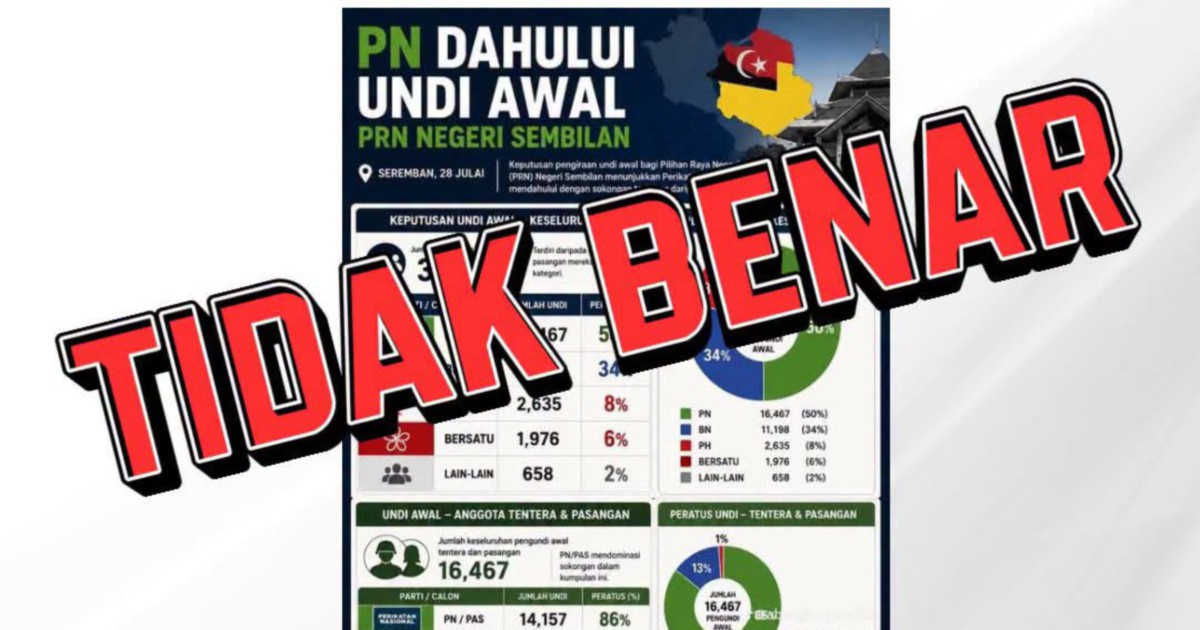
The Election Commission announced on Friday that counting of early votes cast in the 16th Negeri Sembilan state election will commence at 5pm on Saturday, establishing a clear timeline for the initial phase of vote tabulation in what is shaping up to be a significant test of political strength in the central Malaysian state. The announcement came from Seremban, the state capital, as the commission moved to clarify procedural details ahead of the weekend count.
The staggered approach to vote tallying—beginning with early votes before the general count—is standard practice in Malaysian elections, designed to provide transparency and allow for proper documentation of the voting process. Early votes typically include ballots cast by election workers, security personnel, and those unable to vote on polling day itself. This segment often provides observers and analysts with initial indicators of voting patterns, though final results depend entirely on the much larger pool of votes cast on election day proper.
Simultaneously, the Election Commission moved decisively to counter misinformation circulating on social media platforms, where claims had emerged suggesting that the Perikatan Nasional coalition was leading in the contest. The commission labelled these assertions as false, emphasising that no vote tallies have been released to the public ahead of the official counting process. This intervention highlights the growing challenge electoral bodies across Southeast Asia face in combating disinformation during campaign periods, particularly through viral social media channels that can spread unverified information rapidly.
The timing of such false claims is particularly sensitive in the Malaysian context, where electoral outcomes carry substantial weight in determining state governance and coalition configurations. Negeri Sembilan has historically been a competitive state, with control shifting between different political coalitions in previous elections. The circulation of premature or fabricated results can influence voter behaviour, undermine public confidence in democratic processes, and distort the authentic expression of electoral choice.
The Saturday evening counting will represent the first official glimpse of voter sentiment in Negeri Sembilan's 16th state election. While early votes alone cannot determine outcomes—they typically represent only a fraction of total votes cast—they nevertheless generate significant media attention and become the subject of intense political commentary. Both the ruling coalition and opposition parties will be closely monitoring these initial results as bellwethers for the broader electoral mood.
Malaysian voters in Negeri Sembilan have been engaged in a competitive campaign season marked by competing visions for the state's future development, economic management, and social policies. The election occurs against the backdrop of broader political realignment at the national level and represents an opportunity for different coalitions to demonstrate electoral strength or recover from previous setbacks. For residents and observers across Malaysia and the broader Southeast Asian region, the Negeri Sembilan outcome carries implications for understanding contemporary Malaysian political dynamics.
The Election Commission's explicit debunking of the viral claims serves an important gatekeeping function, signalling to the public that official information about vote counts will emanate only through recognised channels and established procedures. This approach aims to establish clear boundaries between speculation and verified fact, particularly crucial in an information environment where false claims can achieve viral circulation within minutes. The commission's swift response also demonstrates growing institutional awareness of the need to defend electoral integrity against disinformation campaigns.
Social media platforms have become primary conduits for political messaging and rumour-mongering during Malaysian electoral cycles. The proliferation of messaging applications and social networks means that unverified claims can reach hundreds of thousands of voters before fact-checkers or official bodies can respond. The Negeri Sembilan election presents another case study in how contemporary elections must navigate not only traditional campaign dynamics but also the parallel information ecosystem operating through digital channels.
As Negeri Sembilan moves toward the Saturday vote count, election observers and political analysts will be monitoring several dimensions beyond the raw vote tallies. The turnout rate among early voters, the geographic distribution of results across different parliamentary constituencies, and the margin of victory in contests between major coalitions will all contribute to a fuller picture of voter sentiment. These details, when cross-referenced with demographic and socioeconomic data, help explain the political forces shaping electoral outcomes.
The five o'clock Saturday start time means Malaysian news organisations, international observers, and the general public will have their first objective data point by early evening. This timing is unlikely to be coincidental; Malaysian electoral procedures are typically designed to allow sufficient daylight hours for counting while ensuring results are available to media outlets operating on daily publication cycles. The counting process itself, conducted at the constituency level with multiple observers present, provides multiple checkpoints for verification before final tallies are announced.
For Malaysian voters, the Saturday early count serves as both an informational moment and a symbolic marker of the democratic process unfolding. Regardless of which coalition emerges with an advantage in early votes, the subsequent general count on the main election day will determine the actual outcome. The Election Commission's firm stance against false claims reinforces the principle that democratic legitimacy rests on verified, transparent procedures conducted according to law—not on speculation or social media claims, regardless of their origin or reach.

