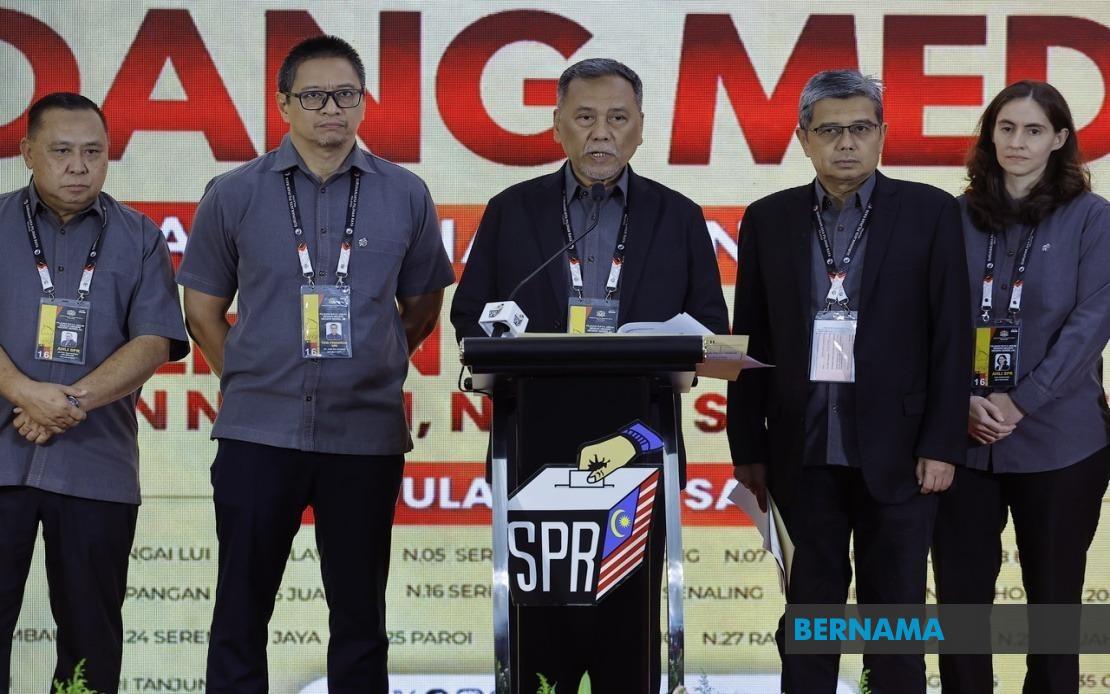
The Election Commission has officially endorsed 103 candidates for Negeri Sembilan's upcoming state election, with the nomination process closing on July 18. The electoral contest will prove notably fragmented, with 21 of the state assembly's 36 seats facing three-cornered battles—a configuration that will test voters' strategic thinking and reshape traditional voting patterns in the state. EC chairman Datuk Seri Ramlan Harun confirmed all submissions after verification at eight nomination centres across the state, setting the stage for what analysts expect to be one of Malaysia's most contested regional elections in recent years.
Pakatan Harapan dominates candidate numbers with a full slate of 36 nominees, reflecting its status as the clear frontrunner heading into the contest. Barisan Nasional, the traditional governing coalition, has fielded 25 candidates, positioning itself as the principal opposition force. The landscape becomes more complex with the entry of Bersatu and Perikatan Nasional, which together have put forward 35 candidates—24 from Bersatu and 11 from PN. This division of anti-establishment votes across two parties could prove decisive in marginal constituencies where traditional loyalties have weakened. The emergence of these new players reflects broader shifts in Malaysian politics since the 2018 general election, when the established two-coalition framework began fragmenting.
Beyond the major players, Negeri Sembilan's electoral battlefield includes five smaller contenders. Barisan Jemaah Islamiah Se-Malaysia (Berjasa), the Malaysian Orang Asli Party (ASLI), and the Socialist Party of Malaysia (PSM) have each fielded single candidates, while four independent hopefuls are running without party affiliation. Although their numerical impact appears minimal, these fringe candidacies matter significantly in tight races and may alter outcomes through vote-splitting dynamics. The presence of ASLI, which specifically focuses on indigenous constituencies, underscores the growing political consciousness among Orang Asli communities seeking dedicated representation rather than relying on mainstream parties' token gestures.
The candidate pool reveals notable gender and age dimensions. Among the 103 aspirants, 94 are male while only nine are female, a gender imbalance that persists across Malaysia's electoral system despite growing calls for inclusivity. The youngest candidate is just 23 years old, representing Bersatu in the Sri Tanjung seat, suggesting fresh blood entering the political arena. By contrast, the oldest contender is 70, running under the PH banner in Gemencheh. This demographic spread reflects how different parties are balancing experience with youthful energy, though the overwhelming dominance of male candidates indicates that gender representation remains a systemic challenge across Malaysian political parties regardless of ideology.
The specific distribution of competitive formats reveals important strategic patterns. While 21 seats will host three-cornered contests, 11 constituencies will see straightforward one-on-one battles where the victor emerges more predictably. Two seats—Nilai and Sri Tanjung—feature the ultimate complexity of five-way races, while Jeram Padang and Rahang will witness four-cornered clashes. These configurations mean that in more than half the state, candidates can win with significantly less than a clear majority, creating opportunities for consolidation around the most viable option in each locality. Voters in three-cornered seats face genuinely complex calculations about whether to support their preferred candidate or cast a tactical vote to block their least-favoured option.
The electoral roll encompasses 889,490 eligible voters across Negeri Sembilan, comprising primarily ordinary citizens but also including dedicated categories often overlooked in political analysis. Among the total, 867,151 are standard civilian voters, while 16,884 military personnel and their spouses form a bloc that has historically leaned toward establishment parties, and 5,455 police officers represent another disciplined constituency. The police voters' participation patterns are particularly significant given concerns about institutional independence during election periods. These special categories, while numerically modest relative to the overall roll, can prove decisive in close-run constituencies where margins have narrowed considerably.
The state assembly itself comprises 36 seats, having been dissolved on June 5, forcing this electoral contest. The timeline set by the EC allows for early voting on July 28, providing flexibility for voters unable to visit polling stations on the main election day of August 1. This two-stage voting process reduces congestion and may boost overall participation, though it also extends the campaign period and increases opportunities for last-minute manoeuvring by candidates and party operatives seeking to shift voter sentiment. Early voting participation rates are watched closely as barometers of genuine enthusiasm versus perfunctory engagement.
For Malaysian observers and regional analysts, Negeri Sembilan's election carries implications beyond the state's borders. The prevalence of three-cornered contests signals a maturing of Malaysia's multi-party system, moving beyond the rigid two-coalition structure that long defined national politics. Bersatu's decision to field 24 candidates rather than cooperate fully with Barisan Nasional demonstrates the party's aspiration toward independent strength, even while it participates in PN. The fragmentation reflects deeper voter disaffection with traditional arrangements and a willingness to experiment with alternatives. Results here will inform calculations by political strategists nationwide about whether independent candidacies and splinter-party strategies can actually deliver victories or merely fragment the anti-establishment vote.
The competitive intensity in Negeri Sembilan also reflects the state's symbolic importance within Malaysian politics. Unlike some states where power changes hands rarely, Negeri Sembilan has experienced genuine electoral fluidity in recent cycles. The state is diverse enough to serve as a microcosm of urban-rural political tensions, generational shifts, and the ongoing negotiation between tradition and modernisation that characterises contemporary Malaysia. Its voting patterns often provide early signals of broader national trends, making analysts attentive to outcomes that might presage shifts in federal-level support. A particularly strong showing by PN or Bersatu candidates could embolden those parties' expansion strategies, while gains by independent or fringe candidates would validate arguments about declining party loyalty among Malaysian voters.
The campaign period leading to August 1 will test whether voters in three-cornered contests reward specific candidates on merit and policy substance, or whether they resort to tactical calculations about consolidated opposition. Campaign messaging from all parties will intensify, with PH emphasising continuity and development, BN attempting to reclaim the narrative of experienced governance, and Bersatu-PN positioning themselves as a genuine third force unburdened by either previous government records. The outcome will matter not merely for which coalition controls state government, but for what the vote distribution reveals about Malaysia's evolving political alignments as the nation approaches the next general election cycle.

