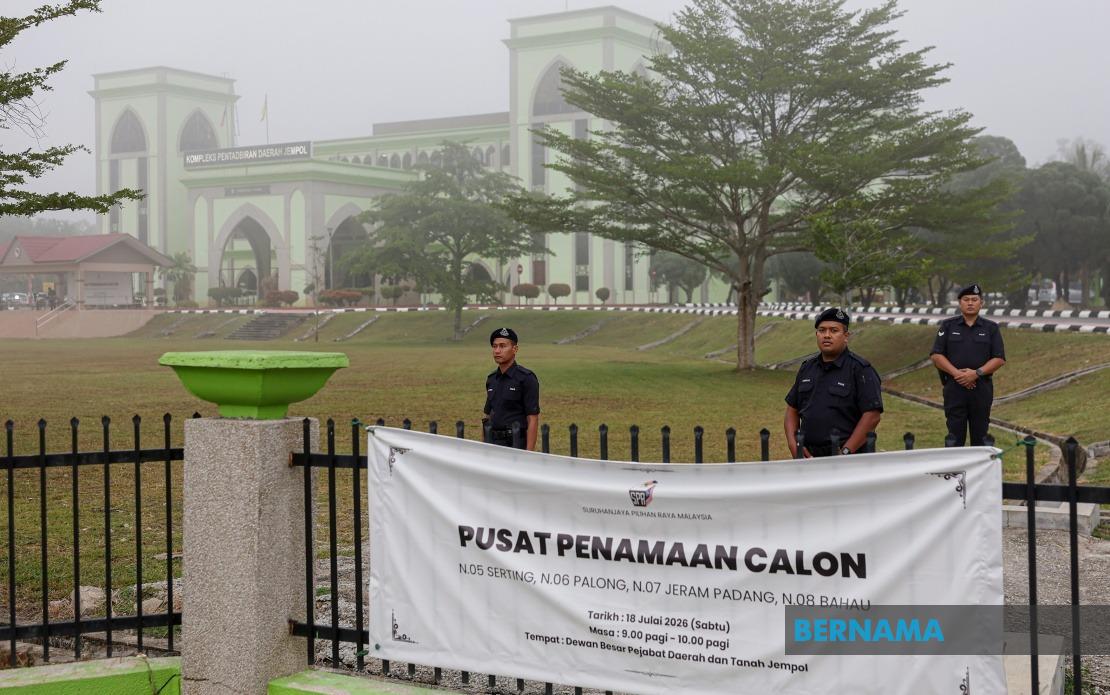
The 16th Negeri Sembilan state election moved into its formal candidate registration phase on July 18, as all eight nomination centres across the state commenced operations simultaneously at 9 am. The nomination window remained open for exactly one hour, concluding at 10 am, allowing the returning officers to immediately proceed with verifying candidate eligibility and publishing the official roster of contenders. This compressed timeframe reflects the Election Commission's carefully choreographed timeline for the entire electoral process, designed to maintain momentum from dissolution through to polling day.
Weather conditions proved favourable across all seven districts of Negeri Sembilan, creating optimal circumstances for both candidates and the large contingent of election staff managing the registration process. The state police force deployed substantial resources to this phase of the election, with Negeri Sembilan police chief Datuk Alzafny Ahmad confirming that 2,393 uniformed personnel had been stationed at the nomination centres. This deployment underscores the seriousness with which state authorities approached crowd management and the prevention of potential disruptions during what remains a politically sensitive period in Malaysia's electoral calendar.
The broader election timeline has been structured to allow voters and parties adequate opportunity for campaign activities. The official campaign period spans 14 days, commencing immediately following the announcement of eligible candidates and concluding at 11.59 pm on July 31. This duration provides political parties with a fortnight to conduct ground outreach, media engagement, and voter mobilisation before the election itself takes place. Early voting has been scheduled for July 28, accommodating military personnel, police officers and their spouses, while the main polling day falls on August 1.
The Negeri Sembilan state election was triggered by the dissolution of the State Legislative Assembly on June 5, following formal consent from the Yang Dipertuan Besar of Negeri Sembilan, Tuanku Muhriz Tuanku Munawir. The dissolution process, while constitutionally mandated, represents a significant moment for the state's political landscape. The decision to hold fresh elections carries implications for Malaysia's broader political dynamics, particularly given the coalition patterns that have emerged nationally in recent years.
The electoral context is particularly noteworthy when examining the composition of the previous assembly. In the 2023 state election, Pakatan Harapan secured 17 of the 36 available seats, establishing itself as the dominant coalition, while Barisan Nasional retained 14 seats and Perikatan Nasional held five. This distribution has remained relatively stable, and the new election presents an opportunity for each coalition to either consolidate its position or attempt territorial gains. For Malaysia's political observers, Negeri Sembilan elections carry significance beyond the state level, as they often foreshadow broader patterns of voter sentiment and coalition dynamics.
The Election Commission has registered 889,490 eligible voters across Negeri Sembilan, based on the electoral roll updated as of June 4, 2026. This voter population comprises 867,151 ordinary voters participating through standard polling procedures, supplemented by 16,884 military personnel and their spouses and 5,455 police personnel who are classified as early voters. The size and composition of the electorate highlight the diverse nature of Negeri Sembilan's population and the various mechanisms the Election Commission has established to ensure comprehensive participation across different demographics and professional groups.
For Malaysian and Southeast Asian observers, state elections within Malaysia's federal system offer insights into how voters respond to local governance issues, coalition performance, and individual candidate appeal. Negeri Sembilan, being neither among the largest nor smallest states, typically demonstrates voting patterns that reflect broader peninsular trends while maintaining its own distinct political identity. The state's relative political stability, combined with its economic characteristics, makes it a closely watched electoral laboratory.
The deployment of such substantial police resources, while routine for Malaysia's election management framework, underscores the institutional importance placed on orderly electoral processes. The 2,393 personnel distributed across nomination centres represent a significant security commitment, though such numbers are proportionate to the scale of activity and the potential for large gatherings. The coordination of election staff, police personnel, and administrative officials across eight simultaneous nomination centres demonstrates the operational complexity inherent in conducting elections across a populated state.
Looking ahead, the compressed campaign period and clearly defined electoral schedule provide all political actors with certainty regarding their preparation timelines. Parties can now engage in detailed strategic planning, knowing the exact dates by which voters will make their decisions. The August 1 polling date gives candidates little more than a week from the close of nomination to complete their campaigning, intensifying the pace of political activity and favouring parties with established ground networks and campaign infrastructure.
For stakeholders across Malaysia's political spectrum, the Negeri Sembilan election serves as both a test of current voter sentiment and a potential indicator of broader electoral trends. The state's result may influence strategic calculations at the federal level, particularly regarding coalition viability and regional support bases. As the nomination process concludes and the campaign phase formally begins, attention will shift to which personalities have successfully registered their candidacy and how the established coalitions position themselves relative to one another in the coming fortnight.

