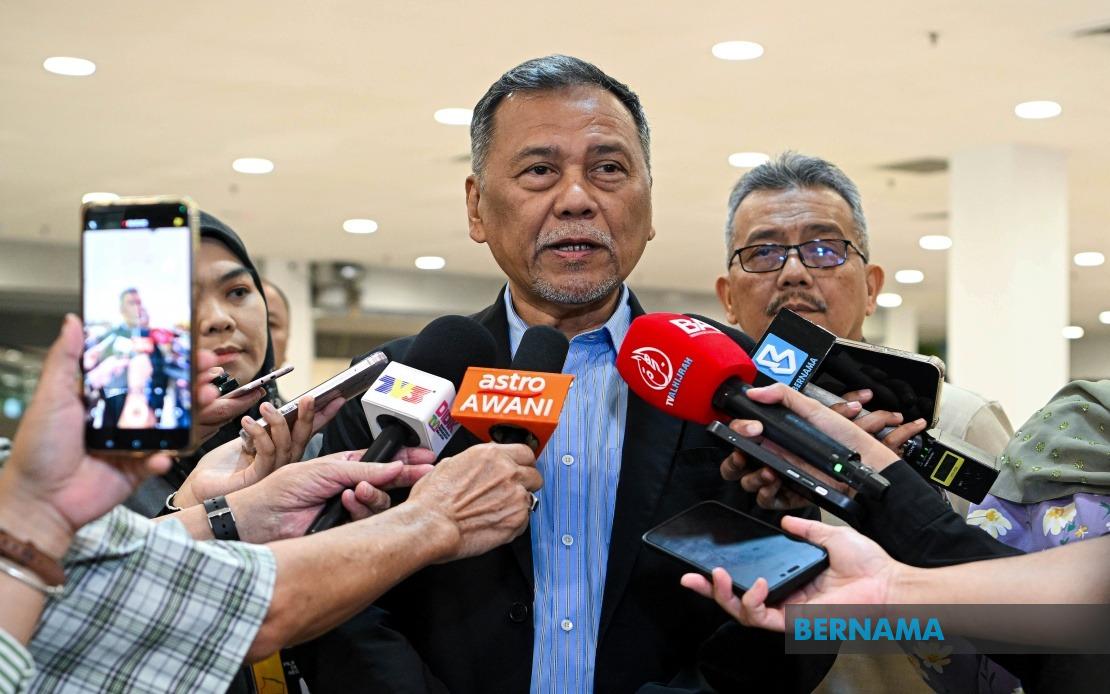
The Election Commission has confirmed that nominations for the Negeri Sembilan state election are advancing as planned, with 464 nomination forms distributed to prospective candidates across the state's 36 constituencies. However, only 70 candidates have formally committed to contesting by submitting their required deposits, prompting EC chairman Datuk Seri Ramlan Harun to urge remaining interested candidates to complete their financial obligations without delay.
Ramlan issued the advisory after touring the state's nomination centres, which are being prepared across the eight parliamentary divisions that will serve as focal points for tomorrow's nomination proceedings. The Election Commission has scheduled nominations to commence at 9 am and conclude at 10 am, allowing returning officers to announce eligible candidates immediately thereafter. With the deposit payment deadline coinciding with nomination day itself, the EC emphasised the importance of candidates arriving early and settling their outstanding fees to prevent last-minute congestion and administrative bottlenecks.
Preparations for the nomination process have been thorough and methodical. The Election Commission deployed its officers at six representative nomination centres—covering Lenggeng, Nilai, Lobak, Temiang, Sikamat, and Ampangan constituencies—where full rehearsal sessions were conducted to identify and resolve any potential procedural obstacles. This groundwork reflects lessons learned from previous state elections and demonstrates the EC's commitment to ensuring operational efficiency despite the compressed timeline.
A notable departure from recent electoral practice is the Election Commission's decision to centralise nominations around parliamentary boundaries rather than individual state constituencies, as was implemented during Johor's recent state election. This structural adjustment accounts for Negeri Sembilan's specific geographical and administrative characteristics, intended to streamline coordination among the 761 EC officers who will oversee proceedings across the eight nomination centres. The centralised model theoretically reduces duplication and enhances resource allocation, though it requires candidates from geographically dispersed constituencies to travel to designated parliamentary-level centres.
The electoral landscape in Negeri Sembilan reflects the broader political fragmentation evident across Malaysian states. In the 2023 state election, Pakatan Harapan secured 17 of 36 seats, establishing a plurality but falling short of outright dominance. Barisan Nasional captured 14 seats, while Perikatan Nasional claimed five, leaving one seat unaccounted for. This competitive distribution suggests the forthcoming 16th state election will likely prove keenly contested, with multiple coalitions viably positioned to influence the outcome and shape the state administration.
The electoral register has been updated to reflect demographic changes since the previous election. A total of 889,490 registered voters are eligible to participate, comprising 867,151 ordinary voters alongside 16,884 military personnel and their families, and 5,455 police officers, all classified as early voters. These categories represent distinct demographic blocs whose voting patterns may carry strategic significance for competing parties, particularly in a state where marginal constituencies could prove decisive.
The election timetable itself reflects practical considerations balancing nomination, campaigning, and administrative preparation. Early voting has been scheduled for July 28, providing military and police voters time to cast ballots before the general polling day on August 1. This sequencing allows the election machinery adequate time to recover and redeploy between early voting exercises and the primary election day, reducing fatigue among EC personnel and minimising logistical strain on polling infrastructure.
Ramlan's remarks on security and political conduct underscore ongoing concerns about electoral decorum. Political parties and their supporters have been explicitly reminded to avoid provocative behaviour, a standard admonition that nonetheless carries weight given Malaysia's recent experiences with heated state elections and campaign-related friction. The EC's emphasis on compliance with electoral regulations and avoidance of common offences signals that commissioners intend to maintain strict administrative discipline throughout the campaign period, deterring violations through clear prior notice.
The dissolution of the Negeri Sembilan State Legislative Assembly on June 5 followed formal constitutional procedures, with consent granted by Tuanku Muhriz Tuanku Munawir, the Yang Dipertuan Besar. This regular constitutional sequence triggered the automatic cascade of nominations, polling preparation, and administrative timelines that have now reached their initial phase. For Malaysian political observers and analysts, the Negeri Sembilan election represents an important interim test of electoral dynamics between federal-level coalitions, offering insights into voter sentiment and emerging political alignments before larger national contests potentially materialise.
The relatively modest deposit payment rate—only 70 of several hundred eligible parties and independent candidates formalising their candidacies—may reflect either strategic selection among established political entities or ongoing indecision among prospective independent candidates. Historically, independent candidacies in Malaysian state elections have constituted a small fraction of total nominations, with organised political parties dominating the nomination process. The final candidate roster, once officially announced following tomorrow's nomination ceremony, will clarify the actual competitive field and reveal whether fringe candidates and political newcomers have mounted significant challenge bids.
Looking forward, the compressed campaign period between nomination closure and polling day presents both advantages and constraints. A shorter campaign window reduces overall expenditure and fatigue but compresses opportunities for grassroots mobilisation and candidate exposure. For voters, the abbreviated timeframe necessitates heightened attention to candidate positions and party policies, potentially advantaging better-organised political machinery capable of rapid, efficient voter outreach.

