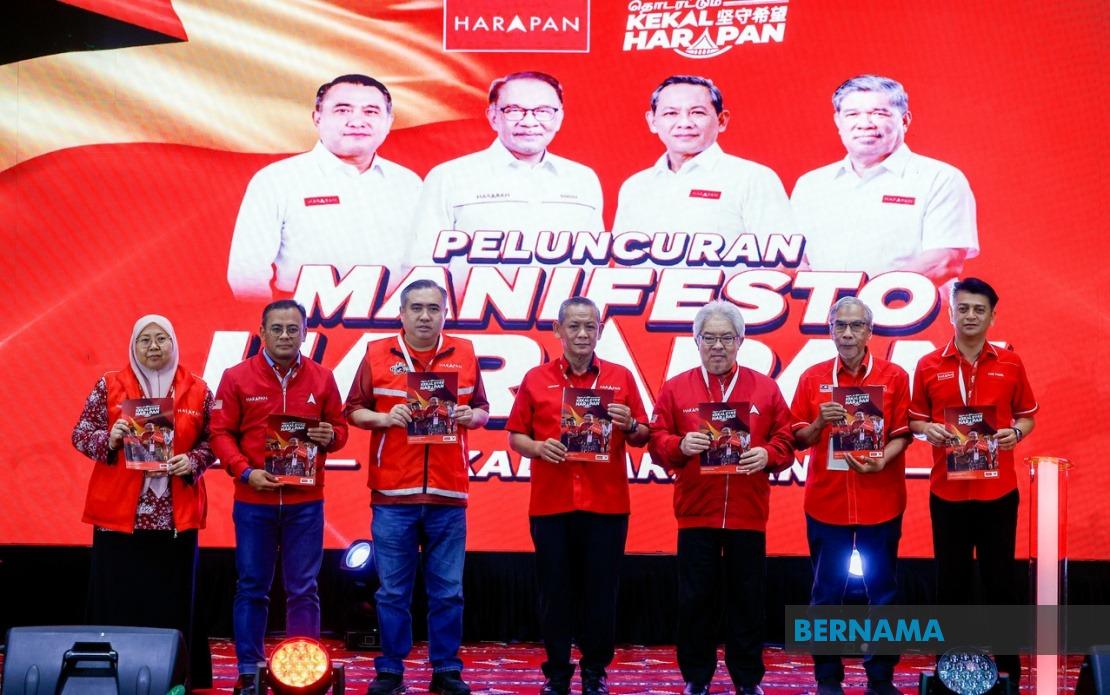
Pakatan Harapan is positioning its Negeri Sembilan state election campaign around tangible results and proven governance rather than aspirational promises, with coalition leadership drawing a deliberate contrast between its approach and what it characterises as typical political posturing. The strategy reflects a broader trend among Malaysian ruling coalitions seeking to anchor voter confidence in demonstrated competence following years of implementation experience, a messaging tactic that carries particular weight in contests where incumbents must justify renewal of their mandates.
Menteri Besar Datuk Seri Aminuddin Harun, who chairs the Pakatan Harapan coalition in Negeri Sembilan and is personally defending the Linggi state seat, articulated this positioning at the manifesto launch in Seremban. Rather than unveiling a slate of transformative new pledges, he framed the coming electoral period as a continuation and refinement phase, explicitly rejecting what he termed the distinction between aspirational rhetoric and achievable commitments. This rhetorical choice signals confidence in incumbent performance while implicitly criticising opposition approaches that may rely more heavily on future-oriented messaging.
The eight-year tenure of Pakatan Harapan governance in Negeri Sembilan provides the evidential foundation for this strategy. Aminuddin underscored that the coalition's manifesto was constructed from direct experience managing the state apparatus, allowing party strategists to distinguish between initiatives that have demonstrated viability and those that remain theoretical or problematic in implementation. This grounding in operational experience rather than campaign creativity reflects a maturation in how ruling coalitions present themselves to voters, particularly in states where political competition has intensified.
Central to the coalition's messaging is the concept of foundation-building for future generations, a long-term framing that positions immediate electoral victory as one phase in multi-decade state development. Aminuddin explicitly articulated this generational dimension, suggesting that the five-year term beginning after the election should be understood not as a discrete political cycle but as crucial scaffolding for sustained prosperity and opportunity. This rhetorical approach attempts to elevate campaign discourse beyond partisan competition toward stewardship language, potentially appealing to voters concerned about governance quality over dramatic policy swings.
The manifesto itself, branded 'Negeri Sembilan Kekal Harapan' (Negeri Sembilan Stays With Harapan), encompasses ten key commitments structured around this enhancement-rather-than-innovation framework. While specific policy details were not enumerated in available reporting, the thematic architecture suggests a focus on programme consolidation, expansion of successful schemes, and targeted improvements to existing state infrastructure and services. This approach carries implications for electoral strategy, as it potentially constrains opposition ability to outflank the incumbents on fresh policy ground while concentrating competition on implementation quality and resource allocation efficiency.
For Malaysian voters and political observers, this electoral dynamic in Negeri Sembilan offers instructive lessons about how coalition politics operates in an increasingly mature democratic context. Rather than governance-versus-opposition framing, the contest increasingly hinges on competing visions of state management within relatively similar policy boundaries. Both ruling and opposition parties increasingly converge on fundamental objectives such as economic development, service delivery, and infrastructure, with differentiation occurring through claimed implementation capacity and resource prioritisation rather than ideological divergence.
The emphasis on deliverability also reflects lessons learned from earlier electoral cycles in Malaysia where ambitious manifestos encountered practical constraints in implementation. State governments operate within fiscal limitations, constitutional constraints, and bureaucratic realities that frequently diverge from campaign expectations. By positioning the Pakatan Harapan approach as grounded in existing state experience, Aminuddin attempts to preempt criticism of unfulfilled promises by anchoring commitments to known budgetary and administrative parameters. This evidence-based campaign methodology may resonate with voters who have experienced broken campaign promises in previous electoral cycles.
The generational emphasis deserves particular attention for Malaysian policymakers and voters. By framing the coming five-year term as foundation-work for future Negeri Sembilan residents, the coalition leadership invokes a longer temporal horizon than typical three-to-five year electoral cycles encourage. This language suggests that immediate gratification politics—smaller tax cuts, rapid spending initiatives, or dramatic policy reversals—are being deliberately subordinated to sustainable institutional building. Whether this appeals to voters or appears to them as deflecting demands for immediate improvement remains an open question that will likely shape campaign dynamics through polling day.
The Negeri Sembilan contest also carries implications for inter-coalition dynamics within Pakatan Harapan itself. Coalition governance requires coordination across component parties with distinct electoral interests and support bases. By emphasising demonstrated competence and programme continuity, the coalition leadership minimises intra-coalition dispute potential while maximising voter perception of organisational stability and mature governance. This approach stands in contrast to more contentious electoral periods where coalition partners compete aggressively for credit or distance themselves from unpopular policies.
Regionally, Negeri Sembilan's election represents one of several Malaysian state contests that will test voter appetite for incumbent renewal versus demand for political change. While the peninsular state's economic and demographic profile differs from Sabah, Sarawak, and other regions, patterns of voter behaviour across these contests will illuminate broader trends in Malaysian electoral politics. Whether voters reward demonstrated competence sufficiently to extend incumbency, or whether fatigue with existing governance structures drives demand for alternatives, remains uncertain as these contests approach.

