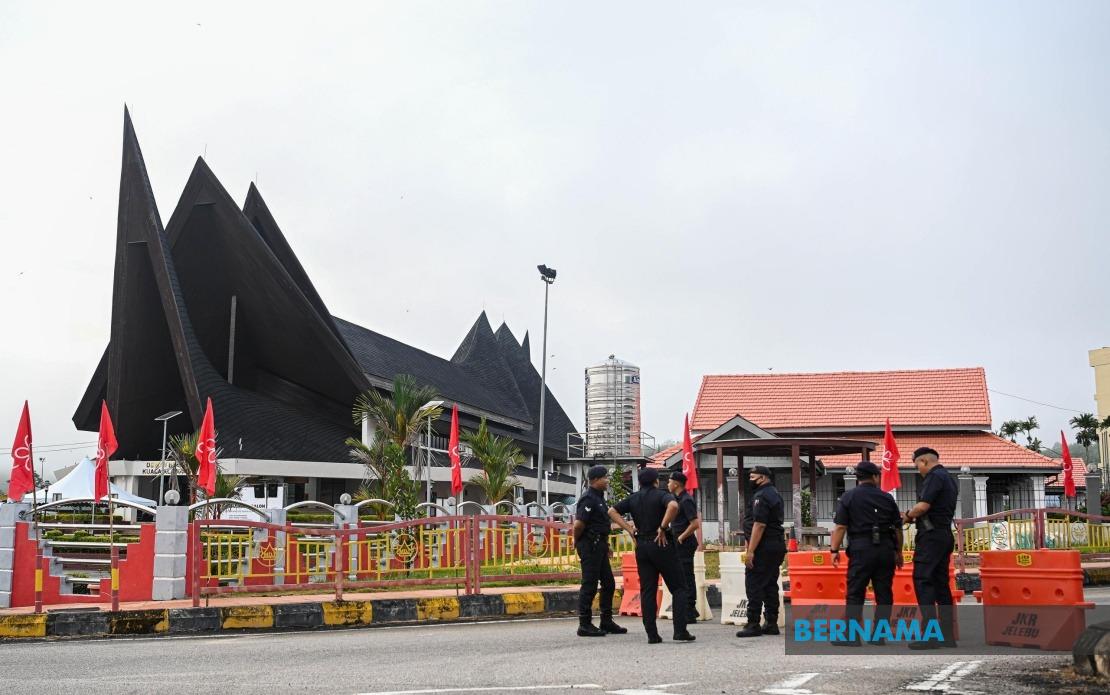
The nomination process for Negeri Sembilan's 16th state election unfolded without significant disruption on July 18, as overcast skies and mild conditions provided ideal circumstances for the day's proceedings. Election Commission officials had positioned themselves at eight nomination centres throughout the state ahead of the 9 am start time, conducting final checks and verifying documentation systems to accommodate the candidates and their representatives filing nominations throughout the one-hour window.
Median-sized crowds of party supporters and political observers had gathered at nomination venues well before the official opening, with journalists and camera crews establishing positions by mid-morning to document the submission of candidate papers. The early arrival of media contingents underscored the competitive nature of this state election, particularly given the shifting political alignments and seat allocations announced by various coalitions and independent contenders in recent weeks.
Negeri Sembilan's electorate encompasses 889,490 registered voters distributed across the 36-seat state assembly. This figure incorporates 867,151 ordinary citizens eligible to vote, alongside 16,884 military personnel and their families, and 5,455 police force members entitled to participate in the electoral process. The state assembly itself was dissolved on June 5 following standard constitutional procedures, with the Election Commission subsequently announcing a two-stage voting schedule featuring early polling on July 28 and general voting day on August 1.
The constellation of participating parties reflects the fragmented political landscape currently shaping Malaysian electoral contests. Pakatan Harapan declared its intention to contest all 36 available seats, positioning itself as the comprehensive option for voters seeking complete representation across every constituency. Barisan Nasional opted for a more selective approach, announcing candidacies in 25 constituencies, suggesting strategic calculations about resource allocation and competitive viability in specific districts.
Perikatan Nasional committed to fielding candidates in 11 seats, maintaining its presence while acknowledging the need for careful positioning in an increasingly crowded field. Several smaller registered parties—Parti Orang Asli Malaysia, Parti Sosialis Malaysia, and Parti Barisan Jemaah Islamiah Se-Malaysia—each nominated single candidates, preserving their organisations' electoral legitimacy and symbolic participation despite minimal expectations of electoral success.
Partai Pribumi Bersatu Malaysia emerged as a notable independent force, announcing its intention to contest 24 state seats as a solo entity without formal coalition arrangements. This strategy marked a significant departure from conventional Malaysian electoral practice, where major parties typically operate within formal alliances. Bersatu's decision included accommodations for Parti Bersepakat Hak Rakyat Malaysia, which would field candidates under the Bersatu banner in two constituencies, effectively allowing the smaller party to participate while maintaining visual and organisational unity.
The 2023 elections provided a recent benchmark for understanding Negeri Sembilan's political trajectory. Pakatan Harapan emerged as the clear victor in that contest, securing 17 of 36 available seats and thus commanding a straightforward majority within the state assembly. Barisan Nasional finished second with 14 seats, retaining substantial representation despite losing its previous dominance in this state. Perikatan Nasional captured five seats, establishing itself as a tertiary force with growing support in specific constituencies.
These results set the stage for the current campaign, with multiple parties recalibrating strategies based on performance fluctuations and shifting voter sentiment. The fact that no single coalition controlled the entire spectrum of contestation—as has historically been more common in Malaysian state elections—reflects broader uncertainty about voting patterns and coalition durability at the sub-national level. For Pakatan Harapan, defending 17 seats while competing vigorously for additional gains represents the primary objective. For Barisan Nasional, the challenge centres on retaining its existing footprint while identifying opportunities for incremental advances.
The nomination process itself carries symbolic weight beyond mere procedural significance. Successful candidate vetting, financial declaration compliance, and proper documentation submission all filter out candidates who fail to meet statutory requirements, effectively winnowing the field before serious campaigning begins. The Election Commission's management of this process—ensuring equitable treatment across all participating organisations and maintaining transparent procedures—sets the tone for public confidence in the electoral exercise's integrity.
For Southeast Asian observers tracking Malaysian electoral dynamics, Negeri Sembilan's contest illuminates broader patterns of political dealignment affecting the region. Traditional two-coalition frameworks are giving way to more fluid, multi-factional competitions where voters exercise greater independence and smaller parties retain negotiating leverage. The presence of Bersatu as an independent contesting 24 seats alongside conventional coalition participants suggests that Malaysian electoral politics continues evolving in ways that reward adaptability and penalise rigid organisational structures.
The August 1 polling day will reveal whether recent nomination-day enthusiasm translates into actual voter participation and whether the various party strategies produce anticipated results. Early voting on July 28 will provide preliminary indicators of engagement levels among military and police personnel, offering parties crucial data for final campaign adjustments. Weather conditions permitting, the two-week nomination-to-election interval should allow adequate time for campaigning, though the compressed timeline compared to some previous elections may advantage incumbents with established ground networks over emerging challengers.

