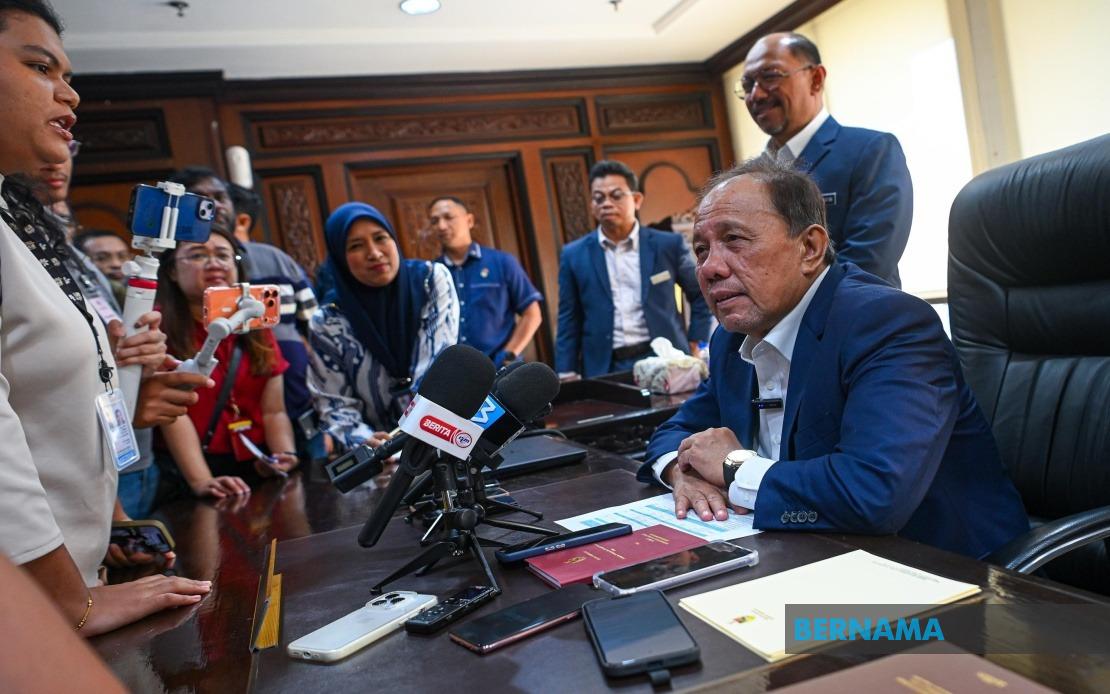
Negeri Sembilan's newly appointed Menteri Besar Datuk Ismail Lasim has signalled his intention to reshape the state cabinet by introducing Deputy Executive Council positions, a move designed to distribute ministerial responsibilities more widely across the coalition government. Speaking at Wisma Negeri in Seremban on his first official day in office, Ismail outlined plans to create these secondary positions within several portfolios deemed strategically important, though he acknowledged the constraints that prompted this innovative approach. The expansion reflects a broader ambition to strengthen administrative capacity at a time when the state's two-coalition government enjoys substantial parliamentary backing.
The underlying rationale for establishing Deputy Exco posts stems from a straightforward problem: the number of traditional Executive Council positions available falls short of the assembly members deserving recognition within the Barisan Nasional and Perikatan Nasional alliance. By introducing a tiered executive structure, Ismail plans to accommodate representatives from both coalitions' component parties—Barisan Nasional, PAS, and Parti Wawasan Negara—without fundamentally altering the cabinet's existing architecture. This approach offers political flexibility while maintaining the pretence of balanced power-sharing, a consideration critical in Malaysia's delicate coalition environments where every appointment carries symbolic weight.
Ismail, 67, from the Juasseh constituency, formally commenced his duties at the Menteri Besar's Office this morning, where he received greetings from State Secretary Datuk Mohd Zafir Ibrahim and departmental heads. His appointment followed his swearing-in ceremony before the Yang Dipertuan Besar of Negeri Sembilan, Tuanku Muhriz Tuanku Munawir, at Istana Besar Seri Menanti on Sunday. The ceremonial completion of his transition underscores the formal commencement of a new administrative era for the state, though internal reorganisation remains ongoing.
The proposal to create Deputy Exco positions represents what Ismail characterised as a novel administrative approach, distinguishing his tenure from previous governance models in Negeri Sembilan. However, the Menteri Besar declined to specify how many such positions would ultimately be created, suggesting ongoing deliberation within coalition leadership. This circumspection reflects the politically sensitive nature of portfolio distribution, where each appointment decision carries implications for internal coalition dynamics and potential grievances among excluded factions. The ambiguity also provides negotiating room as Ismail fine-tunes the cabinet structure to accommodate various stakeholder interests.
Separately, Ismail confirmed that senior-level Executive Council appointments—positions that would rank above traditional Exco members—remain under consideration. While constitutional provisions exist to facilitate such appointments, their finalisation has been deferred pending broader cabinet discussions. This suggests a deliberate sequencing of announcement decisions, with the Menteri Besar clearly mapping out a phased rollout of the new administrative framework rather than unveiling everything simultaneously. Such gradualism can serve multiple purposes, allowing time for coalition partners to adjust expectations and reducing shock value.
The complete Executive Council lineup is scheduled for announcement either on Friday or Monday at the latest, according to Ismail's statement. This tight timeline indicates that fundamental decisions regarding portfolio distribution and individual appointments have already been substantially resolved in private coalition negotiations, with public revelation merely awaiting an opportune moment. The compressed announcement window also suggests pressure to establish full administrative clarity quickly, enabling departmental permanent secretaries and agency heads to understand their reporting relationships and policy priorities without prolonged uncertainty.
Negeri Sembilan's political configuration provides substantial room for such administrative innovation. In the recently concluded state election, Barisan Nasional secured 18 seats while Perikatan Nasional captured seven, combining for a commanding 25-seat supermajority in a 36-member assembly. Pakatan Harapan's 11 seats leave the opposition substantially weakened, with limited capacity to obstruct executive initiatives or mount meaningful parliamentary challenges. This overwhelming numerical advantage offers the governing coalition considerable flexibility in designing administrative structures without fear of legislative reversal, though intra-coalition tensions over portfolio allocation remain relevant.
The introduction of Deputy Exco posts carries practical implications for Negeri Sembilan's governance architecture. Such positions would ostensibly assume delegated responsibilities from their supervising Executive Council members, potentially accelerating policy implementation and providing mentorship pathways for aspiring politicians. However, the lack of established precedent in Negeri Sembilan means institutional clarity regarding Deputy Exco authority remains undefined. Questions persist about whether these positions carry voting rights within cabinet, direct budget allocation authority, or merely symbolic recognition of rank. Malaysian state governments occasionally employ such intermediate titles, but standardised protocols for their operational integration remain inconsistent.
For Malaysian observers tracking coalition politics, Negeri Sembilan's administrative restructuring illustrates how governing partnerships manage the perpetual tension between democratic representation and executive efficiency. The Barisan Nasional-Perikatan Nasional arrangement, while numerically commanding, comprises multiple component parties with competing claims for ministerial recognition. Creating Deputy positions allows Ismail to offer political advancement and governmental involvement to broader constituencies without establishing an unwieldy, consensus-dependent cabinet. Whether this experiment in administrative structure-building succeeds in enhancing governance capacity or merely diffuses ministerial responsibility across too many shoulders will become apparent as the state government navigates its full term.
The timing of this administrative initiative also reflects Negeri Sembilan's post-election stabilisation phase. With coalition formation recently completed and a fresh electoral mandate secured, this represents an opportune moment for organisational redesign before institutional routines calcify. Ismail's deliberate pace in announcing these changes—stretching decisions across several weeks rather than deciding everything at once—suggests a preference for consensus-building within coalition leadership rather than unilateral executive fiat. This consensus-building approach may indicate his negotiating position within the coalition, balancing Barisan Nasional's numerical advantage against Perikatan Nasional's strategic importance.
Ulimately, Negeri Sembilan's proposed Deputy Exco structure exemplifies how Malaysian state governments adapt institutional frameworks to political necessities. Rather than confronting the impossible task of satisfying all coalition members' ambitions through traditional positions, Ismail proposes expanding the executive layer itself. Whether this innovation becomes a template for other states or remains a Negeri Sembilan experiment depends partly on whether it demonstrably improves governance outcomes or merely creates administrative overhead. The coming months will reveal whether this administrative creativity enhances state government effectiveness or complicates decision-making through proliferated hierarchies.

