Pakatan Harapan enters the Negeri Sembilan state election campaign with a straightforward strategy: emphasise the administrative integrity and development record of incumbent Menteri Besar Datuk Seri Aminuddin Harun as its strongest asset in retaining control of the state assembly. The coalition's election machinery is banking heavily on voter perception that Aminuddin's nearly two-term tenure has been marked by steady stewardship and freedom from major controversy—a positioning that reflects broader concerns about governance standards across Malaysian politics.
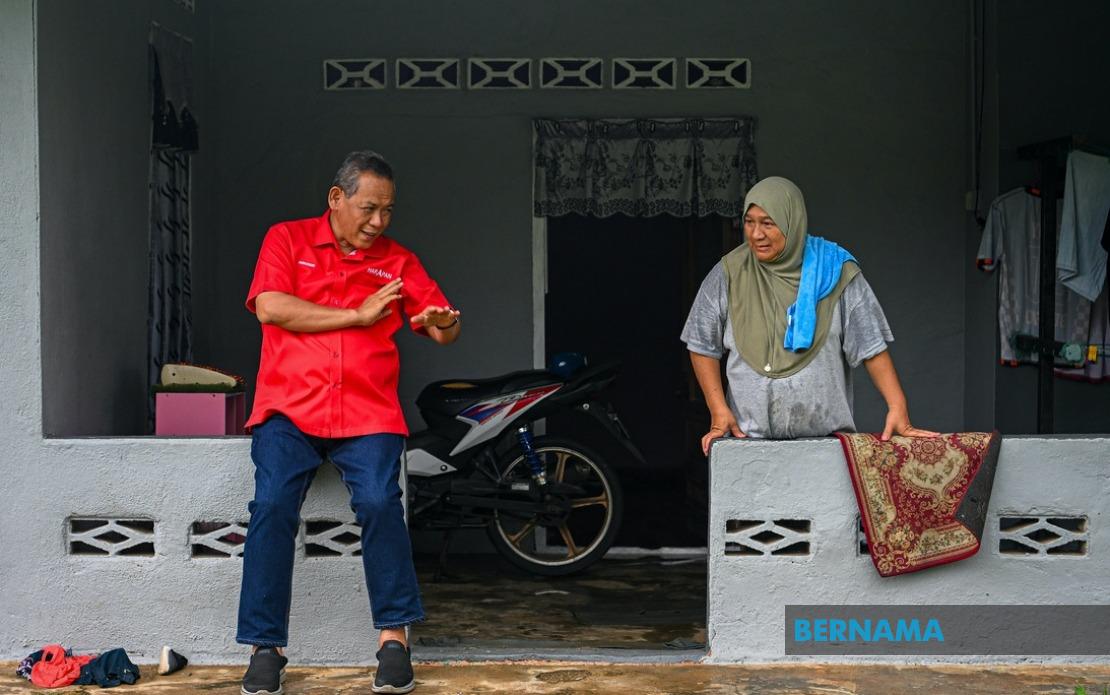
The PH campaign is being led by Datuk Seri Amirudin Shari, who serves as both the coalition's election director for Negeri Sembilan and as Menteri Besar of neighbouring Selangor. Speaking during the initial phase of campaigning, Amirudin characterised the grassroots reception as overwhelmingly positive, noting that party workers had encountered few substantive grievances about Aminuddin's administration during doorstep interactions. This feedback-driven confidence reflects a deliberate PH approach: moving away from large-scale rallies toward granular community engagement designed to gauge and reinforce local sentiment.
Amirudin's assertion that "there has been no major scandal associated with the Pakatan Harapan administration from the beginning until now" serves as a tacit contrast to broader questions about corruption and governance that have dominated Malaysian politics. For state elections in Negeri Sembilan, where economic concerns are tied to traditional sectors like mining heritage and current service industries, a clean administration message resonates with voters seeking stability and predictability in state-level policy. The emphasis on accountability reflects lessons PH learned from its 2018 federal victory and subsequent challenges, positioning cleaner governance as a competitive advantage.
Beyond Aminuddin's personal standing, PH is marshalling organisational strength at the ground level. The coalition's grassroots machinery in Negeri Sembilan is being presented as well-coordinated and effective, suggesting that voter outreach extends beyond prominent personalities to include systematic canvassing. This structural confidence matters in state elections, where local issues—economic opportunities, infrastructure, service delivery—often outweigh national narratives. The machinery's strength would be crucial in defending PH's current 17 seats against opposition challenges in what remains a competitive three-way contest between PH, Barisan Nasional, and Perikatan Nasional.
Prime Minister Datuk Seri Anwar Ibrahim's leadership is being leveraged as an additional campaign asset. Amirudin drew an explicit parallel to PH's recent success in the Johor state election, where Anwar's popularity among voters translated into concrete electoral gains for coalition candidates. The logic is straightforward: federal-level confidence in PH's stewardship can bolster state-level candidates by association, particularly in marginal seats where swing voters might be influenced by national performance metrics such as economic management and inflation control.
The coalition's manifesto, to be unveiled during the campaign period, represents a deliberate balancing act between continuity and change. PH's strategy combines acknowledgment of ongoing initiatives—suggesting that popular programs will continue—with new proposals designed to demonstrate forward momentum and responsiveness to emerging voter concerns. For Negeri Sembilan, where development priorities span urban renewal in Seremban, rural connectivity, and employment creation, this dual positioning allows PH to claim both stability and dynamism.
Electorally, PH's baseline is the 17 seats it secured in the 2023 state election, when Barisan Nasional won 14 seats and Perikatan Nasional captured five seats across the 36-seat assembly. To retain its mandate and form a government, PH needs to hold ground while potentially making incremental gains. The fragmentation among opposition forces—with BN and PN as separate entities rather than a unified challenge—creates opportunities for PH to exploit divided opposition votes in swing constituencies. Aminuddin's personal visibility as a Port Dickson MP since 2018, combined with his state leadership role, gives him an unusually strong local profile for a menteri besar.
The election mechanics underscore the scale of this contest. A total of 889,490 registered voters are eligible to participate, spanning 867,151 ordinary voters alongside early voting provisions for 16,884 military personnel and their spouses and 5,455 police personnel. Early voting occurs on July 28, with the main polling day set for August 1. The Negeri Sembilan State Legislative Assembly was dissolved on June 5, formally triggering the campaign period during which PH is conducting its ground-level assessment and public positioning.
For Malaysian observers, the Negeri Sembilan election carries significance beyond state-level implications. As a mid-term test of PH's federal coalition under Anwar, the results will offer clues about the coalition's resilience and voter confidence in its governance approach. A comfortable retention of Negeri Sembilan would validate PH's messaging around clean administration and economic management; a loss or significantly reduced majority would suggest that governance arguments alone may be insufficient to overcome headwinds from inflation, living costs, or grassroots dissatisfaction. The emphasis on Aminuddin's track record, therefore, functions both as a concrete campaign message and as an implicit assertion that good governance translates into electoral support—a proposition that Malaysian voters will ultimately evaluate on August 1.

