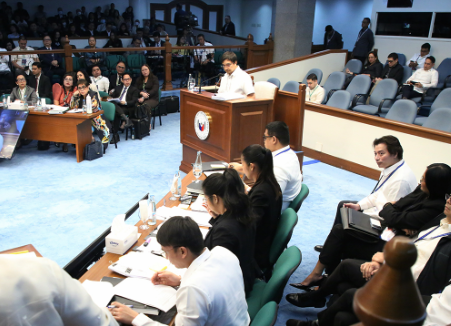
The Philippine Senate impeachment court heard critical testimony on Tuesday from National Bureau of Investigation regional director Jeremy Lotoc, who asserted that Vice President Sara Duterte possessed both the intention and practical capacity to execute her publicly announced threats against President Ferdinand Marcos, first lady Liza Araneta-Marcos, and former Speaker Martin Romualdez. Lotoc's testimony, delivered on the fifth day of the Vice President's impeachment proceedings, formed a central pillar of the prosecution's argument that her controversial remarks constituted grave threats and a betrayal of the public trust—an impeachable offence under the Philippine Constitution.
The former chief of the NBI's Cybercrime Division anchored his assessment on the Vice President's elevated constitutional position and her political lineage. When Senate President Sherwin Gatchalian directly asked whether Duterte possessed the capability to execute her threats, Lotoc responded with unqualified affirmation. He emphasised that her office as Vice President inherently conferred such capacity, and when pressed to elaborate, he referenced her family background, noting that her father had served as the nation's chief executive. This reasoning proved controversial among observers, as it suggested that proximity to executive power constituted sufficient grounds to establish capability in the absence of concrete evidence of planning or preparation.
A central difficulty in the prosecution's case emerged when Lotoc acknowledged that the NBI had identified no independent evidence confirming the existence of any individual whom Duterte allegedly engaged to carry out violence. The bureau's entire conclusion rested exclusively on statements and admissions made by Duterte herself during public forums and media interviews conducted in late November 2024. When Gatchalian specifically questioned whether the bureau's determination relied solely on Duterte's own utterances, Lotoc conceded straightforwardly: "Yes. Statements and admission, Sir." This admission raised fundamental questions about the evidentiary threshold required to prove the crime of grave threats in Philippine jurisprudence and whether subjective assessments of intent could substitute for objective investigation.
Lotoc explained that during a November 23 online press conference and a subsequent interview five days later, Duterte had explicitly stated she had spoken with someone to exact revenge should harm befall her. The NBI interpreted these declarations as serious rather than rhetorical, leading investigators to conclude she had indeed contracted with an individual to commit violence. However, Lotoc conceded that investigators never identified this purported conspirator, gathered communications between Duterte and such a person, or uncovered any planning documentation. Instead, the bureau maintained that Duterte's public statements themselves constituted sufficient admissions of conspiracy, despite her subsequent denials that she had hired an assassin.
The Vice President's refusal to appear before NBI investigators significantly shaped the bureau's analysis. Lotoc testified that the bureau sought direct questioning to probe whether Duterte had genuinely contracted an intermediary, but she declined to submit to NBI questioning. In response, Duterte provided a written denial, which Lotoc dismissed as legally insufficient to overcome her earlier public utterances. This procedural impasse highlighted broader concerns about the investigative process: investigators contended they could not verify whether threats were genuine without the suspect's cooperation, yet that very refusal was treated as evidence supporting the grave threats charge. The circular reasoning troubled independent observers, as it suggested that non-cooperation itself validated the prosecution's theoretical framework.
During questioning by Senator Raffy Tulfo, discussion turned to the so-called "Operation Romanov," which Duterte invoked when asserting that she herself faced threats justifying her defensive rhetoric. Lotoc testified that NBI investigation traced the term's origin to Davao City Mayor Sebastian 'Baste' Duterte during a January 2024 rally, and that intelligence indicated the operation was directed toward President Marcos and his family rather than the Vice President. The bureau found no validated threat against Duterte herself, and information from vlogger Princess Maui, who had initially raised the Romanov operation during Duterte's November briefing, was deemed unreliable after the vlogger failed to provide substantiation to investigators. This finding undermined Duterte's narrative that her statements reflected reasonable security concerns.
The prosecution strategy sought to establish that regardless of whether Duterte actually engaged an assassin, her public advocacy for such action demonstrated unfitness for high office and contempt for constitutional governance. Prosecutors contended that her statements revealed conduct unbecoming the nation's second-ranking constitutional officer and raised legitimate questions about her suitability to assume the presidency should circumstances require succession. The argument pivoted on the proposition that public threats from a sitting Vice President created institutional danger regardless of their practical likelihood of execution. This framing transformed the trial into an examination of the boundaries of permissible political speech and acceptable conduct for those holding office.
When the defence raised technical discrepancies in NBI documentation, Lotoc dismissed them as inconsequential clerical errors that neither affected the bureau's substantive findings nor altered its conclusions. Private prosecutor Amado Virgil Ligutan highlighted during redirect examination that Duterte had never retracted her controversial statements—she had only denied hiring an assassin—and that her November 26 interview constituted a reaffirmation rather than withdrawal of her earlier remarks. Lotoc interpreted this pattern as evidence she had not spoken in jest, a characterisation that inverted traditional legal presumptions by treating silence on retraction as proof of genuine intent.
The testimony revealed fundamental tensions within the impeachment framework regarding evidentiary standards and the burden of proof. Whereas criminal proceedings typically demand proof beyond reasonable doubt grounded in objective evidence, the impeachment trial operated under less stringent standards. Prosecutors built their case substantially on the Vice President's own statements interpreted through investigators' subjective assessments of her seriousness, without corroborating evidence of planning, procurement, or communication with alleged conspirators. This approach raised broader questions about whether impeachment proceedings, designed to remove officials for serious misconduct, should accept inference and interpretation as substitutes for concrete evidence of criminal conduct.
For Malaysian and Southeast Asian observers, the Duterte trial illuminates the fragility of institutional checks on executive power in the region. The Vice President's impeachment reflects deep fractures within Philippine political leadership, with constitutional mechanisms designed to remove unfit officials now deployed as weapons in internecine elite conflict. While the testimony focused on specific threats allegedly made by Duterte, the broader context involves competition between rival political factions seeking advantage through the impeachment process. The trial's outcome will establish precedents for how Philippine institutions interpret grave threats, executive accountability, and the fitness standards for high constitutional office—precedents potentially relevant to other democracies in Southeast Asia grappling with similar questions about political leadership and institutional legitimacy.

