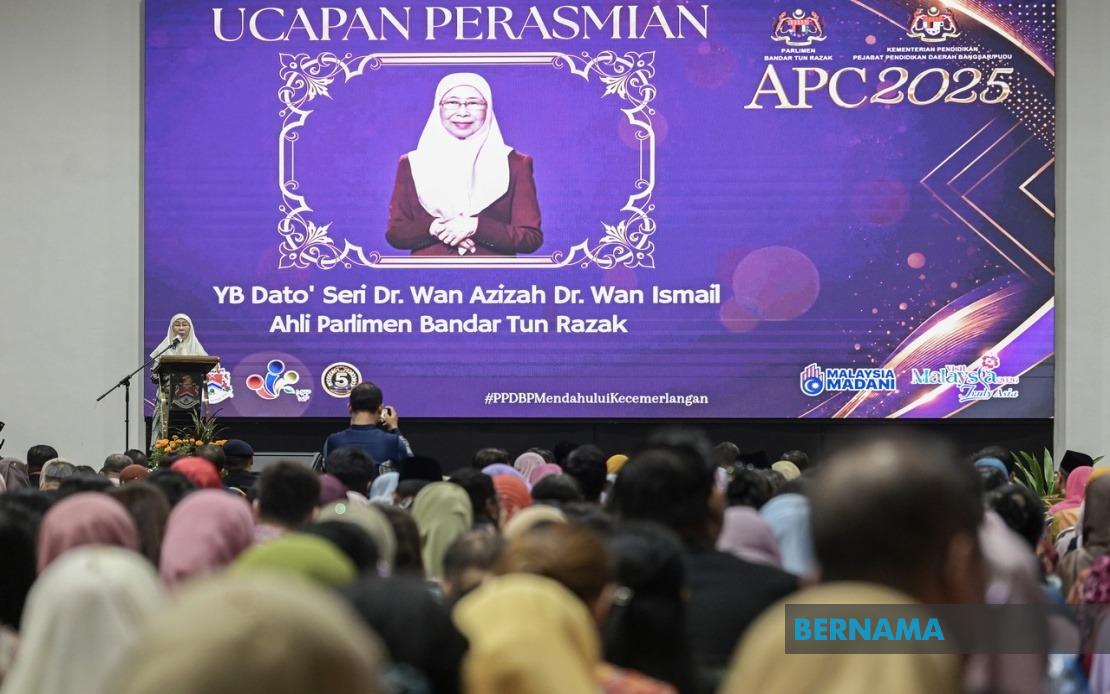
Datuk Seri Dr Wan Azizah Wan Ismail, wife of the Prime Minister and Member of Parliament for Bandar Tun Razak, has articulated a vision of national development that extends beyond conventional measures of progress. Speaking at the 2025 Excellent Service Award ceremony in Kuala Lumpur on July 23, she contended that a country's real foundation rests upon its capacity to develop citizens who combine intellectual capability with ethical grounding and compassionate engagement with society. This perspective challenges the often narrow focus on gross domestic product and infrastructure development as primary indicators of national achievement.
The forum provided an occasion to recognise 746 teachers and school administrators drawn from 143 institutions across the Bangsar/Pudu district, rewarding their contributions throughout 2025. Held at the Kuala Lumpur City Hall Training Institute and organised by the Bangsar/Pudu District Education Office, the ceremony assembled approximately 1,000 participants to celebrate educators' dedication to institutional excellence and improved learning outcomes. The scale of recognition reflects the significance accorded to the teaching profession within Malaysia's ongoing educational development.
Dr Wan Azizah identified educators as instrumental architects in this character-formation process, noting that teachers shoulder particular responsibility given the substantial hours children spend in educational environments. She emphasised that this responsibility intensifies in urban contexts where dual-income households often limit parental availability during school hours. The observation carries particular relevance for Malaysia's rapidly urbanising population, where many families navigate the competing demands of economic participation and child-rearing. Teachers consequently assume an expanded role beyond curriculum delivery, functioning as secondary custodians of social development and moral formation.
Her remarks signal a recalibration of education's fundamental purpose, moving beyond the transmission of technical knowledge to encompass character cultivation. The framework she outlined envisions schooling as an integrated endeavour that simultaneously imparts information while instilling virtues such as integrity, respectful conduct, and empathetic engagement. This holistic conception addresses longstanding educational debates within Southeast Asia regarding whether schools should prioritise academic achievement or broader personal development—a tension that remains unresolved across the region's diverse systems.
Particularly striking is Dr Wan Azizah's emphasis on critical thinking capacity within an era dominated by artificial intelligence and information proliferation. She warned that education systems must actively equip students to navigate information landscapes where distinguishing credible knowledge from misinformation represents an increasingly vital skill. This concern resonates throughout Southeast Asia, where rapid technological adoption and social media penetration have created novel challenges for educators tasked with developing student discernment. The Malaysian context, with its diverse media environment and evolving digital landscape, presents specific challenges in this domain.
The integration of values-based education alongside technological literacy suggests recognition that educational institutions cannot remain neutral spaces insulated from societal pressures. Instead, schools must deliberately cultivate capacities that enable students to make informed moral judgments in complex environments. This represents a significant pedagogical proposition requiring substantive curriculum redesign and teacher professional development—undertakings that demand sustained investment and policy coherence across multiple government departments.
Dr Wan Azizah's framing also implicitly addresses concerns regarding social cohesion and national identity formation in a diverse, pluralistic society. By emphasising shared values of character, integrity, and compassion rather than narrower ideological content, her remarks suggest an inclusive vision of education's civilising function. This approach holds particular significance for Malaysia, where educational institutions serve diverse communities and must navigate sensitivities surrounding religious and cultural representation. The emphasis on universal human virtues rather than particularistic identity markers potentially creates space for genuine pluralism within Malaysian schooling.
The ceremony itself demonstrated institutional commitment to recognising teaching excellence, with participation from significant government figures including the Prime Minister's Political Secretary Datuk Azman Abidin and Kuala Lumpur Federal Territory Education Department director Megat Affandi Ismail. This high-level attendance underscores the symbolic importance attached to teacher recognition within contemporary Malaysian governance, suggesting that education receives sustained political attention at senior levels.
Dr Wan Azizah's call for renewed commitment to comprehensive education reform carries implications extending beyond Malaysia's borders. Throughout Southeast Asia, nations grapple with balancing economic competitiveness against social stability and cultural preservation. Her emphasis that economic strength and technological prowess remain insufficient without accompanying ethical development offers a counterweight to purely market-driven educational policies that have dominated regional discourse. This perspective invites reconsideration of whether educational investment strategies require rebalancing toward soft skills and character formation.
The recognition of 746 educators represents tangible acknowledgment that implementing such comprehensive educational philosophy requires workforce engagement and morale. Teachers operating within resource constraints and frequently experiencing low social status across Southeast Asia require consistent validation that their work encompasses dimensions beyond standardised test performance. The awards ceremony provided such validation, potentially reinforcing educator commitment to broader developmental objectives amid competing pressures toward academic measurement.
Moving forward, translating Dr Wan Azizah's rhetoric into substantive systemic change presents considerable challenges. Educational transformation requires coordinated effort across curriculum development, teacher training institutions, assessment frameworks, and school leadership practices. Resource allocation decisions must reflect stated priorities regarding character development alongside academic achievement. Without such structural reinforcement, exhortations regarding ethical education risk remaining aspirational rather than achieving meaningful institutional transformation.
The address ultimately articulates a vision wherein Malaysia's international competitiveness depends not primarily upon technological adoption or infrastructure investment, but upon developing citizens equipped with ethical judgment, intellectual capacity, and social responsibility. Realising this vision demands sustained commitment from government, educators, families, and civil society. The Bangsar/Pudu awards ceremony represented one institutional acknowledgment of this imperative; whether Malaysian education systems collectively mobilise toward such comprehensive reform remains an open question with significant implications for the nation's trajectory.

