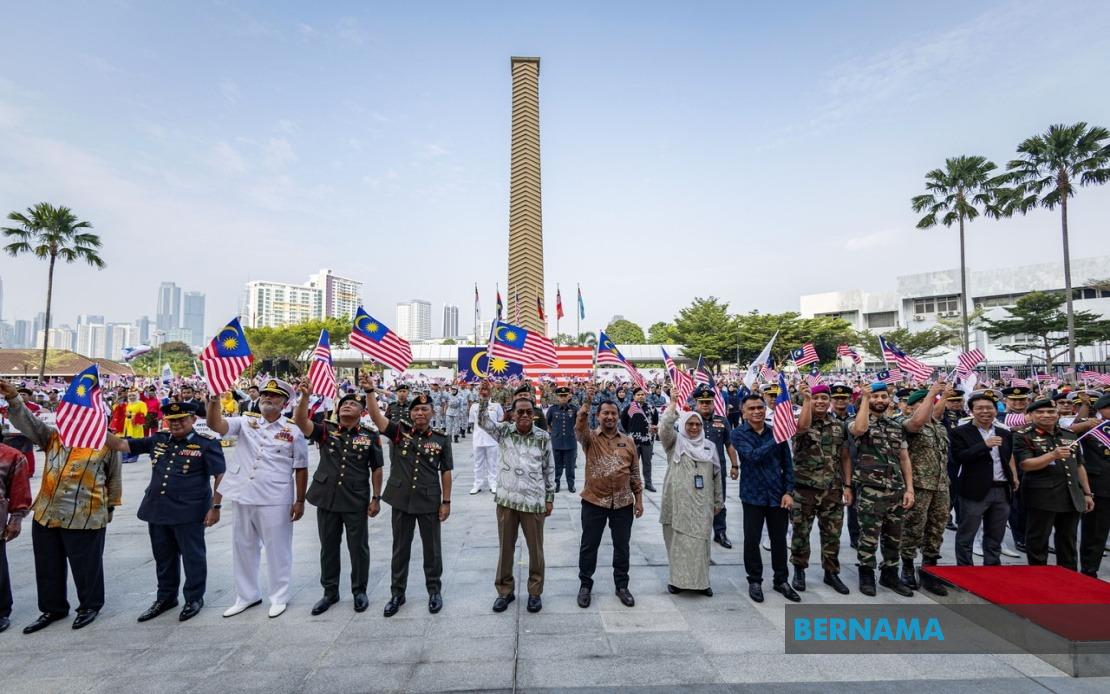
Defence Minister Datuk Seri Mohamed Khaled Nordin has warned against weaponising Malaysia's National Day and Malaysia Day celebrations for political purposes, arguing that these occasions should serve as moments for citizens to demonstrate their genuine attachment to the nation rather than outlets for discontent over specific issues. Speaking at the launch of the Defence Ministry's National Month and Fly the Jalur Gemilang campaign on August 27, Mohamed Khaled expressed concern over recent calls to boycott the festivities, characterising such moves as counterproductive to national cohesion.
The Defence Minister's remarks come amid growing tensions surrounding how Malaysia marks its independence celebrations. Rather than viewing National Day as a safety valve for airing grievances—whether concerning refugee crises, governance failures, or social inequities—Mohamed Khaled advocated for reimagining these observances as opportunities to reaffirm shared commitment to the nation's foundational principles. His intervention reflects mounting anxiety within government circles about the politicisation of patriotic occasions and the risk that symbolic national events might become contested terrain rather than unifying experiences.
Mohamed Khaled specifically referenced the Rohingya humanitarian crisis as an example of an issue that, while legitimate for separate discourse and advocacy, should not overshadow or derail the broader purpose of National Day celebrations. This distinction carries particular weight in the Malaysian context, where the country has hosted one of the world's largest Rohingya populations and where public opinion remains divided over immigration policy and humanitarian obligations. By separating the celebration of nationhood from policy-specific activism, the Defence Minister attempted to establish a framework in which citizens could express patriotism without being perceived as endorsing government positions on contentious matters.
Underlying Mohamed Khaled's statement is a deeper anxiety about Malaysia's vulnerability to external interference and internal fragmentation. He emphasised that Malaysians must collectively signal to both domestic and international audiences that the nation will not permit itself to become a stage for competing ideologies or external powers' strategic ambitions. This framing transforms the act of celebrating National Day into a geopolitical statement—a demonstration of national resilience and unity that serves broader defensive purposes beyond mere ceremonial observance.
The Defence Minister grounded his argument in Malaysia's foundational narrative: a multi-ethnic, multi-religious democracy constructed deliberately on principles of mutual accommodation and peaceful coexistence. According to this framework, abandoning these values—even symbolically, through boycotts—represents a betrayal of the social contract that has enabled Malaysia's relative stability compared to many neighbours. He urged all segments of society to recommit to preserving these integrative principles as essential prerequisites for maintaining both territorial integrity and communal harmony.
Mohamed Khaled's call for citizens to display the Jalur Gemilang with "pride and gratitude" carries implicit assumptions about what constitutes appropriate patriotism in Malaysia's specific context. For a nation where ethnic and religious identities have historically intersected with political loyalty, flag-flying becomes more than symbolic nationalism—it represents acceptance of the constitutional settlement that granted citizenship rights to multiple communities. His invocation of gratitude alongside pride suggests that patriotism in Malaysia should encompass appreciation for the arrangements that enable coexistence, not merely celebration of territorial or cultural particularity.
The Defence Minister also extended recognition to military and security personnel serving at Malaysia's borders, framing their work as a parallel manifestation of patriotism deserving public acknowledgment during National Month. This rhetorical move positions defence and national security as central to the meaning of Malaysian nationhood, potentially resonating with segments of the population concerned about territorial threats or regional instability. However, it also invites scrutiny regarding whether security considerations should take precedence over other dimensions of national identity or citizen concerns.
Mohamed Khaled's intervention must be understood within the broader political economy of Malaysian patriotism. Historically, the ruling coalition has sought to monopolise the definition and expression of nationalism, treating alternative manifestations—whether through boycotts, critical commentary, or activist reframing—as threats to social cohesion. Yet this approach creates tension with liberal democratic principles emphasising citizens' rights to express dissent, including during national observances. The Defence Minister's attempt to distinguish between legitimate policy critique and inappropriate politicisation of national celebrations attempts to square this circle, though critics might argue the boundary remains ambiguous.
For Southeast Asian observers, Mohamed Khaled's remarks illuminate how Malaysian elites attempt to manage the relationship between civic nationalism and ethnic-religious identity politics. Unlike some neighbours, Malaysia has not resolved these tensions through assimilationist nation-building projects, instead institutionalising accommodation through constitutional provisions and power-sharing arrangements. National Day celebrations thus become testing grounds for whether these arrangements retain legitimacy across diverse communities, making the Defence Minister's appeal for transcendent patriotic sentiment strategically important even if practically challenging to achieve.
The practical implications of the Defence Minister's argument extend to how civil society organisations, youth groups, and religious communities choose to engage with National Month programming. His framing discourages parallel patriotic performances or alternative celebration formats that might embody different visions of Malaysian identity. Whether this rhetorical pressure will successfully consolidate public celebration around government-approved narratives, or whether citizens will continue articulating patriotism through varied and sometimes contentious expressions, remains an open question fundamental to Malaysia's democratic trajectory.

