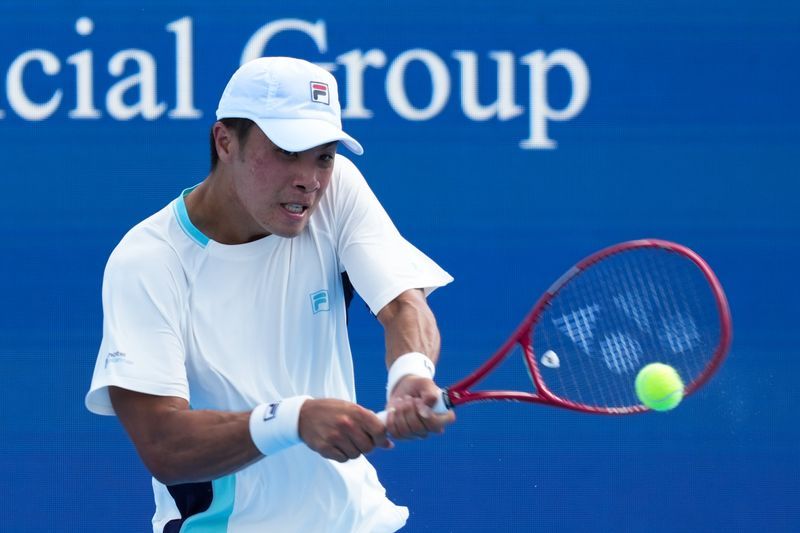
Brandon Nakashima's impressive North American hard-court campaign reached another milestone on Friday when the 25-year-old American produced a thrilling comeback to overcome sixth-seeded compatriot Taylor Fritz in a Cincinnati Open quarter-final. Playing at the Masters 1000 event in Ohio, Nakashima secured a 7-6(9) 4-6 6-3 victory despite facing a break down in the decisive third set, demonstrating the mental resilience and tactical adaptability that has defined his recent run of success.
The tournament appearance marks Nakashima's second consecutive week competing in the latter stages of an elite Masters 1000 event. Having recently reached the semi-finals in Montreal, his progression to the Cincinnati last four underscores a sustained elevation in his competitive level at the sport's highest tier. For Malaysian and Southeast Asian tennis followers tracking the North American swing, Nakashima's performances this August offer a compelling narrative of a player transforming from promising prospect into genuine title contender, arriving at a crucial juncture in the professional calendar with momentum firmly in his corner.
The opening set encapsulated the high quality of tennis on display, as both competitors demonstrated the serving prowess characteristic of modern American hard-court specialists. With Nakashima and Fritz trading holds throughout, the first set extended to a tiebreak where marginal opportunities determined the outcome. After a prolonged exchange featuring multiple mini-breaks and lead changes, Nakashima finally secured the set at 7-6 when Fritz's concentration lapsed momentarily, sending a ball beyond the baseline on Nakashima's fifth set point.
Fritz responded decisively to avoid an early deficit, utilizing an aggressive returning strategy to break Nakashima's serve at the outset of the second set. The 27-year-old sixth seed's tactical adjustment proved effective as he consolidated the break and closed out the set cleanly with an ace, forcing the encounter into a deciding frame where the psychological dynamics would shift repeatedly over the subsequent games.
The final set became a battle of momentum swings and error management. Fritz initially seized the initiative by capitalizing on unforced errors from his younger opponent to establish a 3-2 lead, positioning himself to potentially force a comeback from a set down. However, the pivotal moment arrived when Nakashima recovered from 30-0 deficit to convert his second break point of the match, leveling the score at 3-3 and fundamentally altering the trajectory of the encounter.
From that crucial juncture forward, Nakashima demonstrated superior composure and consistency, winning the final three games as Fritz's unforced error count mounted and his confidence visibly eroded. The American's ability to maintain aggressive intent while avoiding reckless shot selection separated the two players during this critical phase, and he served out a convincing conclusion that extended what has become the most productive stretch of his career.
Nakashima entered this quarter-final carrying a relatively modest 1-4 head-to-head record against Fritz, suggesting this victory represents a significant statement of intent against a player previously occupying his ranking vicinity. The win improved his season record against top-10 opponents to four victories, a statistic that gains resonance when considering the competitive environment required to accumulate such results at the Masters 1000 level. For regional observers, these performances by Nakashima offer evidence that American tennis depth extends beyond the established elite, with younger generation players capable of competing effectively in tournaments where Asian competitors increasingly seek breakthrough moments.
The semi-final assignment for Nakashima presents another formidable challenge, with the American facing either 10th-seeded Italian Lorenzo Musetti or fellow American Frances Tiafoe. Both opponents represent quality competition that would further test Nakashima's current form heading into the U.S. Open, the season's final Grand Slam event beginning later this month. Regardless of the specific opponent, the semi-final opportunity itself validates the strategic importance of the North American hard-court swing for American players and highlights how performances in these competitions can reshape ranking trajectories and seeding positions for major tournaments.
Cincinnati's significance within the professional tennis calendar extends beyond ranking points and prize money. The tournament serves as a crucial preparation window for the U.S. Open, allowing players to build momentum, identify tactical adjustments, and build confidence on the same surface hosting the year's final Grand Slam. Nakashima's back-to-back Masters semi-finals over consecutive weeks demonstrate a consistency rarely achieved by players at his ranking level, suggesting he enters the New York fortnight with elevated expectations and genuine prospects of a deep run.
The broader narrative surrounding American tennis competitiveness receives reinforcement from performances like Nakashima's Cincinnati quarter-final victory. While conversation often centers on established players or Grand Slam champions, the depth of American talent competing effectively at Masters 1000 events ensures sustained excellence in men's tennis. For Southeast Asian audiences, the emergence of accomplished American mid-ranking competitors illustrates the global nature of modern professional tennis, where breakthrough performances can arrive from multiple geographic regions and age cohorts simultaneously.

