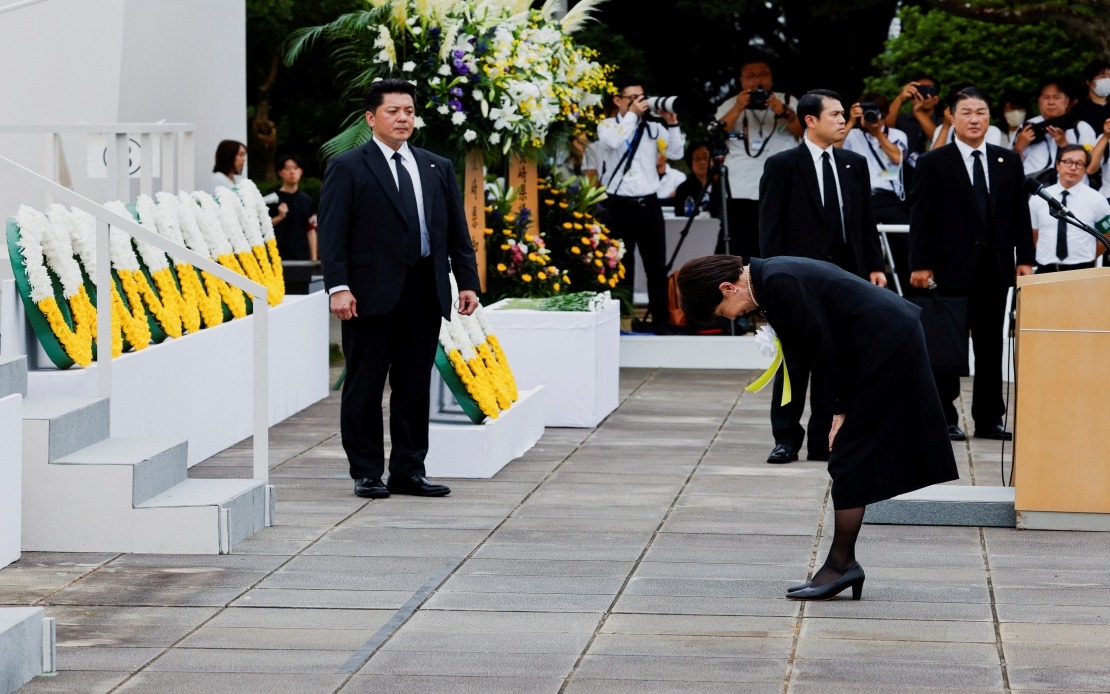
The southwestern Japanese city of Nagasaki observed the 81st anniversary of the devastating atomic bombing that concluded World War II on August 9, with the solemn commemoration coinciding with escalating international dialogue about nuclear weapons and their role in modern geopolitical tensions. The ceremony brought together survivors, government officials, and dignitaries to reflect on a tragedy that fundamentally shaped Japan's postwar identity and continues to inform debates about nuclear deterrence across the Asia-Pacific region and beyond.
Mayor Shiro Suzuki addressed the assembled crowd at the memorial service, delivering a powerful message calling upon world leaders to prioritize nuclear disarmament and reject the notion that humanity can sustainably coexist with nuclear weapons. His remarks encapsulated the enduring conviction among Nagasaki's residents and Japan's broader peace movement that the lessons of August 9, 1945, remain profoundly relevant to contemporary security challenges. The mayor's intervention reflects growing anxiety in Japan about shifting attitudes toward nuclear weapons among major powers, particularly given regional tensions involving China, Russia, and North Korea.
The precise moment of commemoration arrived at 11.02 a.m., when observers observed a moment of silence to mark the instant the "Fat Man" plutonium device was released from a US bomber and detonated above Nagasaki. The explosive force devastated the city in seconds, leaving approximately 74,000 people dead by the close of 1945 and inflicting immeasurable suffering on countless survivors whose health complications persisted throughout their lifetimes. Nagasaki remains the sole location on Earth to have endured a nuclear attack, a distinction that anchors its moral authority in global disarmament conversations.
Prime Minister Sanae Takaichi attended the ceremony to deliver official government remarks, while the United Nations Secretary-General Antonio Guterres transmitted a statement to be read during the proceedings. These high-level participations underscored the international dimensions of the commemoration and acknowledged that Nagasaki's historical experience carries universal significance. For Malaysia and other Southeast Asian nations, the event serves as a sobering reminder of the catastrophic human costs associated with nuclear conflict, a concern that resonates particularly given China's expanding military capabilities and ongoing regional territorial disputes.
The Nagasaki anniversary arrives at a particularly fraught moment for global nonproliferation efforts. The May review conference of the Nuclear Non-Proliferation Treaty, convened in New York after a month of intensive negotiations, concluded without achieving consensus for the third consecutive cycle. This failure represents a troubling breakdown in international cooperation on controlling the spread of nuclear weapons and establishing frameworks for reducing existing arsenals. The stalled negotiation reflects deep divisions between nuclear-armed states, developing nations seeking energy security, and non-aligned countries demanding more aggressive disarmament commitments.
Japan itself finds itself at a philosophical crossroads regarding its longstanding three non-nuclear principles, which prohibit the production, possession, or introduction of nuclear weapons onto Japanese territory. Following the Hiroshima ceremony on August 6, Prime Minister Takaichi reaffirmed the government's commitment to these principles, yet the very fact that reassurance became necessary highlights perceptible shifts within Japanese security discussions. Rising voices in Japan's defense establishment have begun questioning whether the nation should reconsider its nuclear abstinence given threats from North Korea and China, a debate that would have seemed unthinkable in earlier decades but reflects hardening geopolitical realities.
For observers across Southeast Asia, including Malaysia, Japan's internal reconsideration of its nuclear posture carries significant implications. A Japanese pivot toward nuclear weapons development or deployment could destabilize regional security calculations and potentially trigger cascading shifts in the arsenals and strategic doctrines of neighboring powers. Malaysia and ASEAN have consistently advocated for maintaining Southeast Asia as a nuclear-weapon-free zone, and any Japanese repositioning would complicate those efforts and invite pressure from other regional actors to reassess their own nuclear aspirations.
The emotional and moral dimension of these commemorations remains inseparable from their political significance. Atomic bomb survivors, known as hibakusha, and their advocates have undertaken the urgent work of preserving and transmitting testimony about the bombings to younger generations who lack direct experience of nuclear devastation. The average age of officially recognized survivors now exceeds 86 years, creating an accelerating window for historical documentation before firsthand witnesses pass away. These personal narratives provide irreplaceable evidence of nuclear weapons' incomprehensible human toll, grounding abstract policy debates in concrete suffering.
The August 15, 1945 Japanese surrender, which followed the Nagasaki bombing by six days, terminated World War II but opened an era defined by nuclear anxiety that persists to the present moment. The weapons that brought the war to its conclusion have since proliferated across the globe, multiplying the potential for catastrophic conflict in ways that the original atomic bomb survivors could scarcely have imagined. Regional actors including India, Pakistan, and potentially others possess or are suspected of possessing nuclear capabilities, expanding the geographic scope of existential risk.
As nuclear tensions resurface in contemporary international relations, with Russia employing nuclear rhetoric in Ukraine and China expanding its arsenal at an accelerating pace, the moral witness offered by Nagasaki and Hiroshima acquires renewed urgency. The ceremonies conducted each August serve as annual reminders that nuclear weapons represent not an abstract strategic commodity but instruments capable of erasing entire cities and generations. For Malaysia and the broader Southeast Asian community, supporting Japan's commemoration and its advocacy for disarmament reinforces regional commitment to preventing nuclear proliferation and protecting civilian populations from weapons of mass destruction.

