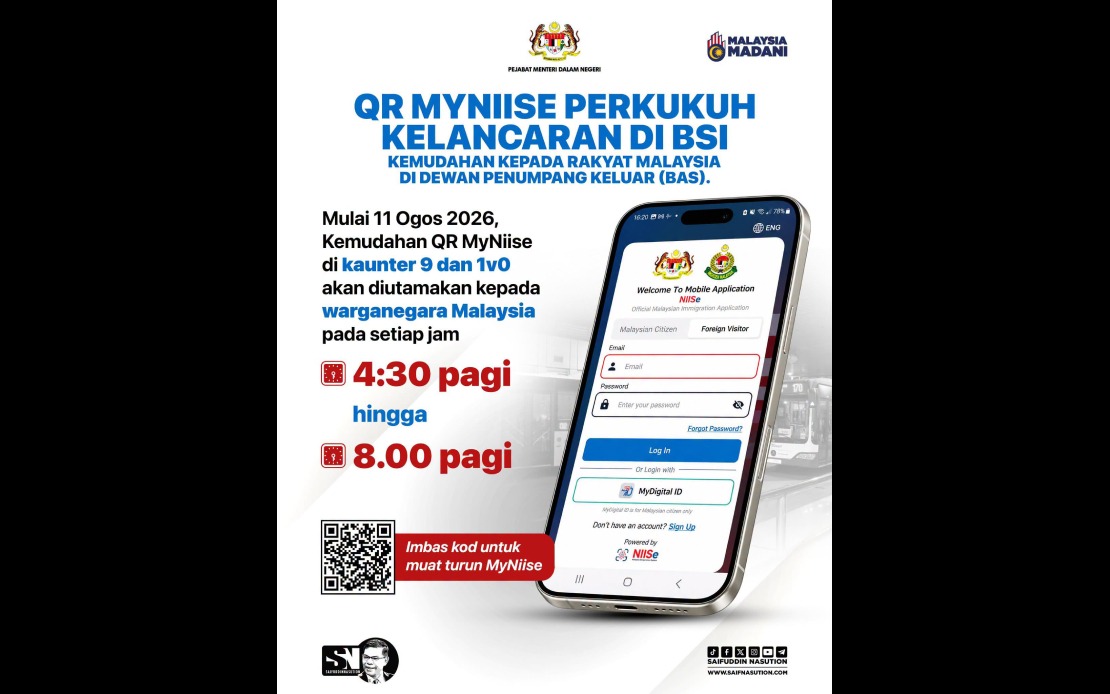
Malaysia has introduced a streamlined immigration process for digitally-savvy travellers crossing into Singapore, with Home Minister Datuk Seri Saifuddin Nasution Ismail announcing that users of the National Integrated Immigration System QR code will bypass standard queues at Bangunan Sultan Iskandar. The initiative, which took effect on August 11, addresses long-standing friction points for the estimated tens of thousands of Malaysians who commute daily across the Johor Strait for work or business.
The priority immigration facility operates from dedicated counters during the morning rush period, when the crossing experiences its heaviest passenger volumes. From 4.30 am to 8 am, commuters equipped with the MyNIISe digital credential can use counters 9 and 10 in the Bus Departure Hall, significantly reducing their processing time compared to traditional manual document checks. This targeted scheduling reflects traffic pattern data showing that early-morning hours present the most acute bottleneck, particularly affecting shift workers and office-bound commuters dependent on scheduled bus services.
The challenge addressed by this initiative reflects the reality faced by hundreds of thousands of cross-border workers. Many Malaysians depart before sunrise to reach employment in Singapore's financial, healthcare, and service sectors, where labour demand has historically relied on Malaysian talent. The compression of so many travellers into a narrow timeframe—roughly three hours—had created predictable queues that threatened to derail carefully coordinated commutes. Even minor delays at immigration multiply across large volumes, potentially causing individuals to miss departure buses and consequently arrive late at workplaces.
MyNIISe represents a broader government modernisation push intended to digitise public services and reduce friction in routine administrative interactions. The system enables registered users to pre-submit biometric and travel documentation through mobile applications, allowing immigration officers to conduct faster verification procedures. Rather than manually processing forms and documents, officers can access already-verified information instantaneously, fundamentally accelerating clearance times. This technological shift mirrors similar digital immigration initiatives adopted across Southeast Asia, including Singapore's own e-gate systems and Thailand's digital immigration channels.
Accessibility to the MyNIISe platform is deliberately broad, with the system available across multiple app marketplaces serving different device ecosystems. Users can download the application from the Apple App Store, Google Play Store, and Huawei App Gallery, reflecting an awareness that Malaysia's commuting population uses diverse smartphone platforms. The multi-platform approach removes a common barrier to technology adoption—incompatibility with less common operating systems—ensuring that cost-conscious commuters using older or alternative devices can still benefit from the system.
For Malaysia's cross-border workforce, this initiative carries significance extending beyond mere convenience. Reliable, predictable commute times directly impact job security and earning potential, particularly for contract workers or those in positions where tardiness triggers disciplinary measures. The priority lane effectively subsidises these commuters' time, allowing them to arrive at workplaces consistently and build reputation for reliability. Over months and years, such efficiencies compound, potentially influencing career progression and lifetime earnings among this economically vital population segment.
The political dimension warrants attention as well. Saifuddin Nasution's public announcement of this benefit deliberately highlights government responsiveness to a large, visible constituency—cross-border workers—whose frustrations were previously channelled through social media complaints and informal networks. By delivering a tangible, measurable improvement, the Home Ministry demonstrates capacity to translate citizen feedback into concrete service enhancements. This contrasts with previous eras when border management remained largely opaque and resistant to public input.
From a regional perspective, the MyNIISe initiative reflects broader patterns of digital infrastructure development across ASEAN economies. As Malaysia competes for reputation as a regionally competitive economy, reducing transaction costs and bureaucratic friction signals economic modernity to both residents and foreign investors. Singapore's own continued development of digital border infrastructure creates competitive pressure on Malaysian counterparts to maintain parity, ensuring that Malaysian travellers are not disadvantaged by slower processing on the Malaysian side of crossings.
The implementation at Bangunan Sultan Iskandar specifically targets Malaysia's busiest land border checkpoint. The Bus Departure Hall handles not only individual commuters but also regular chartered bus services connecting Malaysian towns with Singapore employment centres, educational institutions, and medical facilities. The concentration of priority facilities at this single checkpoint recognises that bus travellers operate under different constraints than private vehicle drivers, who can pass through other land borders with potentially greater flexibility.
Operational sustainability will determine whether this initiative delivers promised benefits consistently. The success of priority lanes depends on maintaining staffing levels, ensuring technology infrastructure remains reliable, and managing the psychological impact on non-MyNIISe users experiencing longer waits. Immigration authorities will likely monitor whether the priority system inadvertently creates congestion elsewhere, or whether overall border throughput genuinely improves through faster QR processing. These operational questions will influence whether the model expands to other crossing points or peak periods.
For Malaysian policymakers, this initiative represents incremental progress toward reducing cross-border transaction costs that have historically affected labour market dynamics. As Singapore's economy continues requiring significant Malaysian labour input, and as Malaysia's own service sectors increasingly employ cross-border workers, efficient movement of people becomes a foundational economic infrastructure concern. Digital immigration systems address this by treating border crossing as a logistical optimisation problem rather than merely a security checkpoint.
Looking forward, the success of MyNIISe at Bangunan Sultan Iskandar may influence expansion plans to other Malaysian borders and airports. If the system effectively reduces congestion while maintaining security standards, authorities may extend priority processing to Malaysia-Thailand checkpoints, particularly those serving commuter populations. Such geographic expansion would align Malaysia with regional best practices and reinforce its positioning within ASEAN's infrastructure modernisation agenda.

