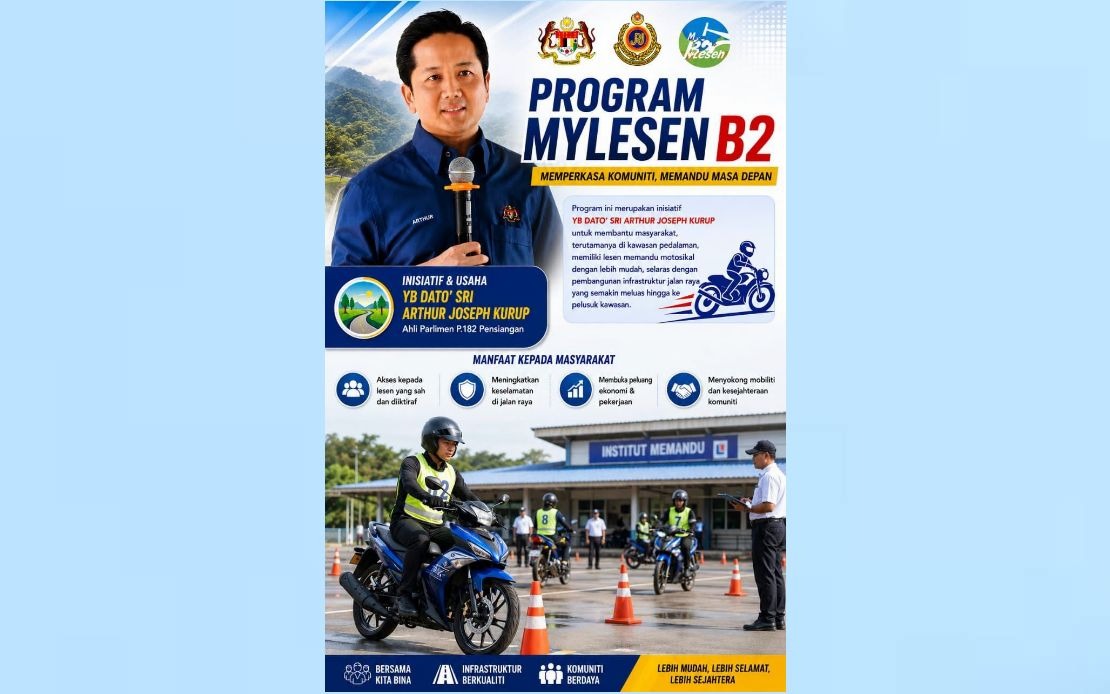
The MyLesen B2 programme has made its return to Pensiangan in Sabah, bringing motorcycle licensing services directly to remote communities and reducing the burden rural dwellers face in obtaining valid credentials. The initiative represents a targeted effort to democratise access to legal riding documentation across Malaysia's interior regions, where geographical distance traditionally forced residents to undertake expensive and time-consuming journeys to urban licensing centres.
Pensiangan Member of Parliament Datuk Seri Arthur Joseph Kurup, who also serves as Natural Resources and Environmental Sustainability Minister, framed the programme as a critical intervention for rural youth and adult residents seeking motorcycle licences without navigating the logistical challenges of travelling to distant towns or cities. His announcement underscores recognition within government circles that licensing infrastructure disparities between urban and rural Malaysia create genuine hardship for communities seeking legal compliance with transportation regulations.
The programme maintains rigorous quality standards despite its accessibility focus. Prospective licence holders must complete mandatory coursework and successfully pass prescribed examinations to qualify for their credentials, ensuring that the convenience of local processing does not compromise road safety standards or regulatory integrity. This balanced approach acknowledges that bringing services closer to communities need not mean reducing standards, a principle increasingly important as Malaysia addresses persistent road safety challenges across all regions.
Educational components form a cornerstone of the MyLesen B2 initiative, extending beyond simple licence issuance to build participant understanding of road traffic legislation and safety practices. This knowledge-building dimension targets the cultural and behavioural factors that contribute to road accidents, particularly in communities where formal traffic safety education may be limited. By coupling licensing access with comprehensive awareness-raising, the programme addresses both the documentation gap and the knowledge deficit simultaneously.
The employment and economic dimensions of motorcycle licence possession carry particular significance in rural Malaysian contexts. Legal riding credentials unlock opportunities for transport-related work, delivery services, and other income-generating activities that depend on valid documentation. For young adults in regions with limited formal employment sectors, obtaining a legitimate licence can represent a meaningful pathway toward economic participation and self-sufficiency, transforming a bureaucratic credential into genuine livelihood opportunity.
Eligibility spans a broad demographic range, with participation open to residents aged sixteen through sixty-three, with particular emphasis on first-time licence applicants who have never previously held driving credentials. This inclusive age range recognises that licensing needs extend across generational cohorts, from young riders beginning their vehicular lives to mature residents who may now be seeking formal recognition of their riding abilities for employment or personal advancement reasons.
The permanence of motorcycle licence validity, subject to regulatory compliance, represents a significant long-term benefit for recipients. Unlike temporary or provisional credentials, successful licence acquisition through MyLesen B2 provides enduring documentation that remains recognised throughout participants' lives, enabling sustained legal mobility and employment access without requiring future renewal cycles or re-qualification processes. This stability offers genuine security for residents in areas where accessing renewal services might prove challenging.
Practical accessibility mechanisms further enhance programme effectiveness. Registration materials are available through both the Pensiangan Parliamentary Service Centre and the Sook State Assemblyman's Service Centre, positioning application processes within existing community administrative infrastructure rather than requiring residents to visit unfamiliar or distant government offices. This decentralisation of registration recognises that administrative accessibility extends beyond physical location to encompass integration with familiar local institutions.
For Malaysian policymakers monitoring rural development outcomes, the MyLesen B2 expansion demonstrates how targeted service delivery can address specific equity gaps without requiring massive infrastructure investment. The programme exemplifies problem-solving that recognises genuine community challenges—in this case, the genuine hardship rural residents face accessing urban services—and deploys existing systems creatively to bridge divides. Similar models might address other services where geographical disparity creates unequal access.
The initiative's emphasis on road safety promotion aligns with broader Malaysian transportation policy objectives. Rural road accident rates remain a persistent public health challenge, with factors including inadequate driver education and informal licensing practices contributing to elevated casualty figures in some regions. By expanding access to formal, standardised licensing that includes comprehensive safety education, the MyLesen B2 programme targets underlying causes rather than merely processing applications.
Pensiangan's particular context reflects Sabah's geographical complexity, where interior constituencies encompass dispersed settlements and limited road infrastructure. Residents in such areas face genuine constraints in accessing urban services that urbanised Malaysians often take for granted. The MyLesen B2 return to Pensiangan thus carries implications extending beyond simple licence provision, symbolising government commitment to addressing rural service delivery disparities across East Malaysia's challenging terrain.
The broader resonance of this initiative extends across Southeast Asia, where comparable rural-urban service gaps characterise transportation licensing systems across the region. Malaysia's demonstrated willingness to innovate in bringing regulatory services to remote communities offers lessons for neighbouring countries confronting similar challenges. As regional transport integration deepens, standardised licensing credentials obtained through accessible, locally-delivered programmes strengthen both national safety outcomes and cross-border mobility frameworks.
Longer-term programme success will depend on sustained resourcing and consistent service delivery across multiple implementation cycles. Early outcomes from Pensiangan will likely inform whether similar MyLesen B2 expansions reach other underserved Malaysian constituencies, establishing precedent for how government balances regulatory standardisation with practical accessibility in regions where geography traditionally determined service availability.

