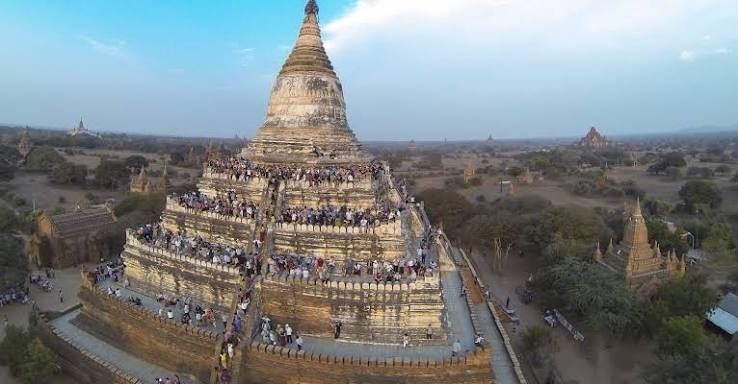
Myanmar's tourism sector is beginning a tentative revival as the country's military-led administration pins hopes on the industry becoming a visible marker of economic stabilisation following the 2021 coup. The government has set an ambitious target of attracting 1.8 million foreign visitors this year, nearly doubling the 973,263 arrivals recorded in 2025, according to official data. This push represents a significant wager that parts of Myanmar can be repositioned as welcoming destinations for both leisure and business travellers seeking to tap into opportunities in the Southeast Asian nation.
The tourism strategy centres on Myanmar's most iconic attractions: the ancient temple complexes of Bagan, the pilgrimage site of the Golden Rock Pagoda, the cultural hub of Mandalay, and the scenic Inle Lake region, alongside Yangon's colonial architecture. Maung Maung Kyaw, permanent secretary at the Ministry of Hotels, Tourism and Culture, emphasised that the government envisions Chinese and Thai tourists as the primary engine for growth, given geographic proximity and existing transport links. To facilitate this influx, authorities have expanded visa-on-arrival schemes for travellers from China, India, Japan, and South Korea, while maintaining visa-free entry for Russian citizens and most Southeast Asian nationals.
Progress so far has been modest. Through May, Myanmar had welcomed 448,205 international arrivals, representing only a five percent increase from the equivalent period a year earlier. To achieve the full-year target of 1.8 million, the country would require substantially accelerated arrivals during the second half—a significant challenge given that Myanmar welcomed 4.7 million visitors in 2015, before the political upheaval. The comparison to Thailand's performance remains stark; Thailand attracted approximately 33 million tourists in 2024 and is pursuing comparable numbers for 2025, highlighting how far Myanmar's tourism infrastructure and international confidence must travel.
Nevertheless, early indicators suggest emerging momentum in specific markets. Chinese visitors remain the largest source of international arrivals by air, with numbers rising twelve percent during the first five months of the year. Thai arrivals increased by seven percent in the same period, while South Korean visitors also feature prominently. These figures underscore the importance of Myanmar's geographic position within the greater Mekong region and the potential for near-term tourism expansion if regional tensions remain manageable and travel infrastructure improves.
The data provided by authorities does not account for individuals illegally trafficked into scam compounds—an issue that has become increasingly visible across Southeast Asia and triggered coordinated regional crackdowns resulting in the repatriation of thousands of Chinese nationals. This shadow tourism market poses reputational risks to Myanmar's attempt to rebuild its image as a safe and legitimate travel destination, even as official channels attempt to project normalcy and controlled growth.
President Min Aung Hlaing's administration has attempted to support tourism revival through broader diplomatic efforts aimed at regional rehabilitation. Since his inauguration in April, the government has conducted state visits to China and India whilst working to normalise relations with Southeast Asian neighbours. Thailand, historically one of Myanmar's closest economic partners, has begun cautiously re-engaging, with Thai Foreign Minister Sihasak Phuangketkeow visiting Yangon in April. More tellingly, prominent Thai travel influencers including Farose and Bas from Go Went Go have recently produced content filmed in Yangon, reintroducing Myanmar to regional digital audiences after years of virtual absence from travel content platforms.
Hotel operators in Myanmar's major cities report measurable signs of recovery. Luxury hotel occupancy in Yangon has risen approximately ten percent since the election, according to Chatrium Hotel Royal Lake's General Manager May Myat Mon Win, who advises the Myanmar Tourism Federation. The guest composition, however, differs markedly from pre-2021 patterns: today's visitors comprise primarily business travellers assessing investment opportunities, organised religious pilgrimage groups, and exploratory visitors interested in potential commercial ventures. May Myat Mon Win indicated that Myanmar can expect a resurgence of Japanese visitors, though she anticipates this will be driven predominantly by business and investment considerations rather than traditional leisure tourism.
Despite warming sentiment among regional neighbours and tourism operators, Western governments maintain a cautious stance. The United States State Department continues to advise against travel to Myanmar, citing ongoing armed conflict and civil unrest. Paradoxically, official figures show American arrivals increased seventeen percent through May, suggesting that global media narratives and official warnings do not uniformly deter independent travellers. Liam Martinez, a 34-year-old from Texas, exemplifies this trend; he travelled to Yangon despite negative international headlines, crediting YouTube travel videos with influencing his decision to visit.
The paradox of Myanmar's tourism recovery lies in its simultaneous openness and fragility. The country is attempting to market itself as stable whilst significant portions remain affected by armed conflict. Thet Lwin Toh, managing director of Myanmar Voyages International Tourism Co., noted that enquiries from Europe, the United States, and India have increased despite Myanmar's severely constrained international flight capacity. This suggests latent global interest in Myanmar's cultural and historical offerings, provided the security situation can be credibly stabilised and presented as manageable to international audiences.
The government's emphasis on promoting Buddhist pilgrimage sites and ancient temples reflects a deliberate strategy to position Myanmar within Asia's broader spiritual tourism market. The Golden Rock Pagoda, Bagan's temple complexes, and various monastic sites hold genuine cultural and religious significance for millions throughout the region and beyond. By channelling tourism activity toward these religiously meaningful destinations, Myanmar's authorities hope to attract visitors with a less volatile spending profile—pilgrimage tourists typically follow established routes, spend predictably, and generate positive cultural narratives.
For Malaysia and other Southeast Asian nations, Myanmar's tourism recovery carries meaningful implications. A successfully rehabilitated Myanmar tourism sector could fragment the regional travel market, drawing visitors and investment capital that might otherwise flow toward established destinations. Conversely, sustained conflict and security concerns could render Myanmar marginal to Southeast Asian tourism networks for years to come. Malaysian tourism operators and hospitality firms should monitor Myanmar's trajectory closely, as regional patterns of tourist flows remain sensitive to perceptions of stability and safety. The next six months will prove crucial in determining whether Myanmar's 2025 tourism targets prove realistic or merely optimistic rhetoric masking deeper structural obstacles to recovery.

