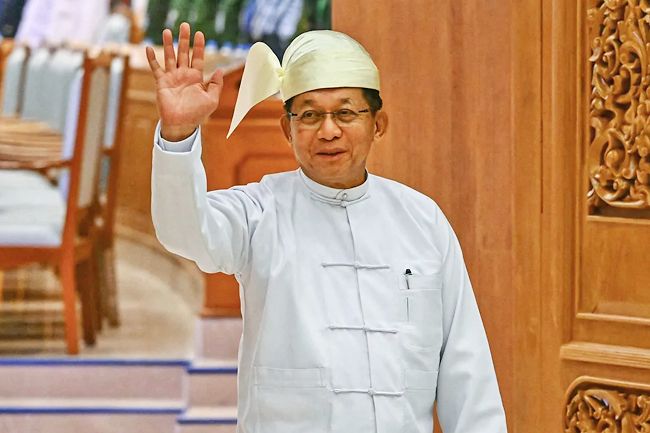
Myanmar's military leader Min Aung Hlaing is set to travel to Bangkok next month for high-level talks with Thai Prime Minister Anutin Charnvirakul on August 6 and 7, according to Thailand's foreign minister Sihasak Phuangketkeow. The announcement comes as Thailand intensifies its diplomatic push to bring the military-dominated state back into ASEAN's fold following the controversy surrounding the country's geopolitical standing since the 2021 coup.
Sihasak made the announcement after participating in what he described as a forthright dialogue with fellow Southeast Asian foreign ministers in Manila regarding the most effective pathway to restore Myanmar's full participation in regional affairs. The discussion underscores the complexity surrounding Myanmar's position within ASEAN, an organization that has struggled to present a unified stance on how to engage with the junta-controlled government that ousted the democratically elected administration of Aung San Suu Kyi three years ago.
Although Myanmar technically retains its ASEAN membership, the regional bloc has systematically excluded it from significant gatherings since the military takeover. This exclusion reflects deep-seated disagreements among member states about how to respond to the coup, with some nations advocating for stricter accountability measures while others, notably Thailand, favour a more pragmatic engagement strategy. The divide has prevented ASEAN from speaking with one voice on Myanmar, complicating efforts to exert collective diplomatic pressure.
Thailand's role as a regional mediator stems partly from its unique geography and humanitarian situation. The country shares an extensive border with Myanmar, which has descended into civil conflict as various armed ethnic groups and opposition forces continue to resist military rule. Additionally, Thailand hosts a substantial displaced population, with millions of Myanmar citizens having fled across the frontier to escape the violence and instability gripping their homeland. These factors have made Myanmar's stability directly relevant to Thai national interests.
Sihasak framed the upcoming visit within what Bangkok describes as a "dual-track approach" to Myanmar engagement. This strategy acknowledges that immediate diplomatic objectives differ from longer-term peace aspirations. On the practical level, Thailand seeks cooperation on pressing transnational challenges that affect both nations directly. Border security concerns, organised crime networks, human trafficking operations, and the flow of illicit narcotics through shared frontier regions demand urgent bilateral attention that transcends broader political considerations about Myanmar's democratic transition.
Yet Thailand's approach does not represent an abandonment of ASEAN's established five-point peace framework, which has served as the bloc's official roadmap for Myanmar's political resolution. Instead, Sihasak suggested that ASEAN must develop more realistic metrics for measuring progress toward the plan's objectives. The foreign minister posed concrete questions about what constitutes meaningful advancement—whether granting the ASEAN special envoy access to detained former leader Aung San Suu Kyi should be considered progress, or whether reducing violence along the Thai-Myanmar border would indicate movement in the right direction.
This recalibration of expectations reflects the challenges inherent in pursuing political transformation in Myanmar under current circumstances. Sihasak acknowledged that comprehensive reform cannot materialize instantaneously, emphasizing instead that achievable gains will accumulate gradually over time. This incremental approach signals Thailand's willingness to acknowledge the junta's consolidation of power while maintaining diplomatic channels that could eventually facilitate broader changes.
The military-conducted elections that formally installed Min Aung Hlaing as president represent another avenue through which Bangkok hopes to advance dialogue. Thai officials anticipate that even the restricted electoral process might create openings for renewed conversations with Myanmar's diverse armed ethnic organisations and underground democratic opposition movements. Thailand particularly sees potential in facilitating direct communication between the junta and ethnic groups positioned along the Thai-Myanmar border, viewing such dialogue as foundational steps toward eventual reconciliation and conflict de-escalation.
Regional observers note that Thailand's diplomatic activism reflects practical considerations beyond ideological commitments to democracy promotion. The refugee burden, security challenges, and economic disruption caused by Myanmar's instability create direct incentives for Thai engagement regardless of international pressure regarding human rights and democratic governance. This positions Bangkok in a nuanced middle position—demonstrating concern for Myanmar's political direction while prioritising bilateral relationship management.
Parallel to Thailand's efforts, the Philippines has suggested that ASEAN consider appointing a permanent, long-term envoy dedicated exclusively to Myanmar affairs. Philippine Foreign Minister Theresa Lazaro acknowledged that the current system of rotating the special envoy position annually has proven inadequate for addressing the country's complex challenges. A dedicated envoy with continuity and institutional knowledge could potentially navigate the relationship more effectively and maintain consistent diplomatic pressure toward meaningful progress.
The Bangkok meeting represents a test of Thailand's capacity to broker agreements that satisfy multiple stakeholders. Success would require balancing the junta's political requirements, democratic opposition aspirations, ethnic armed group concerns, and ASEAN's collective credibility on regional security matters. The outcomes of Min Aung Hlaing's visit may establish whether Thailand's pragmatic engagement strategy can gradually reintegrate Myanmar into normal regional functions while maintaining pressure for political evolution.
For Malaysia and other ASEAN members, developments in Myanmar have direct implications for regional stability, refugee flows, and collective diplomatic coherence. Thailand's individual diplomatic initiatives, while potentially productive, also highlight ASEAN's ongoing struggle to maintain unified positions on critical security challenges. How the bloc responds to Thailand's bilateral approach versus collective mechanisms will shape Southeast Asian regional architecture for years to come.

