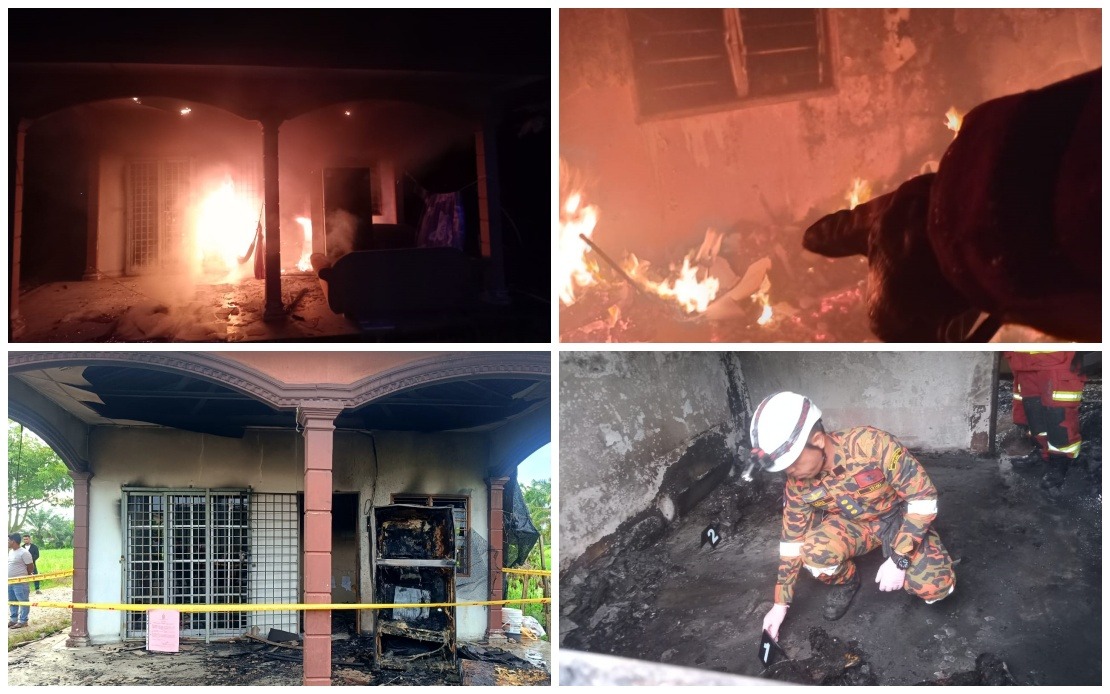
A devastating house fire in Bagan Serai, Perak, on Friday morning claimed the lives of three members of a Myanmar refugee family, leaving the household's sole survivor with serious burn injuries. The tragedy unfolded in the early hours when Mohd Yunus Nor Ali, 27, and his two young sons—Muhammad Woheed Mohd Yunus, 6, and Mohamad Aheed Mohd Yunus, 3—became trapped as flames consumed their rented residence in Taman Serai Maju. Their mother, Saniya Jahan Juma Abul Kasim, 24, who also holds refugee status from Myanmar, escaped the initial blaze but sustained significant burn injuries to her hands and feet.
Firefighters responding to an emergency call at 5:17 am arrived at the single-storey dwelling within thirteen minutes to discover a Class A structure measuring twenty by forty feet already engulfed in flames. The house, which sheltered seven foreign nationals, was consuming approximately seventy percent of its structural integrity by the time the Perak Fire and Rescue Department team took action. According to Datuk Sayani Saidon, the department's director, Saniya was discovered outside the property, frantic and suffering from burns while describing her husband and children trapped within the burning structure.
Rescue operations commenced immediately using standard protocols, with firefighters systematically searching through the intense heat and smoke. Their efforts located all three casualties in the first room where the fire had originated, though tragically, all three individuals had already succumbed to the flames and smoke inhalation by the time they were recovered. Medical personnel from the Ministry of Health who attended the scene confirmed the deaths on arrival, while paramedics from the Emergency Medical Rescue Services provided initial treatment to Saniya before transporting her to hospital for specialized burn care.
The incident highlights the precarious living conditions facing Myanmar refugee populations in Malaysia, who often occupy crowded residential spaces with limited safety infrastructure. These communities, driven by ongoing conflict and persecution in their homeland, frequently inhabit older housing stock in working-class neighbourhoods where fire codes and safety standards may be inadequately enforced. The concentration of multiple families within single dwellings increases vulnerability to catastrophic events, as demonstrated by this morning's tragedy where seven individuals occupied one modest structure.
Investigators from the Perak Fire and Rescue Department's forensic team began examining the scene as firefighters brought the blaze under control at 6:20 am. Preliminary findings indicate the fire originated in the first room where the victims were discovered, though the precise ignition source remains undetermined as of Friday afternoon. The investigation will consider factors including electrical faults, cooking accidents, or improper use of heating or lighting devices—common causes in residential fires within informal settlements.
The death toll represents a sobering reminder of Malaysia's humanitarian challenges in accommodating the estimated 180,000 Myanmar refugees currently resident across the country. While Malaysia is not a signatory to the 1951 Refugee Convention, it hosts the second-largest refugee population in Asia after Turkey, creating a complex dynamic where refugee communities lack formal legal status and often occupy marginalised housing. This precarious position frequently results in substandard living arrangements where safety concerns are secondary to affordability and availability.
Royal Malaysia Police have assumed custody of the deceased victims as formal investigations proceed into both the fire's cause and circumstances surrounding the family's residence in the country. Officers will coordinate with the Fire and Rescue Department to compile comprehensive findings, though the loss of life will inevitably complicate legal and administrative proceedings. The police will also explore whether proper documentation existed for the household and whether any safety violations contributed to the fatality rate.
For the surviving mother, the physical and psychological toll of this catastrophe will be profound and enduring. Burns affecting both hands and feet will require extended hospital treatment and rehabilitation, potentially impacting her capacity to work and provide for herself during recovery. The psychological trauma of losing a spouse and two young children in such violent circumstances will require counselling support, yet access to mental health services for unregistered refugees remains extremely limited in Malaysia's healthcare system.
This tragedy underscores systemic vulnerabilities within Malaysia's approach to refugee management and integration. While the government provides minimal formal support through humanitarian mechanisms, refugee communities frequently exist in legal limbo, unable to access employment protections, housing standards enforcement, or insurance coverage that might mitigate such disasters. International advocacy groups have repeatedly highlighted these gaps, advocating for improved living conditions and safety standards even as political sensitivities around refugee populations remain acute in Malaysian public discourse.
The incident will likely prompt renewed discussion about fire safety in densely occupied residential spaces and whether targeted interventions could prevent similar tragedies. Community-based fire prevention initiatives and partnerships with refugee support organisations might enhance awareness of basic safety measures, though systemic improvements would require significant policy and resource commitments. As investigations continue, this family's loss serves as a stark illustration of the precarious circumstances facing Myanmar's displaced populations seeking refuge in Malaysia.

