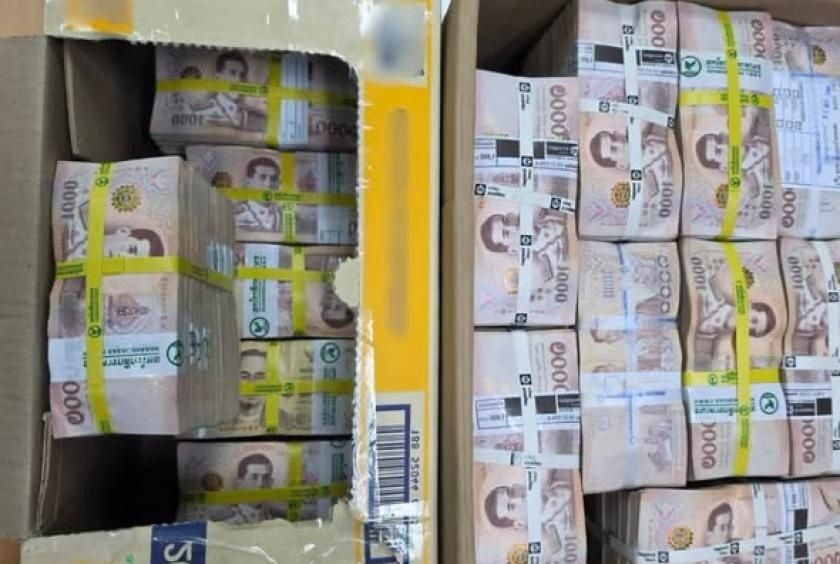
Currency smuggling remains a persistent challenge along Thailand's porous borders with Myanmar, as illustrated by the recent seizure of more than 23 million baht by customs officials at the Mae Sai frontier. The arrest of a 31-year-old Myanmar driver underscores the resourcefulness of networks attempting to move large sums across the Thailand-Myanmar Friendship Bridge, one of the region's busiest trade corridors, and raises questions about the sophistication of smuggling operations in mainland Southeast Asia.
The interception occurred at the Mae Sai customs checkpoint, where Thai officials conducting routine inspections of a Myanmar-registered vehicle discovered an ingenious hiding method. Investigators found approximately 17 million baht concealed within the first carton and a further 6.023 million baht in a second container, both cleverly disguised among legitimate agricultural cargo. The cash had been methodically packaged in plastic bags and layered within boxes ostensibly containing dried fish and potatoes, commodities that commonly cross the border and might ordinarily escape intensive scrutiny.
The Mae Sai border crossing, which straddles one of the world's most economically and geographically complex frontiers, processes thousands of vehicles daily. The Friendship Bridge facilitates trade between Thailand and Myanmar worth billions of baht annually, making it simultaneously a vital economic artery and an attractive conduit for illicit financial flows. Customs officials working at such checkpoints face an enormous challenge in balancing the need for security with maintaining the fluidity essential to legitimate commerce.
The suspected offence carries serious legal consequences under Thai law. Authorities indicated that the alleged attempt to smuggle currency violates both the Customs Act and Thailand's foreign exchange control regulations, statutes designed to prevent capital flight, money laundering, and financing of illegal activities. These regulations exist partly to maintain monetary stability and partly to combat organised crime networks that depend on moving illicit proceeds across borders with minimal detection.
The 31-year-old driver's role in the operation remains unclear from available information, though investigators are exploring whether he operated as part of a larger network. The suspect is currently held at Mae Sai Police Station pending further investigation, with authorities indicating they intend to identify and pursue any associates involved in the smuggling scheme. Such operations typically require coordination among multiple parties—financial organisers, drivers, and potentially corrupt officials—suggesting the investigation may extend beyond the individual arrest.
The scale of the seizure, approaching 690,000 US dollars, indicates either a single major transaction or part of a systematic operation moving money across the border. Currency smuggling networks often target baht specifically because Thailand remains a regional economic hub with deep financial integration across Southeast Asia. Moving baht across borders can facilitate currency speculation, tax evasion, and concealment of proceeds from narcotics trafficking, human trafficking, and other transnational crimes that plague the Golden Triangle region.
Mae Sai itself occupies a unique position within Thailand's security apparatus. Situated in Chiang Rai Province in the country's far north, the town and its border crossing represent the junction of Thai, Myanmar, and Laotian territory. The region has historically struggled with insurgency, drug trafficking, and irregular migration, making border security both strategically important and operationally complex. Customs officials working these frontlines encounter smugglers employing increasingly creative concealment methods.
The incident reflects broader patterns in Southeast Asian organised crime. Criminal networks have proven adept at exploiting border infrastructure designed to facilitate legitimate trade. They study customs procedures, identify gaps in inspection protocols, and invest in increasingly sophisticated hiding methods. The use of food products as cover—dried fish and potatoes—suggests smugglers understand which commodity types receive cursory examination, information likely gleaned from prior experience or insider knowledge.
Thailand's foreign exchange regulations serve important macroeconomic functions beyond simple law enforcement. Capital controls help prevent destabilising outflows during periods of financial stress and reduce opportunities for those seeking to hide wealth from taxation or legal proceedings. The baht's stability depends partly on authorities maintaining some degree of control over cross-border currency movements, though enforcing such controls perfectly remains impossible given the scale and sophistication of modern smuggling operations.
For Malaysian readers, the Mae Sai seizure carries regional implications. Malaysia's own border with Thailand requires similar vigilance, and currency smuggling networks operating in the region likely extend into Malaysian territory. The methods employed—concealment in agricultural products, use of private vehicles, targeting of busy border crossings—are not unique to the Thai-Myanmar frontier. Authorities across Southeast Asia face comparable challenges as criminal organisations exploit the region's economic integration and geographical complexity.
The investigation's outcome remains pending, but the case demonstrates that even large-scale currency smuggling attempts can be disrupted through attentive customs work. However, law enforcement agencies acknowledge that for every major seizure, many smaller shipments likely pass undetected. The cat-and-mouse game between authorities and smugglers continues unabated, with each side constantly adapting methods and countermeasures in this enduring struggle along mainland Southeast Asia's vital trade routes.

