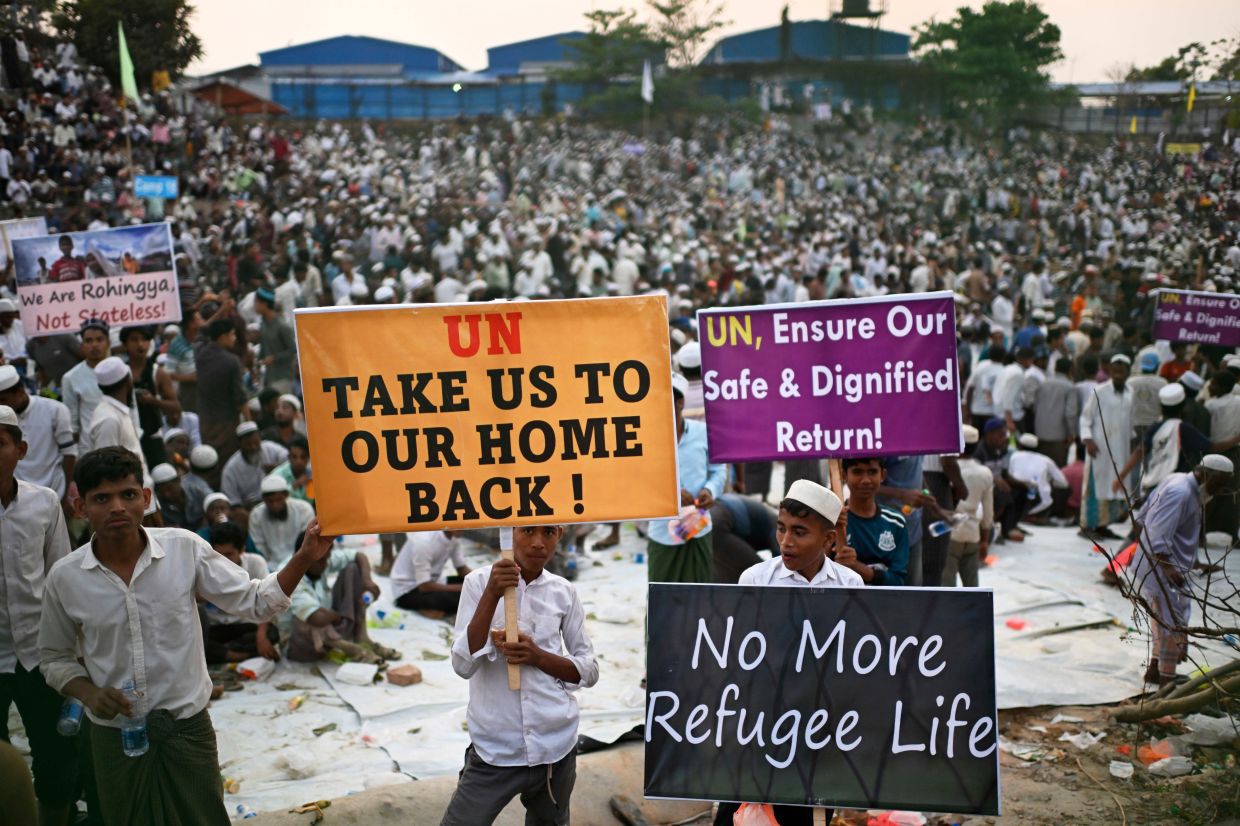
Myanmar's military-backed administration has declared that it has identified and verified over 300,000 Rohingya refugees currently housed in sprawling camps across Bangladesh as legitimate former residents of Rakhine state, signalling a conditional openness to their eventual return. The announcement, made through the Ministry of Foreign Affairs on Saturday, arrives as one of the world's largest refugee crises enters its ninth consecutive year, with the Rohingya population in Bangladesh camps numbering in the hundreds of thousands and showing no sign of imminent repatriation.
The roots of this humanitarian catastrophe trace to August 2017, when Myanmar's military initiated a sweeping military operation in Rakhine state in response to insurgent attacks on border guard posts. The campaign displaced more than 700,000 Rohingya in a matter of months, forcing them across the border into Bangladesh where they joined pre-existing communities of refugees who had fled earlier episodes of violence over previous decades. International observers, including the United Nations and numerous human rights organisations, characterised the operation as bearing hallmarks of ethnic cleansing and genocide, though Myanmar has consistently rejected such accusations.
Central to the international dispute is Myanmar's refusal to recognise the Rohingya as an ethnic minority within its borders. The junta instead categorises them as "Bengalis," a designation intended to suggest they are originally from Bangladesh and therefore have no legitimate claim to reside in Myanmar. This linguistic manoeuvre serves as the cornerstone of Myanmar's argument that the Rohingya are essentially foreign nationals illegally settled in the country, a position that shapes how the government approaches questions of citizenship and repatriation.
According to Myanmar's verification process, completed as of late July, the government examined 828,824 individuals on a list provided by Bangladesh authorities. Of these, the junta verified 426,545 people, determining that 308,797 qualified as former Rakhine residents eligible for return. The remaining figures present a more contentious picture: 113,507 refugees could not be verified through government records, while Myanmar alleged that 4,241 individuals had involvement in what it termed terrorist activities. This categorisation raises immediate concerns among refugee advocates, who question the reliability and political motivations behind such determinations.
The timeline for actual repatriation remains deeply uncertain despite official statements of intent. Myanmar and Bangladesh signed a repatriation agreement in 2018 envisioning a two-year process, yet nearly a decade later, virtually no refugees have returned. The situation deteriorated sharply following Myanmar's military coup in February 2021, which deposed the elected government of Aung San Suu Kyi and triggered widespread civil resistance. The ensuing internal instability made any large-scale refugee return logistically impossible and politically untenable.
Conditions have worsened further since 2023, when armed conflict intensified between the military and the Arakan Army, an ethnic militia based in Rakhine state seeking greater autonomy. This renewed fighting has resulted in the Arakan Army capturing substantial territory from government forces, effectively placing much of Rakhine beyond the junta's direct control. The instability has paradoxically driven additional displacement, with some refugees fleeing camps in Bangladesh to escape the widening regional conflict, choosing irregular maritime routes toward Malaysia and Indonesia over the prospect of returning to Myanmar.
For Malaysian policymakers and regional observers, the crisis carries immediate implications. Prime Minister Anwar Ibrahim announced in late July that Myanmar had committed to accepting 5,000 Rohingya refugees currently residing in Malaysia as part of a structured repatriation programme. However, this claim was quickly contradicted by Han Win Aung, a Myanmar Foreign Ministry official, who told international media outlets that any repatriation arrangement pertained exclusively to verified Myanmar nationals detained in Malaysian detention facilities, explicitly rejecting suggestions that the junta would accept Rohingya populations.
This contradiction encapsulates the fundamental barrier to resolution: Myanmar's steadfast refusal to acknowledge Rohingya as legitimate inhabitants of its territory undermines any framework for large-scale voluntary return. Even as the government presents verification figures as evidence of administrative progress, the underlying political position remains unchanged. Without recognition of Rohingya citizenship or permanent residency rights, numerical verification exercises serve primarily as public relations gestures rather than steps toward genuine repatriation.
The humanitarian toll of prolonged displacement has intensified as international funding for refugee camps diminishes. Donors have reduced contributions as compassion fatigue sets in and competing crises demand resources. These funding pressures have driven thousands of desperate Rohingya, particularly young men seeking economic opportunity, to attempt perilous sea journeys aboard overcrowded, unseaworthy vessels bound for Malaysia and Indonesia. Each year brings reports of capsized boats and lost lives, underscoring the tragic consequences of the impasse.
Regional states including Malaysia face mounting pressure from this irregular migration while remaining hesitant to antagonise Myanmar's government, a complex neighbour whose cooperation is valued across multiple policy domains. The diplomatic balancing act has produced inconsistent messaging, as illustrated by the contradictions between Anwar's July statement and Myanmar's subsequent clarification. This ambiguity leaves refugees, host communities, and policy planners uncertain about realistic prospects for organised return programmes.
For Myanmar itself, the calculus has shifted since 2017. The military's 2021 coup created divisions within the armed forces and society that persist today, with armed resistance movements controlling territory in multiple regions including Rakhine. Whether the junta can establish the "stable security conditions" it cites as prerequisite for accepting Rohingya return remains highly questionable. The Arakan Army's territorial gains suggest that military control over Rakhine may diminish further in coming years, potentially rendering government promises of repatriation capacity irrelevant.
The verification announcement therefore represents less a breakthrough than a continuation of Myanmar's long-standing pattern of appearing cooperative while maintaining fundamental refusal to address underlying causes of displacement. As the crisis enters its tenth year, the 300,000 verified Rohingya remain in Bangladeshi camps with no realistic pathway toward return, while Malaysia and other regional countries grapple with the humanitarian and security dimensions of an unresolved crisis.

