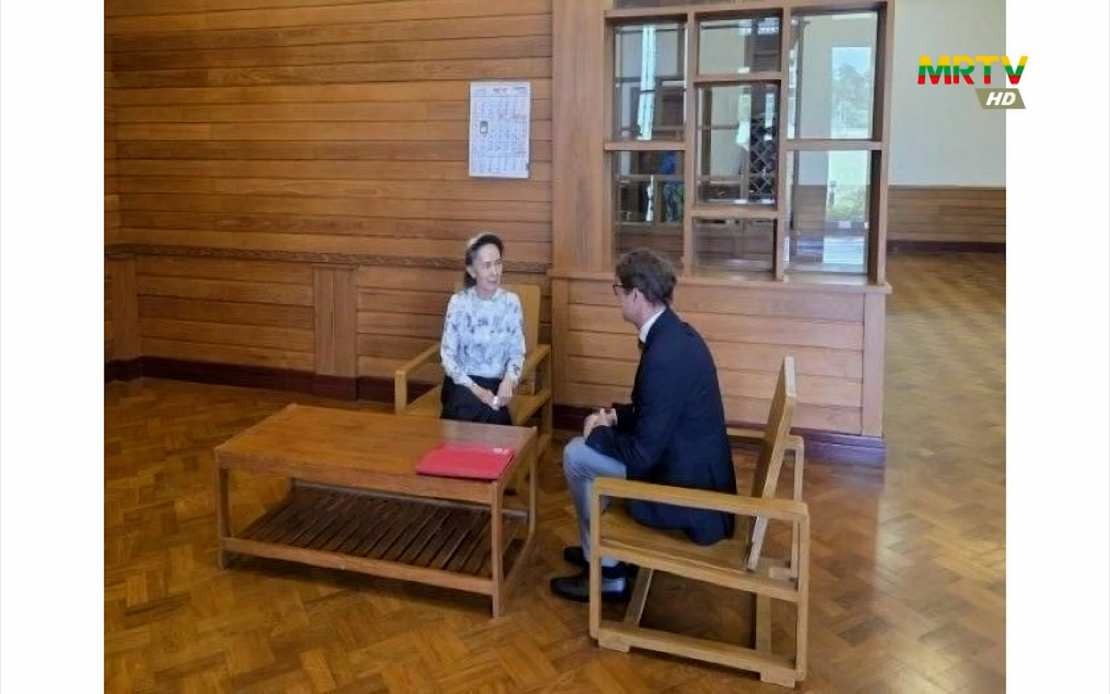
Myanmar's military-led administration has granted the International Committee of the Red Cross access to detained former leader Aung San Suu Kyi, with the encounter taking place in the capital Naypyitaw on Monday. The meeting represents a significant, if limited, opening in the government's historically restrictive approach to international oversight of the country's most prominent political prisoner. Arnaud de Baecque, the ICRC's resident representative to Myanmar, met with Suu Kyi in what officials described as a sparsely equipped room containing only basic furniture, according to government spokeswoman Khine Khine Soe.
The encounter comes amid mounting pressure from regional governments seeking independent verification of Suu Kyi's wellbeing. Since the military's dramatic seizure of power in February 2021, her precise location and health status have remained shrouded in secrecy, frustrating both her family and the international community concerned about her detention. No foreign leader or diplomatic envoy has been permitted to meet her in public until this week's Red Cross visit, underscoring how thoroughly the military regime has isolated the 81-year-old democracy champion from external scrutiny.
The government released four photographs documenting the meeting, presenting visual evidence of Suu Kyi's presence and apparent well-being. In two images, she appears in traditional Burmese dress seated across from de Baecque in the austere meeting room. A third photograph provides an unusual glimpse into her residential quarters, showing her cutting a birthday cake bearing her name, with a clothes rack and storage boxes visible behind her. The final image displays the cake itself, inscribed with "Happy Birthday Aunty Suu 19.6.2026," suggesting her birthday is June 19th. However, Reuters could not independently verify either the photographs' authenticity or when they were actually taken, raising questions about their purpose as propaganda rather than genuine documentation.
Suu Kyi's legal ordeal since the coup has been relentless and, according to her supporters, deliberately designed to neutralise her political threat. Military courts subjected her to extensive secret trials following the February 2021 takeover, ultimately convicting her on multiple charges including corruption, election fraud incitement, and state secrecy violations. The initial sentence of 33 years has undergone several reductions—first to 27 years, then further cut by one-sixth in April—leaving her with approximately 18 years remaining on her sentence. These successive reductions appear calculated to soften international criticism rather than reflect genuine judicial reconsideration, critics contend.
The uncertainty surrounding Suu Kyi's health has become a growing concern, particularly for her family. Her son, Kim Aris, revealed to Reuters in December that he had received almost no reliable information about his mother's condition, obtaining only occasional secondhand reports of heart, bone and gum problems. The isolation extends so far that he has not heard directly from her in years, a separation that weighs heavily on a family fractured by Myanmar's political turmoil. His fears about her survival without familial contact reflect the desperation of loved ones kept deliberately in the dark by a regime seemingly intent on psychological punishment alongside physical detention.
Myanmar's junta-aligned administration has repeatedly issued blanket assurances that Suu Kyi remains in "good health," statements that have proven unconvincing to skeptics both within the region and internationally. The government's reluctance to allow independent health assessments or family visits has generated precisely the opposite effect from its intended reassurance, fuelling suspicions that authorities are concealing deterioration or mistreatment. This transparency gap has become increasingly untenable as regional governments adopt stronger positions demanding verification of her condition.
The pressure intensified following April's military-engineered election, which reinstalled former junta leader Min Aung Hlaing as president under a new constitutional framework designed to maintain military dominance. Authorities announced that Suu Kyi had been transferred to house arrest, suggesting marginally improved conditions, though the substance of this claim remains unverified. Following a subsequent ASEAN ministerial meeting in Bangkok, Thailand's foreign minister Sihasak Phuangketkeow explicitly called for international access to Suu Kyi "so that we can be able to verify the claims" of her good health—a diplomatically phrased challenge to Myanmar's credibility.
ASEAN member nations have grown increasingly vocal about Suu Kyi's situation, viewing her detention as emblematic of Myanmar's democratic regression. The Philippines specifically requested that an ASEAN special envoy be permitted to meet her in May, a request the military government declined. This pattern of refusals suggests that the Red Cross visit, while welcome to international observers, may represent the maximum concession the regime is willing to make rather than an opening toward broader access.
Suu Kyi's historical trajectory amplifies the tragedy of her current circumstances. The daughter of General Aung San, the revered independence hero who founded modern Myanmar, she herself became democracy's most potent symbol. During a previous junta era, she endured 15 years of house arrest at her family home on Yangon's Inya Lake, where she delivered rousing speeches to supporters gathered outside the compound's metal gates. That experience of dignified resistance made her a global icon, yet the current military has proved far more determined to suppress her influence, employing criminal convictions rather than merely house confinement.
The Red Cross visit must be contextualised within Myanmar's broader regional position. The country's Southeast Asian neighbours, particularly Thailand, Indonesia and Singapore, have vocally supported the ASEAN consensus calling for Suu Kyi's release and for genuine democratic transition. Yet their leverage over Myanmar's intransigent military remains limited, constrained by ASEAN's principle of non-interference and Myanmar's geopolitical importance. The Red Cross meeting may therefore represent a compromise whereby the junta demonstrates minimal cooperation with international humanitarian concern while maintaining absolute control over her detention and isolation.
For Malaysian and broader Southeast Asian observers, Suu Kyi's predicament underscores the fragility of democratic gains and the military's enduring capacity for power seizure. Her case demonstrates how autocratic regimes employ criminal justice systems to neutralise political opposition, weaponising courts to validate extra-constitutional power grabs. The international community's limited ability to compel Myanmar's compliance with human rights norms or demands for democratic restoration reflects a wider vulnerability affecting the region—that military-backed governments can largely ignore external pressure provided they maintain domestic control.
The significance of the ICRC meeting lies less in what it represents as a positive development than in what it reveals about the stalemate between Myanmar's military and the international community. Permission for a single Red Cross visit, while better than complete isolation, falls dramatically short of the sustained access, family contact and health transparency that human rights standards demand. As long as Suu Kyi remains imprisoned on convictions widely regarded as politically motivated, Myanmar's military government will face sustained diplomatic isolation and reputational damage, regardless of carefully staged Red Cross photographs suggesting otherwise.

