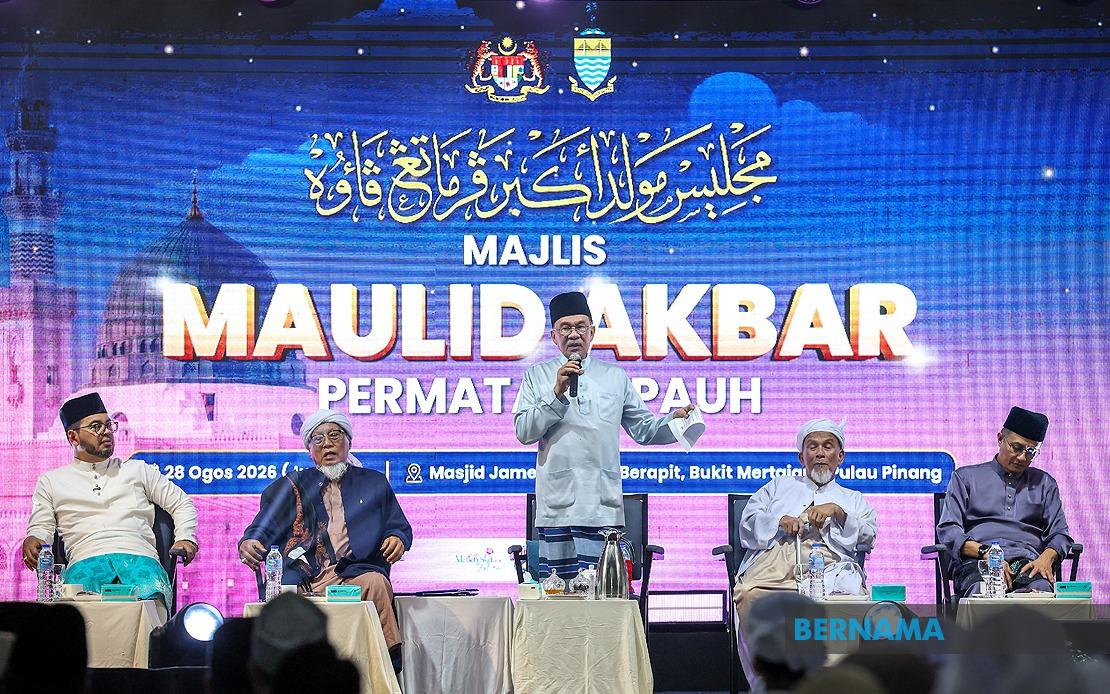
Prime Minister Datuk Seri Anwar Ibrahim has called on Muslims to become exemplars of virtue within Malaysian society, arguing that respect and standing in the community must be earned through consistent demonstration of moral character and ethical conduct. Addressing a gathering at Masjid Tengah in Bukit Mertajam during a Maulid Akbar ceremony marking the nation's birthday celebrations, Anwar emphasised that Muslims carry a particular responsibility to uphold values that benefit all citizens regardless of their religious or ethnic background.
The Prime Minister stressed that the foundation of Muslim respect in society should not rest on rhetoric or claims of religious piety, but rather on tangible actions visible in everyday behaviour. He highlighted that diligence in work, honouring commitments, and refusing to misuse positions of authority are the standards by which communities judge their leaders and fellow members. According to Anwar, a society where Muslims actively demonstrate integrity through honest dealings and transparent conduct will naturally accord greater standing to Islamic values and principles.
Anwar's remarks carry particular resonance in Malaysia's current political context, where public trust in institutions has been challenged by periodic corruption scandals and questions about governance standards. His insistence that character and morality form the bedrock of respect reflects growing recognition among policymakers that restoring confidence in government requires more than structural reform—it demands a cultural shift among officials and citizens alike. The emphasis on personal conduct as a form of religious expression reframes discussions about Muslim leadership from abstract ideals to concrete behavioural expectations.
The Prime Minister further elaborated that Islam's core message encompasses compassion and beneficial conduct toward all members of society, making it incumbent upon Muslims to actively safeguard community welfare and social cohesion across religious and racial divides. This framing positions Islamic values not as exclusive to Muslim practitioners but as universal principles that contribute to national harmony and development. By presenting Islamic ethics as inherently inclusive, Anwar addressed concerns about religious identity in Malaysia's multi-faith context while reinforcing Muslims' responsibility to be bridge-builders rather than divisive voices.
Central to Anwar's address was the concept of balance in human development, encompassing knowledge acquisition, spiritual cultivation, moral fortitude, physical wellbeing, and material advancement. This integrated approach challenges the notion that development necessarily requires choosing between modernity and tradition, between economic progress and spiritual values. The Prime Minister argued that these dimensions are not competing but complementary, each strengthening the others when pursued with intentionality and wisdom.
Drawing a metaphor about reaching toward the sky while remaining rooted in the earth, Anwar articulated Malaysia MADANI's foundational principle that economic policies and technological mastery, while essential, cannot substitute for underlying moral foundations. He positioned the Malaysia MADANI development framework as one that intentionally preserves ethical moorings even as the nation pursues contemporary advancement. This distinction addresses critiques that rapid modernisation risks eroding traditional values, suggesting instead that proper governance can facilitate both.
Anwar's comments underscored the critical importance of intellectual engagement with Islamic scholarship and learning from qualified religious experts. Rather than presenting Islam as static doctrine, he advocated for dynamic engagement with religious knowledge, encouraging dialogue between scholars and political leaders to ensure that policy decisions reflect substantive religious thought. This emphasis on constructive engagement between religious authorities and government contrasts with approaches that either marginalise religious perspectives in governance or impose rigid interpretations without scholarly consensus.
The participation of Minister in the Prime Minister's Department (Religious Affairs) Dr Zulkifli Hasan at the Bukit Mertajam event underscored the government's commitment to integrating religious and spiritual considerations into the Malaysia MADANI agenda. This presence signalled that religious affairs are not peripheral to national development but integral to the administration's vision. For Malaysian readers, this alignment suggests that religious guidance and modernisation are being deliberately coordinated at the highest levels of government.
Anwar's framing has implications beyond religious communities. In a nation where trust in public institutions has been strained, his emphasis on personal integrity and moral conduct from those in positions of authority speaks to broader concerns about governance. By articulating that respect derives from demonstrated character rather than rank or authority, the Prime Minister established a standard applicable across all sectors—civil service, private enterprise, and political leadership alike.
The Malaysia MADANI framework, as described through Anwar's remarks, appears to rest on a theory that sustainable development requires integration of material progress with spiritual and moral development. This represents a distinctive approach to national governance that refuses the false dichotomy between religious values and contemporary prosperity. For regional observers, Malaysia's emphasis on values-anchored development offers a potential alternative to models that treat modernisation and tradition as opposing forces.
Moving forward, the test of these principles will lie in implementation. Anwar's call for Muslims to lead by example creates measurable standards against which his administration and broader Muslim communities can be assessed. Whether government policies demonstrably reflect commitment to transparency, whether Muslim leaders visibly reject corrupt practices, and whether institutions actively cultivate moral character will determine whether these statements translate into substantive change. The Prime Minister has essentially challenged Malaysian society to examine whether the gap between stated values and actual conduct is narrowing or widening.

