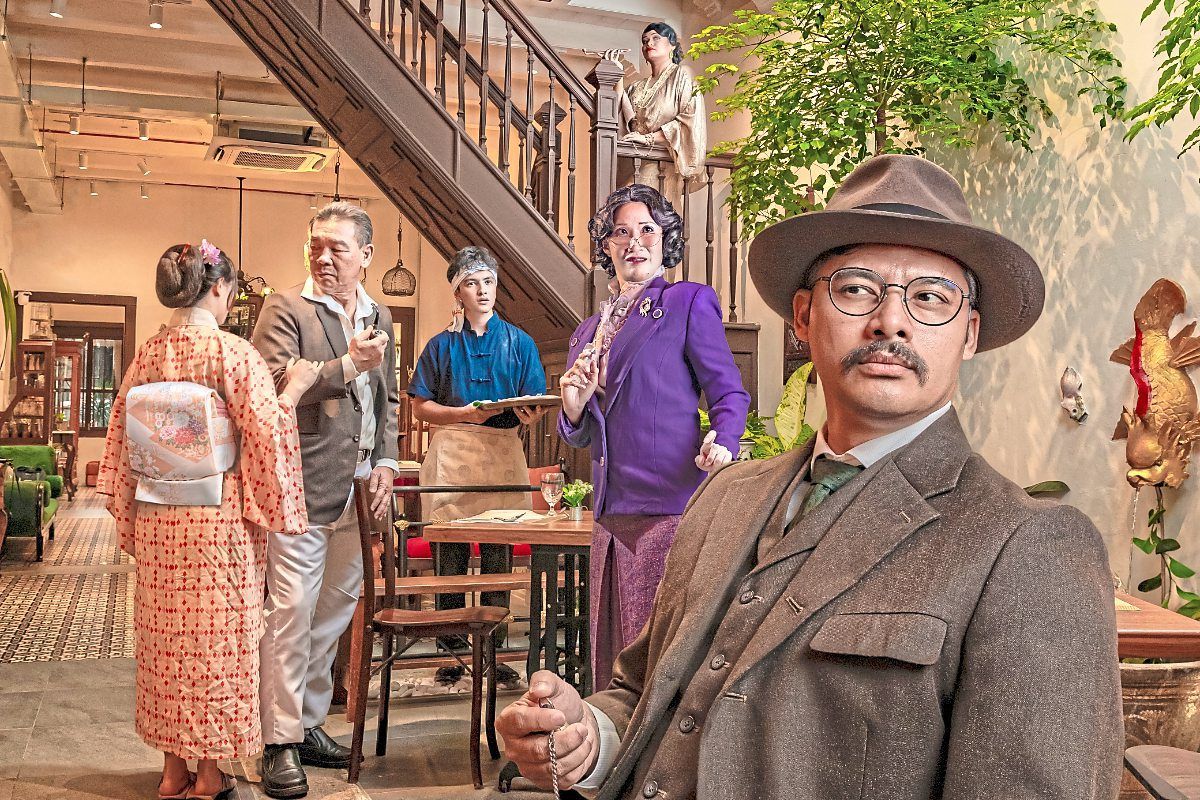
Detective work meets culinary tradition this summer as Melaka's independent theatre collective Krate Creative Space launches an ambitious experiment in immersive storytelling: a murder mystery experience set within the elegant confines of a heritage Peranakan house. Running across four carefully scheduled weekends in July and August, the production represents a bold fusion of two distinctly Malaysian passions—solving puzzles and savouring authentic cuisine—transforming dinner guests into active investigators rather than passive observers.
Hosted at The Garden@Heeren, a carefully preserved Peranakan venue situated on Jalan Tun Tan Cheng Lock, the experience transports participants back to the 1930s through an evening of multiple-course traditional dining interspersed with mounting theatrical tension. As guests work through classics such as pie tee, pongteh chicken, and cincalok omelette, the narrative unfolds around them: a grand reopening celebration for the restaurant of the celebrated Chef Fa takes a sinister turn when tragedy strikes. Suddenly, the evening's trajectory shifts from festive to mysterious, and attendees find themselves enlisted as amateur detectives working alongside a professional investigator to piece together what has occurred.
The creative vision behind this production belongs to Wee, writer and developer of Krate's interactive works, who explains that the right venue was essential to realising her long-held ambition to create a murder mystery. "The biggest challenge was finding the right collaborators and the right venue. When we discovered this beautiful heritage space, everything just fell into place. A classic heritage house naturally lends itself to mystery, suspense and storytelling," she reflects. The location matters profoundly here: rather than staging the experience in a purpose-built black box theatre, the production leverages the architectural and historical authenticity of a genuine Peranakan residence, where period furniture, spatial transitions between rooms, and atmospheric details all contribute to the immersive quality that distinguishes this venture from conventional dinner theatre.
Participants are encouraged to dress in vintage or Peranakan-inspired attire, blurring the boundary between audience member and character. Over the course of two and a half hours, guests encounter a professional cast including Francis Augustine as Detective Raymond, Sonia Lee as Miss Irene, Lee You Meng as Baba Pang, Elijah Skye as Peter Pang, and Neena Shu as Mama Maria. But the experience hinges fundamentally on audience agency: attendees can choose whether to observe events from the margins or assume active investigative roles, moving through the house's rooms, searching for hidden clues, questioning suspects, and ultimately presenting their own verdicts about the identity of the perpetrator. As Wee emphasises, "No two performances are exactly alike because the audience drives the investigation. Different groups will ask different questions, uncover different clues and interact with the suspects in their own way."
A particularly inventive structural choice involves offering two distinct narrative resolutions: the first two weekends will conclude with one ending, while the final two weekends will present an entirely different resolution. This design encourages returning audiences to experience genuinely fresh material, solving a different mystery with alternate story implications. The production is recommended for participants aged 15 and above, ensuring sufficient maturity to engage with the mystery's conventions and participate meaningfully in the investigative process.
Wee's vision for this production explicitly situates it within a broader cultural tourism strategy for Malaysia. "I wanted to create an experience that combines theatre with dining. Instead of simply watching a performance, guests are transported back to the 1930s through all five senses, from the setting and costumes to the food, music and interactions," she explains. This multisensory approach taps into Melaka's established reputation for culinary heritage while introducing a performative dimension that appeals to audiences seeking experiences beyond conventional museum visits or guided historical tours. The production acknowledges that international tourists increasingly seek authentic cultural encounters, and the synthesis of Peranakan gastronomy with immersive narrative offers precisely such an opportunity.
Krate Creative Space itself represents a distinctive phenomenon within Malaysia's theatre landscape. Established in 2016, it has positioned itself as Melaka's first independent creative community dedicated to customised, interactive, and multidisciplinary live performances. The organisation has mounted more than 10 original productions, cultivating a devoted following that extends well beyond Melaka's borders. Wee notes that approximately half their audience originates locally, while significant cohorts travel from the Klang Valley, Penang, Johor, and Singapore—even drawing tourists from further afield explicitly seeking these unconventional cultural experiences. This geographic pull testifies to a hunger among Malaysian and regional audiences for theatre that engages with local identity and heritage in participatory, imaginative formats.
Maintaining creative independence within Malaysia's theatrical ecosystem has demanded considerable resilience. Krate's base at Bukit Beruang functions simultaneously as rehearsal studio, creative hub, and cafe, a diversification strategy born from practical necessity. Wee acknowledges forthrightly that "it hasn't been easy for Krate to keep its doors open, which is why they have learned to constantly adapt, diversifying beyond staging performances alone." This vulnerability is not unusual for independent theatre collectives in Southeast Asia, yet Krate's continued operation and expansion of its programming speaks to both organisational adaptability and genuine audience commitment. Many returning patrons demonstrate willingness to travel considerable distances for new productions, validating Wee's artistic direction and providing crucial support for an experimental venture operating outside conventional funding frameworks.
Looking forward, Krate harbours ambitions to establish a permanent cultural venue in Melaka, from which heritage-inspired immersive experiences could be presented regularly throughout the year. Such a development would position the city as a destination not merely for historical sightseeing but for innovative, participatory storytelling rooted in local traditions. This aspiration reflects a broader regional trend: heritage cities across Southeast Asia are discovering that immersive cultural experiences can attract both domestic audiences and international visitors seeking authenticity and engagement beyond passive consumption. By anchoring theatrical production in specific places and culinary practices, Krate demonstrates how performance can become integral to how communities understand and share their own cultural identity.
The murder mystery series arrives as Krate consolidates momentum from recent successes. The company previously brought its original production The Best Nyonya to Penang in May, staging it at Georgetown Mansion and expanding its geographic reach within Malaysia's heritage tourism circuit. The Melaka murder mystery represents a logical evolution of this strategy: deeper investment in longer-running, iterative programming within a single heritage location, allowing audiences to return multiple times and experience genuine narrative variation. As cultural tourism in Malaysia increasingly emphasises experiential, participatory formats rather than traditional observation-based attractions, productions like this position independent theatre collectives as significant contributors to how Malaysian cities market and sustain their cultural heritage.

