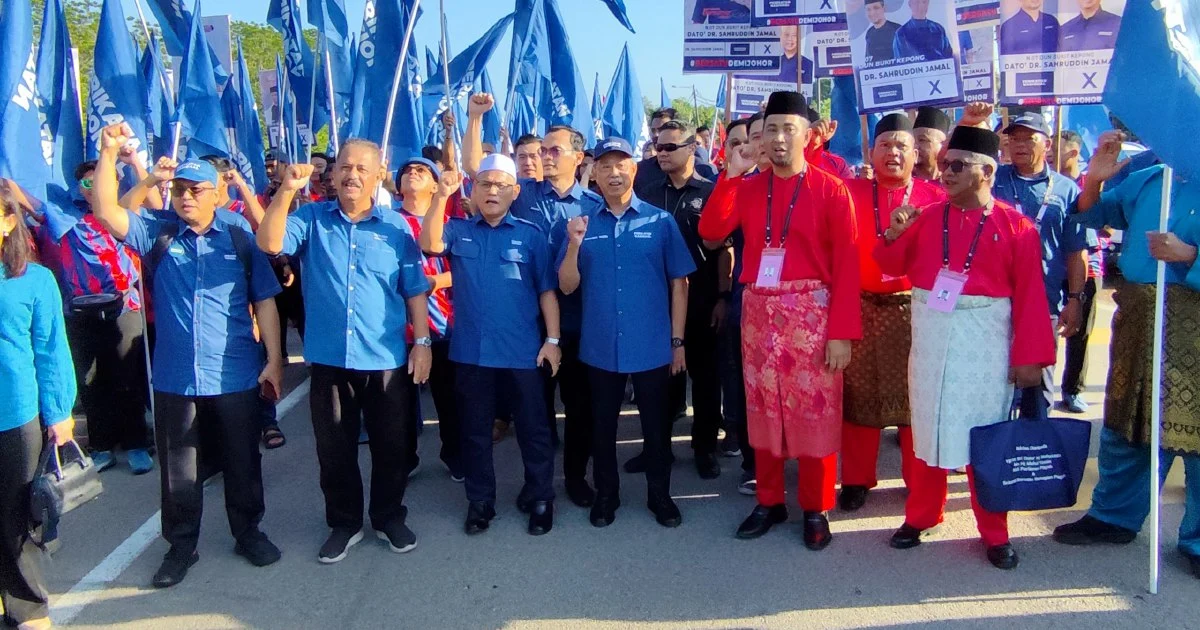
The Bukit Kepong nomination process in the ongoing Johor state election took a significant turn when Bersatu president Tan Sri Muhyiddin Yassin made a personal appearance at the polling station in Pagoh. Arriving at the Pagoh Sports Complex Hall at 8.45 am, Muhyiddin's presence alongside Sahruddin underscored the party's determination to strengthen its foothold in the critical Johor constituency, where electoral fortunes could tip the balance in state-level power dynamics.
Muhyiddin's direct involvement in accompanying the Bukit Kepong candidate carries substantial symbolic weight within Malaysian political circles. As the head of Bersatu, one of the coalition partners in the current federal government framework, his hands-on participation signals more than mere party protocol—it demonstrates a calculated effort to energize grassroots support and validate the candidacy through high-profile endorsement. This approach reflects the increasingly personalised nature of Malaysian campaign strategies, where senior party figures leverage their public recognition to amplify messages and generate momentum.
The timing of Muhyiddin's visit to the nomination centre coincides with heightened anticipation surrounding the Johor election's outcome and implications for the broader political landscape. Johor, as Malaysia's second-largest state by population and economic output, traditionally serves as a bellwether for national electoral trends. The state's political trajectory carries consequences far beyond its borders, influencing coalition stability at federal level and shaping perceptions of party viability among voters across Southeast Asia's most developed state economy.
Bukit Kepong represents a constituency with its own unique demographic and geographic characteristics that informed Bersatu's strategic candidate selection. The nomination day proceedings, conducted under election commission protocols, represent the formal gateway through which prospective representatives must pass before launching their campaigns. Muhyiddin's attendance at this administrative milestone demonstrates the seriousness with which Bersatu approaches the contest and the significance attached to securing victory in this particular seat.
The presence of a former prime minister and current party president at a nomination centre generates substantial media attention and frames the candidate's effort within a broader narrative of party strength and internal cohesion. In the fractious landscape of Malaysian politics, where coalition stability frequently comes under strain, such public displays of unity serve practical purposes beyond ceremonial functions. They communicate to party members, allied partners, and floating voters that Bersatu maintains organised structures and maintains focus on electoral objectives.
For Malaysian observers, the Bukit Kepong contest exemplifies how Bersatu has repositioned itself within the political ecosystem following its transition from previous governing arrangements. The party's participation in the Johor state election forms part of its broader strategy to consolidate representation across key electoral battlegrounds and prove its continued relevance in a competitive environment where coalition configurations remain fluid.
The nomination process itself represents the formal commencement of campaigning activities, triggering spending limits, regulatory frameworks, and intensified voter engagement efforts by all competing parties. Sahruddin's nomination, supported visibly by Muhyiddin's attendance, marks the beginning of what will undoubtedly become a closely watched race with implications for state government formation and factional positioning within ruling coalitions.
Bersatu's commitment to the Bukit Kepong seat must be understood within the context of the party's broader electoral strategy in Johor, where multiple constituencies present opportunities for seat gains or consolidation. The allocation of campaign resources, candidate selection, and high-level support indicate where party leadership believes victory is achievable and where votes can be converted into parliamentary representation that translates into cabinet positions and policy influence.
Muhyiddin's early morning appearance at the nomination centre reflects the intensive preparation required to execute successful electoral campaigns in Malaysia's complex multi-party environment. The nomination day itself, while administratively routine, carries outsized political significance as media focuses on candidate announcements, party positioning, and the formal statements candidates make about their campaign platforms and constituent concerns.
As the Johor election progresses from nomination phase through campaign season toward polling day, races like Bukit Kepong will increasingly capture attention from political analysts, coalition partners assessing their relative strength, and ordinary voters evaluating competing visions for state governance. Muhyiddin's hands-on involvement suggests Bersatu is mobilising senior leadership resources strategically rather than leaving campaigns entirely to individual candidates, a common approach adopted by parties competing in high-stakes electoral contests where small margins determine parliamentary control and influence over resource distribution.

