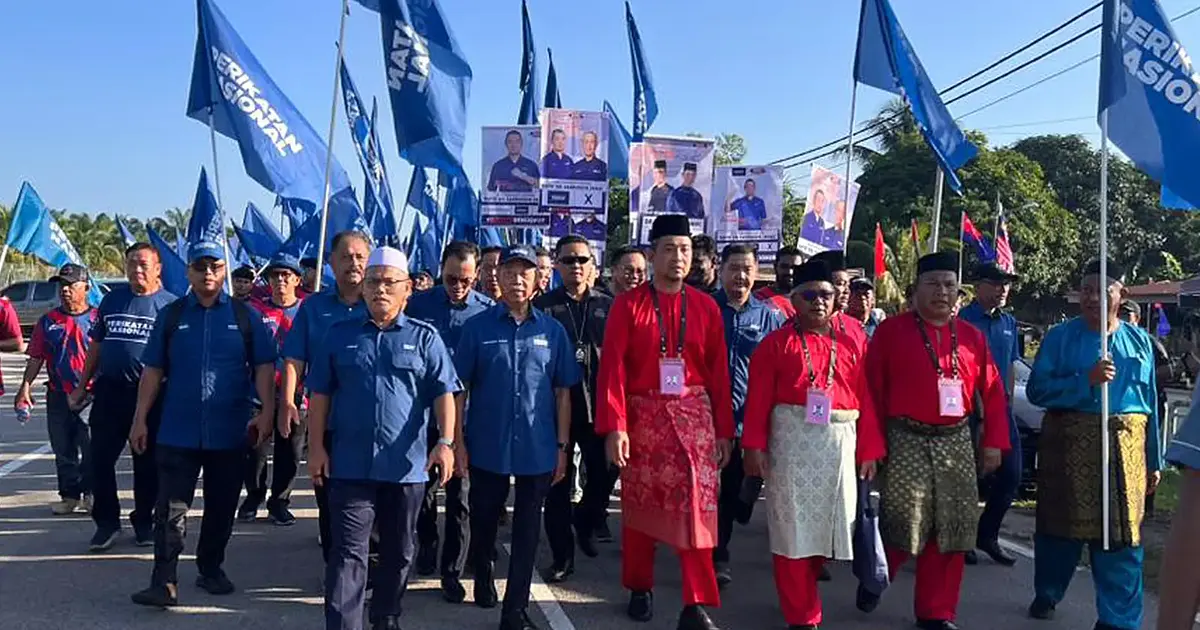
Perikatan Nasional chairman Muhyiddin Yassin threw his personal weight behind the opposition coalition's electoral push at Bukit Kepong, appearing alongside hundreds of party faithfuls to champion the candidacy of Dr Sahruddin Jamal, who will carry Bersatu's banner in the constituency race. The gathering demonstrated the alliance's resolve to mount competitive challenges across the political landscape, with senior leadership visibly engaged in street-level campaign mobilisation rather than delegating the effort to lower-tier operatives.
Dr Sahruddin Jamal brings considerable legislative experience to the contest, having successfully held the Bukit Kepong assemblyman seat through two consecutive terms. His track record suggests familiarity with constituent concerns and the machinery required to maintain electoral dominance in his territory. The two-term incumbent status positions him as an established figure with demonstrated ability to translate local issues into electoral support, a critical asset in state legislative contests where personal networks and grassroots goodwill often prove decisive.
Bersatu's selection of Dr Sahruddin reflects the party's strategy of fielding candidates with proven legislative credentials rather than political newcomers. This approach, if consistent across constituencies, suggests PN is banking on experience and incumbency advantage to counter any anti-incumbency sentiment the government coalition might face. The choice also indicates confidence in Dr Sahruddin's personal popularity transcending broader shifts in voter sentiment, a calculated bet that his individual standing can anchor support despite potential national political currents.
Muhyiddin's personal appearance carries symbolic weight within the Malaysian opposition ecosystem. As PN chairman, his presence elevates the campaign beyond routine constituency-level activities and signals the coalition's belief that Bukit Kepong represents contested terrain worth commanding attention from apex leadership. Such high-profile engagement traditionally aims to energise grassroots volunteers and reinforce messaging that the seat carries strategic importance to coalition objectives.
The assembly of hundreds of supporters reflects PN's capacity to mobilise its base for promotional events, though turnout figures often require contextual analysis. In Malaysian politics, organised rallies frequently draw party members and sympathisers through networks and workplace arrangements rather than representing purely organic spontaneous enthusiasm. Nevertheless, the demonstration of organisational capability serves propaganda purposes, signalling momentum and breadth of support to media observers and undecided voters alike.
Bukit Kepong's status as a specific electoral battleground warrants examination. Malaysian constituencies rarely receive such high-level opposition attention unless they represent marginal seats where outcomes remain genuinely unpredictable, or where symbolic victories carry disproportionate importance to coalition narratives. The presence of PN's national chairman suggests either genuine electoral vulnerability for the governing coalition or PN's determination to reframe the political balance sheet through incremental territorial gains.
The timing of this campaign activity reflects broader Malaysian electoral rhythms. State-level constituencies periodically undergo contests following dissolved state assemblies or by-elections triggered by vacancy. The mobilisation visible in Bukit Kepong suggests PN perceives the electoral environment as favourable for consolidating opposition strength and potentially expanding representation beyond current holdings. Such positioning matters for coalition relevance in negotiations surrounding national governance and ministerial portfolios.
For Bersatu specifically, fielding candidates in state contests maintains the party's relevance independent of federal government participation. Though Bersatu has oscillated between governing and opposition benches in recent years, maintaining competitive electoral machinery at state level preserves the party's capacity to claim constituency mandates and leverage such claims in negotiating post-election coalitions. Dr Sahruddin's candidacy thus serves multiple strategic functions beyond the immediate contest outcome.
The composition of PN itself remains instructive context. The coalition traditionally encompasses Bersatu, PAS, and various smaller regional parties. The delegation of Bukit Kepong to Bersatu suggests internal allocation of constituencies among partners, a practical necessity requiring negotiation and agreement on which party contests which seat. Such internal arrangements determine the coalition's electoral efficiency and the subsequent distribution of parliamentary or legislative power among component parties.
SEA political observers should note that Malaysian state-level contests often presage national electoral sentiment. Bukit Kepong results, if such a contest occurs, will generate commentary regarding broader opposition momentum or government resilience. Analysts monitor state-level races partly for early indicators of whether electoral coalitions remain intact and whether local issues drive outcomes or national political currents overwhelm localism.
For Malaysian readers specifically, Bukit Kepong's contest represents the lived experience of competitive democracy. Constituencies where multiple serious candidates contest genuinely competitive races remain valuable precisely because they require politicians to engage constituent concerns substantively. The appearance of Muhyiddin and Dr Sahruddin's campaign activity suggests Bukit Kepong voters will face genuine electoral choice rather than predetermined outcomes.
The implications for governance extend beyond raw electoral accounting. Should PN gain seats through such campaigns, the coalition's negotiating position in post-election settlement discussions strengthens proportionally. Every seat becomes currency in coalition-formation discussions, potentially influencing which parties receive ministerial appointments, committee assignments, and resource allocation. Bukit Kepong therefore represents not merely symbolic territory but practical stakes in governance architecture.

