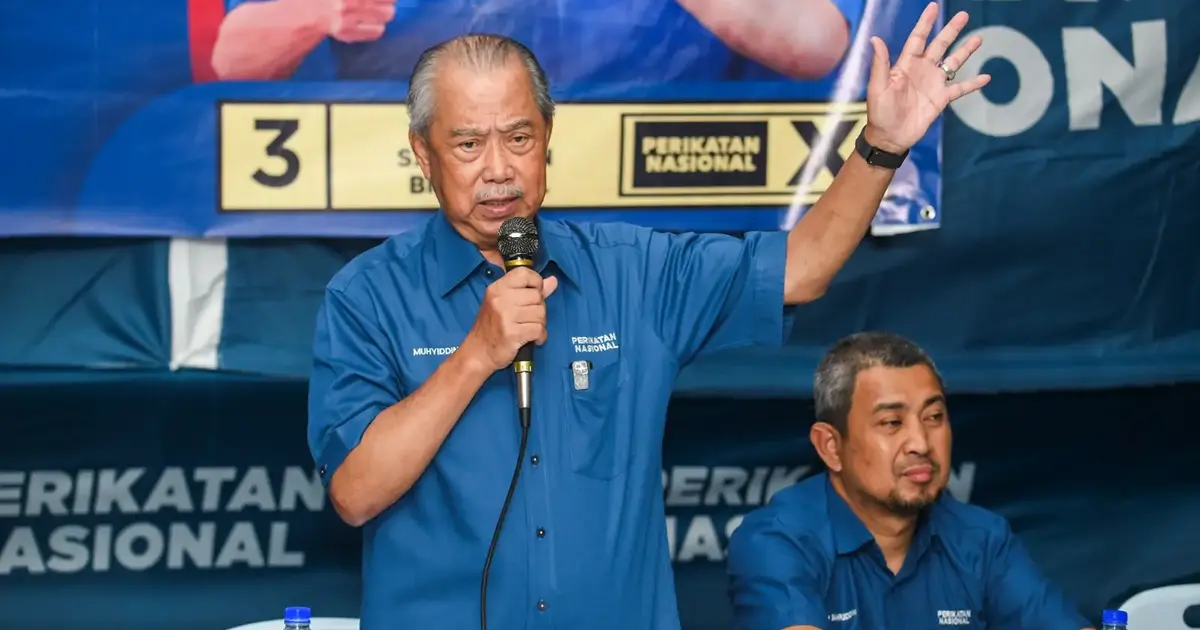
Bersatu party president Muhyiddin Yassin has publicly raised questions about the timing of any potential release of former Prime Minister Najib Razak, suggesting that the Johor state elections may play a role in political calculations surrounding the convicted leader's future. The remarks reflect growing speculation within Malaysian political circles about whether electoral considerations in the southern state could influence decisions affecting Najib's imprisonment and legal status.
Muhyiddin's comments underscore the contentious position Najib continues to occupy in Malaysian politics, nearly a decade after the 1Malaysia Development Berhad scandal first erupted. Despite the passage of time and changes in government, Najib remains a polarising figure whose name generates intense debate across party lines and among ordinary Malaysians. The mention of Johor's elections suggests that Muhyiddin views any decision regarding Najib's release not merely as a legal matter but as part of a broader political landscape shaped by electoral considerations.
Najib was convicted on multiple charges related to abuse of power and money laundering connected to massive funds diverted from 1MDB, a state investment fund established during his tenure as Prime Minister. His conviction and subsequent sentencing represented a significant moment in Malaysian legal history, marking the first time a former Prime Minister had faced prosecution and conviction on such serious charges. The complexity and scale of the 1MDB scandal captured international attention and raised questions about governance, accountability, and institutional integrity in Malaysia.
The question of Najib's potential release carries implications beyond his personal circumstances. Any move to free or pardon him would trigger substantial political and social reactions, particularly given the scale of alleged corruption involved and the international dimensions of the case. Civil society groups, transparency advocates, and opposition parties have consistently argued that such actions would undermine efforts to combat corruption and signal weakness in Malaysia's commitment to rule of law and institutional independence.
Johor represents a crucial battleground in Malaysian politics, holding significant electoral weight due to its size and population. The state has traditionally been associated with UMNO and, more recently, has seen shifting allegiances among various political coalitions. Any electoral contest in Johor could reshape the political balance at both state and potentially federal levels, making the timing of high-profile political decisions particularly sensitive for parties seeking to maximise their electoral prospects.
Muhyiddin's positioning on this issue reflects Bersatu's complex relationship with the United Malays National Organisation, the party from which Muhyiddin himself emerged before establishing Bersatu as a separate political entity. The two parties have alternated between cooperation and competition depending on political circumstances, and their respective stances on figures like Najib often signal broader shifts in coalition dynamics. By raising the connection between Johor's elections and Najib's potential release, Muhyiddin appears to be signalling Bersatu's awareness of political manoeuvring that may be occurring behind the scenes.
The legal apparatus in Malaysia has become increasingly scrutinised when handling high-profile cases involving former leaders. Questions about judicial independence, executive influence over legal outcomes, and the consistency of sentencing have all been raised in relation to Najib's case and other prominent corruption investigations. Any unusual developments in his legal situation would inevitably attract critical examination from legal experts, civil society observers, and international watchdogs monitoring Malaysia's democratic health.
Public opinion on Najib remains deeply divided along political and demographic lines. Supporters view him as a victim of political persecution orchestrated by political opponents, while critics see his conviction as a necessary accountability measure for one of Malaysia's most consequential corruption scandals. This polarisation means that decisions affecting his imprisonment carry genuine risk of inflaming existing social and political tensions.
The mention of Johor's elections by Muhyiddin appears designed to invite scrutiny of potential political motivations behind legal decisions. By explicitly linking the two developments, he is essentially arguing that any move to release Najib should be examined not only on legal merits but also in terms of electoral calculations that may have influenced such decisions. This approach exemplifies how Malaysia's political landscape remains deeply interconnected, with legal, electoral, and party-political considerations frequently intertwined rather than operating as separate domains.
For Malaysian policymakers and international observers monitoring the country's democratic trajectory, the conversation around Najib's case continues to serve as a barometer of institutional health. The degree to which legal decisions can be separated from electoral considerations, and the extent to which Malaysia's courts and executive remain independent of political pressure, remain fundamental questions about the nation's governance system. Muhyiddin's remarks bring these underlying tensions into sharp public focus, even as formal decisions about Najib's status remain pending.

