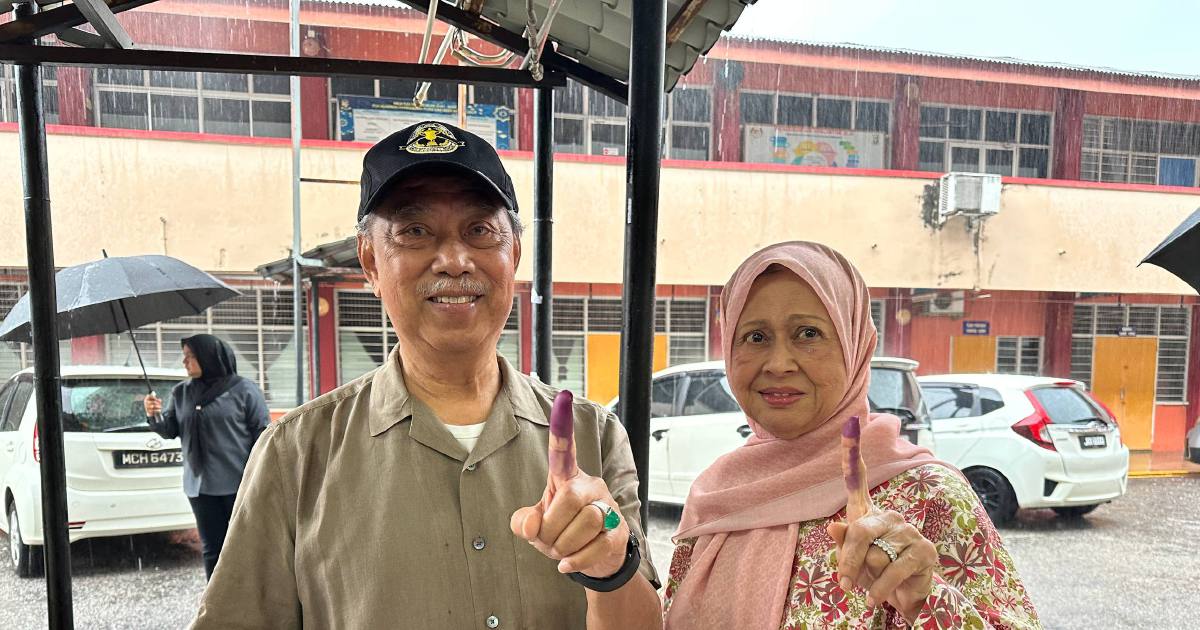
Johor's state election unfolded under challenging weather conditions today, as heavy downpours swept across multiple districts throughout the morning. Despite these atmospheric obstacles, Bersatu's leadership remained buoyant about electoral participation, with party officials projecting that voter turnout could surpass the 70 per cent threshold—a benchmark that would signal strong public engagement with the democratic process.
Persimmon Muhyiddin, leading Bersatu's campaign efforts in Muar, articulated the party's confidence that rainfall would not substantially dampen electoral enthusiasm among registered voters. The inclement weather traditionally presents a logistical challenge for election day operations, as rain can impede voter mobility and deter participation, particularly among elderly and rural populations who may face transportation difficulties. Bersatu's optimism therefore rested partly on the assumption that voter resolve would outweigh environmental friction.
The 70 per cent benchmark carries particular significance for Johor's political narrative. State elections in Malaysia typically see participation rates fluctuating between 50 and 75 per cent, with higher turnouts generally interpreted as indicators of electoral competitiveness and voter investment in local governance. A result above 70 per cent would suggest that Johor's electorate viewed the contest as consequential enough to justify navigating adverse weather conditions.
Historically, Johor has demonstrated respectable electoral participation rates compared to other Malaysian states, reflecting the state's relative political maturity and the contested nature of several constituencies. The state has witnessed significant political realignments in recent years, with multiple coalitions vying for control. Such competitive environments typically correlate with higher turnout as voters mobilize to support their preferred candidates and parties.
The timing of the election during a tropical weather season meant that meteorological disruption was always a plausible scenario. Weather forecasts had indicated the possibility of rain before polling day, prompting election officials to prepare contingency plans for wet conditions. These preparations included ensuring polling stations remained operational despite water ingress and maintaining clear pathways for voter access.
Bersatu's emphasis on turnout projections reflected the party's broader strategic narrative entering the contest. Higher turnout potentially favours certain demographic segments and geographic constituencies, and Bersatu clearly calculated that exceeding 70 per cent participation would create a political environment conducive to its electoral prospects. The party's public statements served simultaneously as expressions of confidence and appeals for supporters to overcome practical obstacles and cast their ballots.
For Malaysian electoral observers, turnout rates communicate important information beyond raw participation numbers. They reveal something about the vitality of democratic participation and public confidence in electoral institutions. A strong turnout despite adverse weather would demonstrate that Johor voters maintained faith in the election process and viewed their votes as meaningful contributions to political outcomes.
The impact of inclement weather on election day varies significantly across constituencies. Urban polling stations with better infrastructure and accessibility typically experience minimal disruption, while rural and semi-urban areas dependent on informal transportation networks may see reduced participation. Uneven weather distribution across the state—with some districts receiving heavier rainfall than others—meant that turnout would likely vary geographically, potentially advantaging or disadvantaging parties differently across constituencies.
Election officials had coordinated with weather monitoring agencies to track rainfall patterns throughout the day, enabling real-time assessments of how conditions affected voter movement. Early indications from morning polling periods would provide crucial signals about whether Bersatu's optimism regarding the 70 per cent threshold would materialize or whether weather would suppress turnout below expected levels.
Bersatu's public positioning regarding turnout projections also reflected the party's confidence in its electoral machinery and ground organization. Successfully mobilizing voters amid adverse circumstances requires robust logistical networks, communication systems, and grassroots infrastructure capable of encouraging participation despite obstacles. The party's willingness to set a specific turnout target publicly suggested internal confidence in these organizational capacities.
For the broader Malaysian political context, the Johor election result would carry implications extending beyond state-level governance. As a large and economically significant state with a substantial electorate, Johor's political direction influences the balance of power within Peninsular Malaysia and affects federal political dynamics. Strong electoral participation would enhance the legitimacy of whichever coalition prevailed, providing stronger mandates for policy implementation and governance.

