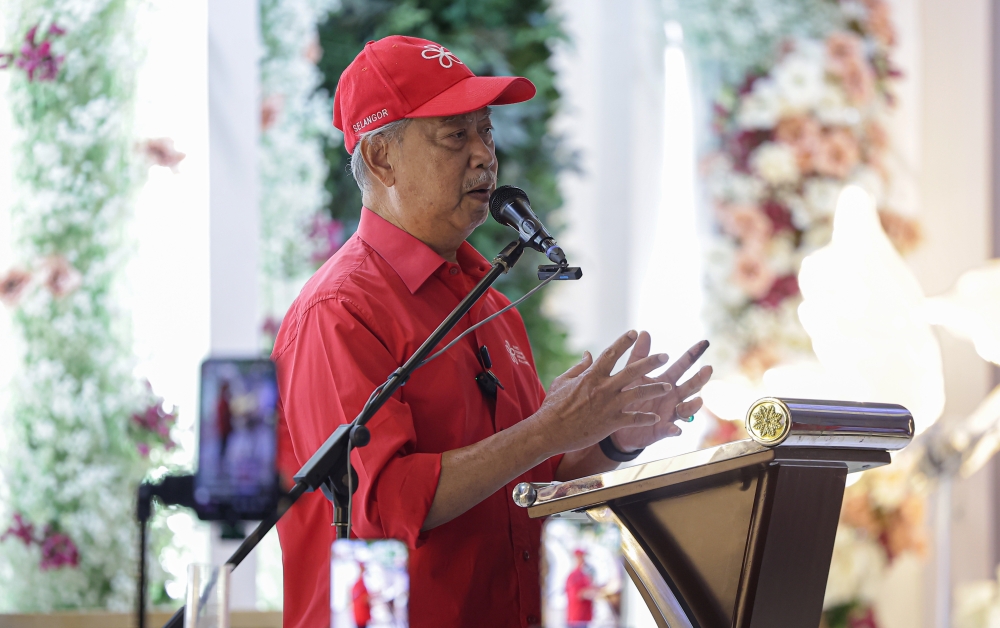
Tan Sri Muhyiddin Yassin has moved to establish Parti Pribumi Bersatu Malaysia as the sole authentic voice of parliamentary Opposition in Malaysia, staking the party's claim to principal challenger status at a moment when the nation's political architecture is undergoing significant reconfiguration. The assertion reflects heightened competition for legitimacy among rival blocs and underscores the fragmentation characterising contemporary Malaysian politics, where traditional alignments have fractured and new formations continue to crystallise.
Bersatu's positioning assumes particular significance against the backdrop of Malaysia's volatile coalition dynamics. The party, which has navigated multiple partnerships since its formation, is attempting to carve out distinct political territory separate from both the ruling administration and other opposition configurations. This differentiation strategy signals Muhyiddin's determination to establish Bersatu as an indispensable political force rather than a satellite faction reliant on larger alliances, though such assertions inevitably provoke debate about the true extent of parliamentary leverage and ideological consistency across the Opposition benches.
The claim underscores a broader pattern in Malaysian politics whereby parties seek to consolidate electoral narrative advantages by claiming principal challenger status. In a system where coalition formation frequently trumps individual party strength, the ability to portray oneself as the authentic alternative to government carries substantial symbolic and organisational weight. Muhyiddin's statement thus represents both a tactical positioning exercise and a reflection of substantive concerns about party identity and political relevance in an increasingly crowded opposition landscape.
Malaysia's opposition space has become markedly more complicated in recent years, with multiple configurations competing for voter attention and parliamentary resources. Bersatu's claim to singular Opposition legitimacy implicitly challenges the coherence and commitment of alternative opposition groupings, questioning whether they possess unified platforms or merely represent collections of convenience united primarily by anti-government sentiment. Such fragmentation creates strategic vulnerabilities for voters seeking clear alternative visions to incumbent governance arrangements.
The timing of Muhyiddin's assertion coincides with visible realignments across Malaysian political formations. Several parties and political leaders have repositioned themselves in response to shifting electoral calculations and popular sentiment, creating conditions where traditional bloc boundaries have become increasingly porous. Within this fluid environment, Bersatu evidently judges that staking territorial claims to Opposition leadership offers optimal positioning for upcoming electoral contests and parliamentary negotiations. The strategy presumes that coherence and identity clarity will prove attractive to voters fatigued by coalition instability.
For Southeast Asian observers, Malaysia's opposition fragmentation reflects broader regional patterns whereby dominant coalition-building dynamics produce opposition spheres fragmented among competing visions and personalities. Unlike established two-party or two-coalition systems, Malaysia's parliamentary landscape rewards organisational agility and narrative control, rendering Muhyiddin's effort to claim Opposition singularity a rational if contested strategic choice. The assertion simultaneously acknowledges Bersatu's limited parliamentary numbers while asserting moral or ideological priority.
Bersatu's pathway to Opposition authenticity claims differs substantially from older opposition traditions. The party emerged comparatively recently and carried significant baggage from its involvement in previous government formations, creating inherent questions about its consistency and commitment to opposition politics. Muhyiddin's pronouncement attempts to overcome such scepticism by positioning Bersatu as having evolved into committed parliamentary dissent, fundamentally distinct from compromised configurations elsewhere in the opposition spectrum.
The implications for Malaysia's governance extend beyond party positioning contests. A genuinely fragmented opposition struggles to present unified policy alternatives or maintain sustained pressure on government accountability. While some argue that diverse opposition voices strengthen democracy through multiple ideological expressions, others contend that fragmentation weakens parliamentary scrutiny and enables governing majorities to govern with minimal institutional resistance. Muhyiddin's assertion reflects confidence that Bersatu can fill authentic Opposition vacuum, though sceptics might question whether any single party can claim that mantle when opposition votes remain divided.
International observers monitoring Malaysian democratic health will likely scrutinise whether opposition fragmentation strengthens or weakens overall parliamentary function. Competition among opposition factions can encourage innovative policy thinking and prevent opposition sclerosis, yet it simultaneously reduces collective leverage in legislative contests and accountability mechanisms. Bersatu's claim thus represents not merely internal party positioning but a statement about preferred future operating norms for Malaysian democracy.
The assertion also reflects Muhyiddin's personal standing and historical trajectory. His complex political history—encompassing multiple party memberships and government roles—necessarily shapes how his claims to Opposition authenticity register across different voter constituencies. Some will perceive genuine commitment to principled opposition politics, while others will interpret the positioning as tactical maneuvring by a seasoned political operator seeking renewed relevance. This ambiguity itself constitutes a complication for Bersatu's Opposition branding efforts.
Moving forward, Bersatu faces the challenge of substantiating its Opposition claims through consistent parliamentary performance, policy coherence, and demonstrated commitment to accountability agendas. Mere assertion of Opposition status carries limited durability without corresponding legislative impact and public perception alignment. The party's ability to consolidate genuine Opposition support depends substantially on delivering visible parliamentary scrutiny and articulate alternative governance visions that resonate across diverse Malaysian constituencies and demographic groups.

