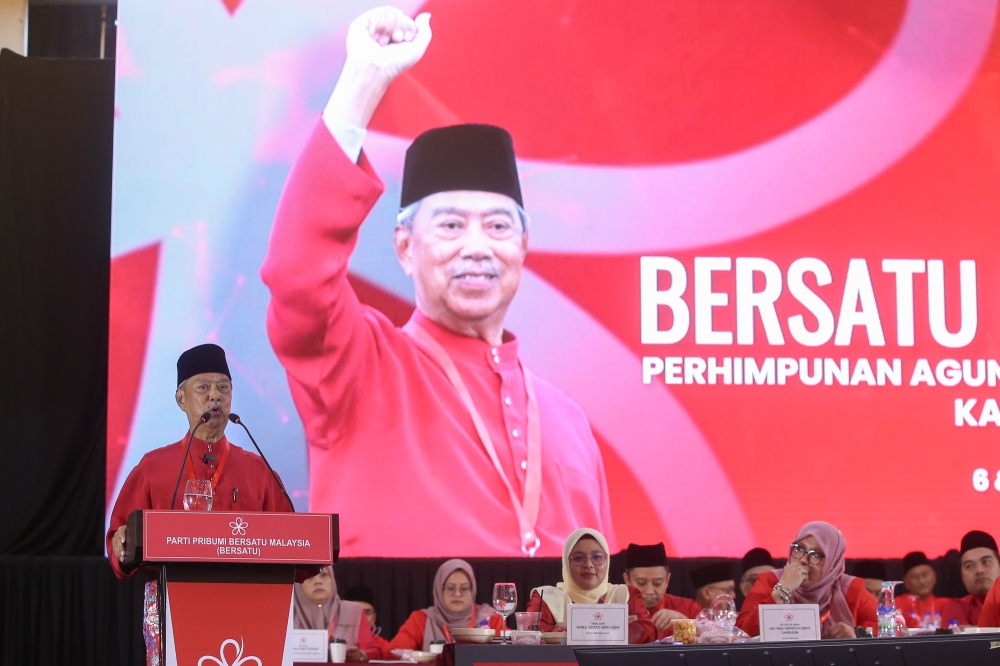
Tan Sri Muhyiddin Yassin, president of Parti Pribumi Bersatu Malaysia, has levelled sharp criticism at Perikatan Nasional, contending that the coalition has progressively marginalized Bersatu from meaningful participation in political decision-making. His remarks highlight deepening fissures within the Perikatan alliance and raise questions about the cohesion of one of Malaysia's major political blocs at a time when the nation gears up for a complex multi-party political environment.
The Bersatu leader's grievance extends beyond questions of organizational procedure to the fundamental character of the coalition's current direction. Muhyiddin specifically questioned whether the partnership between Perikatan and Umno genuinely embodies Malay-Muslim political unity or instead represents a dilution of the coalition's original ideological moorings. This challenge strikes at the heart of how Perikatan has repositioned itself within Malaysia's fractured political landscape in recent months.
For Malaysian political analysts, these tensions illustrate a broader pattern of instability within opposition coalitions. Bersatu's role within Perikatan has always been complicated, given the party's hybrid character—positioned between Umno-style Bumiputera nationalism and Pakatan Harapan's multi-ethnic approach. The party's fluctuating alliances since its formation have made it a pivotal but unpredictable actor in national politics, and Muhyiddin's current complaints suggest that Bersatu feels its strategic importance has been undervalued.
The accusation that Bersatu has been sidelined from decision-making processes within Perikatan carries implications for how the coalition functions operationally. Coalition partners typically require mechanisms for collective deliberation and consensus-building; public accusations of exclusion suggest these mechanisms may be breaking down. Such dysfunction can weaken overall coalition effectiveness, particularly as Malaysia approaches electoral cycles where unified opposition or governmental blocs prove essential for commanding parliamentary strength.
Muhyiddin's questioning of the authenticity of Malay unity within the Umno-Perikatan arrangement touches on ideological tensions that run through Malaysian politics. Umno's representation of Malay-Muslim interests has historically centred on institutional connections to the state apparatus and traditional authority structures, while Bersatu emerged partly as a challenge to Umno's dominance, though recent years have seen pragmatic cooperation between the two parties. The discomfort Muhyiddin expresses suggests that Bersatu members may feel their party's distinct political identity is being absorbed into an Umno-dominated framework rather than achieving genuine partnership.
Regionally, Malaysia's coalition politics carry implications for Southeast Asian democratic systems. When major political blocs fragment or experience internal strain, it can destabilize governance and complicate policy continuity on matters affecting the broader region—from economic initiatives to security arrangements. The viability and coherence of Malaysian coalitions thus extends beyond domestic electoral competition to influence the nation's capacity to sustain consistent regional engagement.
The timing of Muhyiddin's public critique suggests calculation about how Bersatu can recalibrate its position as political dynamics shift. By articulating grievances about exclusion and questioning the legitimacy of current coalition arrangements, the Bersatu leadership signals readiness to explore alternative configurations. This posturing may be intended to extract concessions from Perikatan partners regarding Bersatu's voice in coalition decisions, or it may foreshadow more fundamental realignment if internal negotiations prove unsuccessful.
For Malaysia's electorate, these intra-coalition disputes raise practical questions about which political formation can effectively govern. Voters increasingly evaluate coalitions not merely on the basis of individual party credentials but on their capacity to function cohesively in power. Public disagreements between coalition partners, particularly accusations of exclusion and bad faith, erode voter confidence and suggest potential governance instability should such coalitions assume office.
Muhyiddin's stance also reflects broader debates within Malay-Muslim political circles about identity, representation, and strategic direction. Traditional Umno-centric approaches to Malay politics face competition from newer parties and movements that claim more authentic or progressive expressions of community interests. Bersatu's position within these conversations remains contested, and its president's recent comments indicate he believes the party must reassert its distinct identity rather than dissolving into a larger coalition structure.
The sustainability of Perikatan as currently configured appears questionable if its component parties continue to view each other with suspicion and compete for recognition of their contributions. Coalition durability typically depends on members accepting subordination of some individual interests to collective goals; when this reciprocal understanding erodes, structural instability follows. Muhyiddin's public complaints suggest that threshold may be approaching within Perikatan.
Looking forward, these tensions may precipitate concrete changes in Malaysian coalition architecture. Bersatu leadership may seek to renegotiate its standing within Perikatan, pursue alternative partnerships, or operate with greater independence. The outcome will significantly shape the competitive landscape as Malaysia navigates upcoming political cycles and determines which configurations of parties possess the coherence and popular support necessary for meaningful governance.

