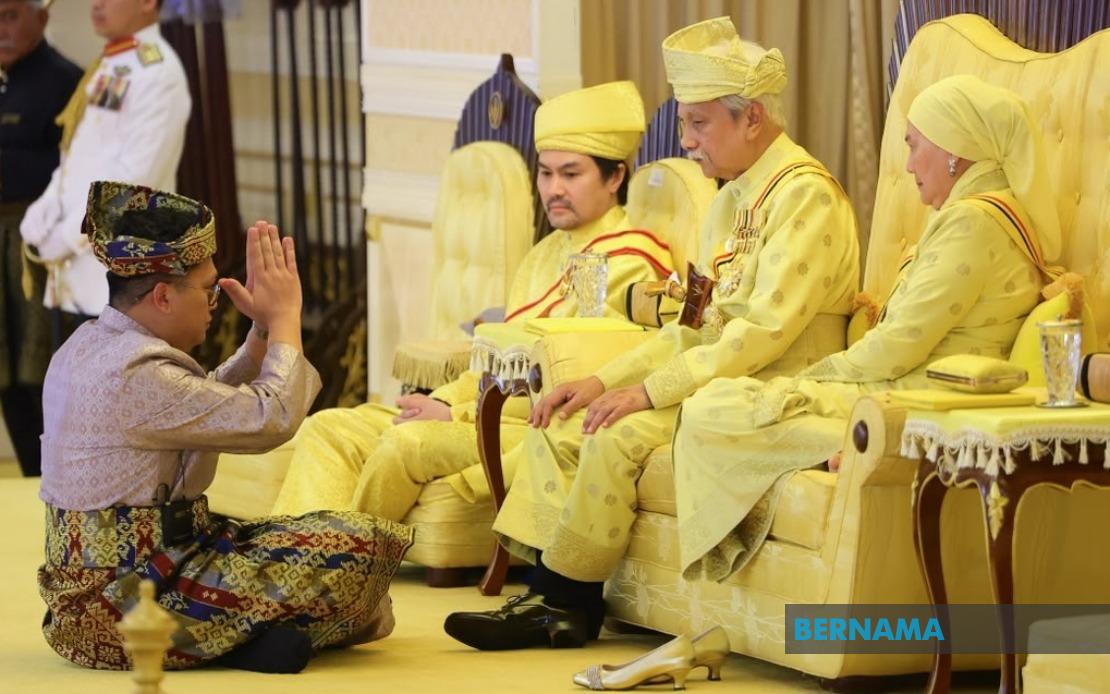
Muhammad Faris Johari has officially assumed the position of 11th Undang of Luak Sungei Ujong following a formal installation ceremony presided over by Yang Dipertuan Besar of Negeri Sembilan Tuanku Muhriz Tuanku Munawir at Istana Besar Seri Menanti in Kuala Pilah on June 27. The appointment, conducted according to traditional protocols, saw the young leader conferred with the hereditary title Datuk Klana Petra, marking an important transition in the state's customary leadership structure.
The installation ceremony adhered to long-established Negeri Sembilan traditions, commencing with the Orang Empat Istana—the senior chieftains of the state—seeking formal consent from Tuanku Muhriz to proceed with the proceedings. This foundational step underscores the hierarchical relationship between the customary leadership and the Yang Dipertuan Besar, reflecting Negeri Sembilan's distinctive matrilineal inheritance system and constitutional arrangements. Following this permission, Muhammad Faris proceeded to take an oath of loyalty to the ruler, symbolically reaffirming the bonds that connect the Undang to the sovereign and the institutions of state.
Tuanku Muhriz subsequently proclaimed Muhammad Faris's appointment in a formal royal address, which was characterized by calls for the preservation and strengthening of Negeri Sembilan's unique political and cultural heritage. The ruler emphasized that those assuming custodial roles over traditional institutions bear responsibility for maintaining the integrity and ethical standards that have historically defined their office. His remarks reflected broader concerns about ensuring that customary governance structures remain relevant and effective in contemporary Malaysia while honouring their foundational principles.
The ruler's statement addressed the essential relationship between constitutional monarchy and adat leadership, asserting that mutual respect, trust and consensus represent the cornerstones upon which these dual systems must function. Tuanku Muhriz specifically reminded all Orang Kaya—the collective body of hereditary chieftains—of their obligation to maintain loyalty to the institution of the Yang Dipertuan Besar and to cultivate a respectful, harmonious association with the palace and its representatives. This framing positions the Undang and his fellow chieftains as stewards whose authority ultimately derives from and remains accountable to the sovereign.
A distinguished assembly of royal dignitaries attended the ceremony, including Tunku Ampuan Besar Tuanku Aishah Rohani Tengku Besar Mahmud, Tunku Besar Seri Menanti Tunku Ali Redhauddin Tuanku Muhriz, and Tunku Panglima Besar Tunku Zain Al-'Abidin. The presence of these senior members of the royal hierarchy reflected the significance accorded to the installation and underscored its place within Negeri Sembilan's formal constitutional and ceremonial framework. Beyond the royal contingent, the ceremony was witnessed by Menteri Besar Datuk Seri Aminuddin Harun and senior officials from state government departments, indicating that the installation carried implications extending beyond customary governance into the state's broader administrative apparatus.
Muhammad Faris brings substantial professional credentials to his new position. The 26-year-old—born on October 30, 1997—holds a bachelor's degree in accountancy from Universiti Teknologi MARA (UiTM) and completed his professional qualification through the Association of Chartered Certified Accountants (ACCA) programme in 2022. His background in accounting and financial management represents a contemporary skillset that may inform how he approaches the administrative dimensions of his hereditary role. He is married to Sharifah Amirah Syed Ismail Ash-Shahab, further cementing family alliances within Negeri Sembilan's aristocratic circles.
The installation of Muhammad Faris occurs within Negeri Sembilan's distinctive constitutional framework, which differs markedly from Malaysia's other states. As a federal territory-like entity with unique governance arrangements, the state maintains its Adat Perpatih system—a matrilineal customary law and inheritance practice that designates the Undang as custodians of particular Luaks (territorial divisions). This appointment therefore carries profound symbolic weight, as it represents the continuation of centuries-old succession traditions in a modern nation-state.
Tuanku Muhriz's address gave particular emphasis to the Adat Perpatih tradition, calling upon contemporary leaders and the broader populace to preserve and actively uphold the values embedded within this inheritance system. He framed this preservation as essential not merely for maintaining cultural continuity, but for ensuring the state's ongoing stability and well-being. This rhetorical positioning suggests that in Negeri Sembilan's perspective, customary governance and its ethical foundations remain functionally integral to good administration and social cohesion.
The ruler also called upon the people of Negeri Sembilan to work collaboratively with the customary leadership—Muhammad Faris and his fellow Orang Kaya—in fulfilling their respective responsibilities to the state and its communities. This appeal for partnership between the populace and hereditary leaders reflects an understanding that customary institutions require ongoing social legitimacy and engagement to remain relevant. It also implies that the success of figures like Muhammad Faris in their roles will be measured not solely by their ceremonial functions but by their capacity to serve their communities' practical needs while honouring tradition.
The timing of Muhammad Faris's installation follows a broader pattern of succession transitions within Negeri Sembilan's customary hierarchy. Later the same day, another royal audience was scheduled to formally install the 22nd Undang of Luak Rembau, indicating that multiple transitions in the state's customary leadership were occurring concurrently. These overlapping appointments suggest a generational shift within Negeri Sembilan's traditional elite, raising questions about how these younger leaders will navigate the tensions between preserving historical practices and addressing contemporary governance challenges.
For Malaysia more broadly, the installation of Muhammad Faris represents a significant moment in the ongoing evolution of customary institutions within the federal system. While Negeri Sembilan's adat governance structures occupy a distinctive legal and constitutional space, their operations remain subject to broader Malaysian law and federal arrangements. How Muhammad Faris and his generational cohort manage this complex terrain—balancing hereditary authority with contemporary accountability standards, and traditional practice with modern governance expectations—may offer instructive lessons for understanding how Malaysia's plural institutional structures can evolve while maintaining their foundational integrity.

