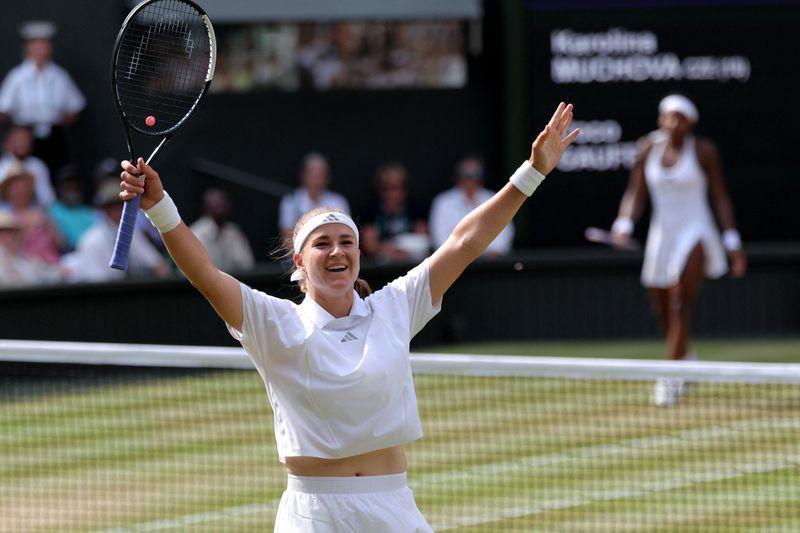
Karolina Muchova's dominant grasscourt display and nerves of steel secured her first Grand Slam final appearance after she defeated American seventh seed Coco Gauff in a gripping Wimbledon semi-final that stretched well beyond two hours. The Czech player's 6-2 1-6 7-6 victory on Centre Court on July 9 saw her recover from match point down in the third set tiebreak, ultimately prevailing when Gauff's forehand sailed into the net. Muchova's progression sets the stage for a potential all-Czech final on Saturday, should her compatriot Linda Noskova overcome Ukrainian Marta Kostyuk in Thursday's second semi-final.
The prospect of two Czech players meeting in a Wimbledon final would represent a remarkable achievement for the tennis nation, continuing a golden streak that has seen Czech women claim three of the last four grass major championships. Marketa Vondrousova claimed the Venus Rosewater Dish in 2023, followed by Barbora Krejcikova's triumph in 2024. A Muchova victory would represent the third Czech champion in four years at the All England Club, underscoring the depth and quality emerging from the country's tennis program.
Muchova's path to the final carries particular poignancy given that she contends with severe grass allergies, requiring medication, sprays, and eye drops simply to compete on the sport's most prestigious surface. Despite this physical impediment, her tactical acumen and craftsmanship shone throughout the match, particularly in the opening set where she broke Gauff's serve twice. A crushing 111 mph ace closed out the first set decisively, establishing Muchova's authority early. The American's failure to convert break points proved costly in those early exchanges, setting a pattern that would haunt her chances throughout the encounter.
Gauff's resilience, however, demonstrated precisely why she has become one of tennis's most compelling figures. The American had arrived at the semi-final having survived four consecutive three-set contests, a testament to her unwillingness to surrender ground when circumstances turn adverse. After laboring through the opening set, she mounted a dramatic second-set comeback, eventually converting her ninth break point opportunity to secure a 3-1 lead. That breakthrough seemed to energize Gauff's performance, with her mother visibly celebrating in the player's box as the American stormed to a 5-1 cushion before leveling the match at one set each.
The deciding set transformed into a masterclass of competitive tennis from both players, with rallies characterized by penetrating forehands and technically flawless backhands. Both competitors struck the ball with genuine authority, creating moments of breathtaking athletic ability that showcased modern tennis at its most compelling. Gauff had presented herself with two critical opportunities to break Muchova's serve for a 5-4 advantage, but the Czech player demonstrated composure under pressure, escaping that juncture to shift momentum decisively in her favor. Muchova's tactical intelligence and mental fortitude in those moments proved decisive, as Gauff's opportunities evaporated.
The match tiebreak itself became a showcase for Muchova's multifaceted grasscourt arsenal. She executed a spectacular diving volley winner that drew gasps from the Centre Court crowd and struck a perfectly weighted lob that forced Gauff beyond the baseline, combining aggression with precision. These shots furnished Muchova with her first match point, though that opportunity slipped away. The Czech player did not squander her second chance, however, remaining composed as Gauff's forehand unraveled under pressure. After two hours and thirty-five minutes of relentless competition, Muchova raised her arms in triumph, having secured her passage to the showpiece event.
For Malaysian and Southeast Asian tennis enthusiasts, this semi-final offered compelling lessons in resilience, tactical adaptation, and mental fortitude under extreme pressure. Gauff's willingness to extend matches to their limits and maintain competitiveness despite adversity embodies principles that younger regional players would benefit from emulating. Conversely, Muchova's ability to overcome physical limitations through superior court craft and psychological strength demonstrates that raw talent alone remains insufficient at the highest levels of professional tennis. Her journey to the final, achieved despite battling allergies that would deter lesser competitors, illustrates the extraordinary dedication required for Grand Slam success.
The match also underscores the evolving competitive landscape at Wimbledon, where geographic and demographic diversity continues expanding. Gauff's emergence as a perennial contender represents American tennis's renaissance following a period of relative decline at the Grand Slams, while Muchova's breakthrough reflects Eastern Europe's consolidated position within elite women's tennis. For observers across Asia, these developments carry significance beyond mere sporting achievement, reflecting broader patterns of global talent development and the resources required to compete sustainably at professional tennis's highest echelon.
Muchova's triumph represents the culmination of patient career development for a player who has long possessed the technical skills and tactical intelligence necessary for Grand Slam success. Her combination of grasscourt variety—a portfolio of shots extending far beyond the conventional baseline exchanges—and composure in high-pressure moments distinguishes her from contemporaries who rely primarily on power. That she reaches her first Grand Slam final at a major championship, rather than through secondary venues, validates the quality of her performance throughout this fortnight. Her Saturday opponent will face a player operating at peak confidence, having just overcome one of tennis's most resilient competitors in circumstances of maximum drama and pressure.

