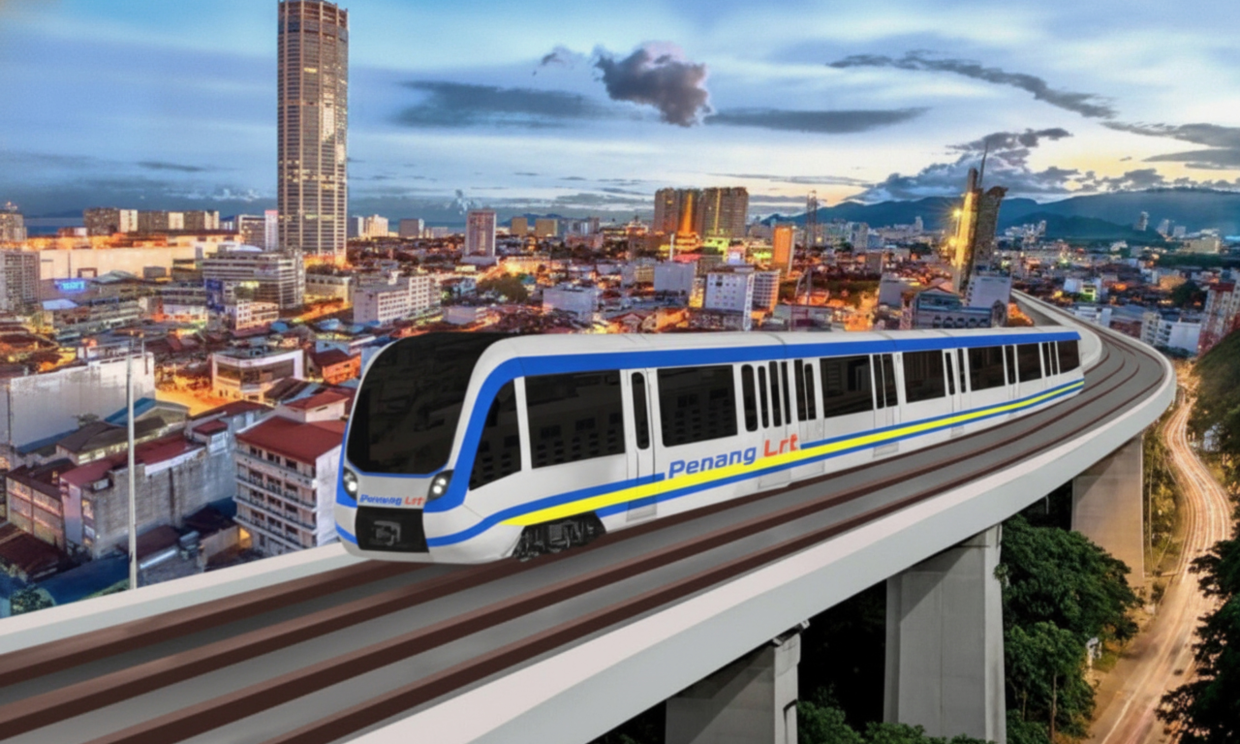
Malaysian Resources Corp Bhd (MRCB) has landed a major infrastructure contract worth RM3.028 billion for the railway systems component of the Penang Light Rail Transit (LRT) Mutiara Line project, signalling continued momentum in Southeast Asia's rapid transit development. The contract, secured through a 90:10 unincorporated joint venture arrangement, represents one of the most substantial recent awards in Malaysia's railway sector and underscores the country's sustained commitment to modernising public transportation across key regional centres.
The scope of work under the nearly 69-month engagement is comprehensive, encompassing the complete lifecycle of railway system deployment and operation. MRCB and its joint venture partner will be responsible for designing, sourcing, installing, rigorously testing, and commissioning all critical railway systems that form the backbone of the Penang LRT's operational infrastructure. This encompasses the rolling stock—the trains themselves—alongside sophisticated signalling apparatus that orchestrates safe train movement and spacing, integrated power distribution networks supplying electricity throughout the system, advanced telecommunications infrastructure enabling real-time communication and coordination, and the ticketing ecosystem that manages passenger access and fare collection.
The contract's extended duration reflects the complexity inherent in modern transit system deployment. The 68.8-month timeframe provides MRCB with a structured implementation schedule while maintaining flexibility to address the multifaceted challenges typical of large-scale infrastructure rollouts. This phased approach allows for sequential system integration and comprehensive testing protocols before full operational launch, reducing the risk of system failures that could compromise service reliability.
For MRCB, the award represents a substantial addition to its project pipeline and a validation of its technical capabilities in complex transportation infrastructure. In its announcement to Bursa Malaysia, the company expressed confidence that the Penang LRT contract will meaningfully contribute to future group earnings, reflecting both the contract's monetary value and its potential to establish MRCB as a trusted partner for future regional transit initiatives. The company's track record in delivering comparable large-scale infrastructure projects formed the foundation of its successful bid.
However, MRCB acknowledges the realities of modern construction contracting. Material and equipment price volatility presents an ongoing challenge in infrastructure projects, particularly given global supply chain complexities and commodity market fluctuations that have intensified in recent years. Currency exposure, labour cost pressures, and unforeseen site conditions are standard risks in any major construction venture. MRCB's response emphasises its established risk mitigation framework—comprising internal control systems, operational procedures honed through prior major projects, and experienced management protocols designed to navigate construction uncertainties.
The Penang LRT Mutiara Line itself represents part of a broader transportation transformation for the state. As Malaysia's second-largest metropolitan area and a crucial economic hub, Penang faces mounting traffic congestion that constrains economic productivity and quality of life. The Mutiara Line is envisioned as a catalyst for mode shift, encouraging residents and commuters to embrace rail-based transit over private vehicles. By connecting key employment, residential, and commercial nodes, the system aims to reduce road congestion while improving air quality and supporting more sustainable urban development patterns.
The contract award also reflects Malaysia's maturation as a hub for complex infrastructure delivery. Rather than relying entirely on foreign contractors, Malaysian companies like MRCB increasingly lead major transportation projects, though often in partnership arrangements that blend local expertise with international capabilities. This joint venture structure, while requiring coordination between parties, distributes risk and leverages complementary strengths—a pragmatic approach increasingly favoured in infrastructure finance and development across the region.
Market response to the announcement proved positive, with MRCB's share price appreciating by one sen to 32 sen—a gain of 3.23 percent—at midday trading. MRCB's joint venture partner, Theta Edge, experienced more dramatic appreciation, surging 14 sen to 69 sen, representing a 25.45 percent jump. This buoyant reception suggests investor confidence in both companies' abilities to execute the project successfully and recover meaningful returns from the engagement.
Beyond the immediate corporate implications, the Penang LRT contract underscores Malaysia's determination to deploy world-class transit infrastructure in major cities. As regional competitors—from Bangkok to Ho Chi Minh City—expand their metro and light rail networks, Malaysian urban centres must match these investments to remain economically competitive and attractive to both domestic and foreign talent. The Penang project thus sits within a larger competitive landscape where transit quality increasingly functions as an economic differentiator.
The railway systems award also highlights the importance of integrated planning in transit development. Modern LRT systems require seamless coordination between civil infrastructure (tracks, viaducts, stations) and systems integration (signalling, power, communications). By consolidating these responsibilities within a single contractor team, project managers can more effectively manage interfaces and ensure compatibility—an approach increasingly standard in major transit projects worldwide.
Implementation success will depend on several factors: supply chain stability for specialised railway equipment, workforce availability and productivity, regulatory approvals for system specifications, and effective coordination with parallel station and track construction workstreams. MRCB's experience positions it favourably, though the compressed timelines typical of modern infrastructure projects mean limited tolerance for delays or cost overruns.
The Penang LRT Mutiara Line represents a tangible manifestation of Malaysia's infrastructure ambitions during a period when public investment in transportation infrastructure has intensified nationwide. As the project progresses, MRCB's execution will establish important benchmarks for future comparable transit ventures across Malaysia and the broader Southeast Asian region, potentially shaping how subsequent light rail and metro projects are structured and delivered.

