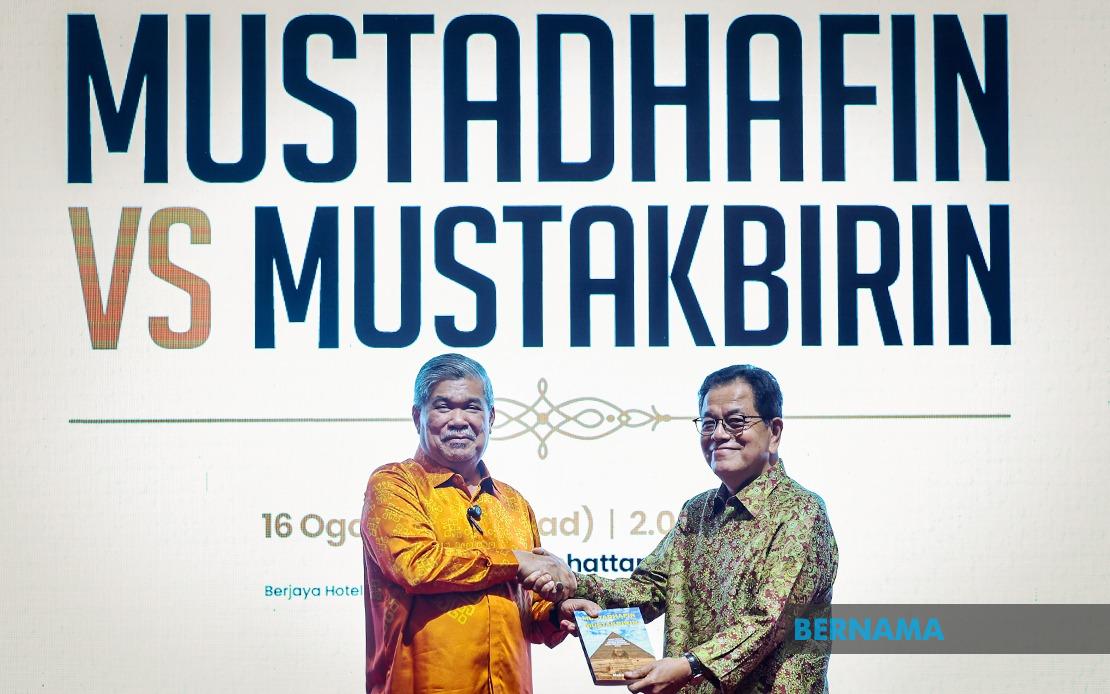
During the launch of his book in Kuala Lumpur on August 16, Amanah president Datuk Seri Mohamad Sabu issued a pointed warning about the dangers of uncritically embracing political accusations. The Agriculture and Food Security Minister argued that Malaysians must resist the impulse to swallow allegations whole, instead demanding evidence and developing a reasoned understanding before forming judgments on contentious matters of state.
Mohamad identified a specific psychological trap that he believes undermines informed public discourse: the tendency toward 'asabiyyah', a concept describing how individuals instinctively defend their own faction regardless of merit while dismissing the achievements of rivals. This bias, he suggested, becomes particularly virulent when people accept unverified claims without subjecting them to scrutiny. Such uncritical acceptance erodes the intellectual foundation necessary for genuine political debate and weakens the public's capacity to distinguish between substance and rhetoric.
The minister drew particular attention to a recurring allegation that has haunted Malaysian politics for decades: claims that the Democratic Action Party, or DAP, harbours communist sympathies and that any political cooperation with the party therefore constitutes tacit endorsement of communist ideology. Rather than accepting this narrative at face value, Mohamad posed a fundamental question to the assembled media: is DAP genuinely communist? The query serves as a broader invitation to citizens to examine such assertions against actual evidence rather than accepting them as self-evident truths.
Mohamad elaborated on the epistemological challenge facing modern democracies in an era of rapid information dissemination. He observed that factual knowledge and rigorous understanding demand intellectual effort and time for proper comprehension, whereas accusations and unfounded suspicions spread with remarkable speed, particularly through social media platforms where verification mechanisms remain weak. This asymmetry between the velocity of misinformation and the labourious pace of truth-seeking creates a structural disadvantage for evidence-based discourse.
The book launch, which was presided over by National Journalism Laureate Tan Sri Johan Jaaffar—a director of Star Media Group Berhad—provided the occasion for these reflections. According to Mohamad, the volume documents his personal trajectory of seeking understanding through direct engagement rather than passive acceptance of prevailing narratives. He revealed a lifelong practice of epistemic independence, noting that since his youth he has resisted the temptation to absorb information uncritically, preferring instead to investigate matters personally before accepting claims, regardless of how widely they are propagated or how authoritative the sources may appear.
This approach to information evaluation carries particular significance in Malaysia's complex political landscape, where coalition governments and shifting alliances routinely generate competing claims about parties and politicians. The minister's insistence on direct investigation over deference to circulating propaganda represents a refreshing departure from the tendency of partisan actors to weaponize information during periods of political tension. His argument essentially calls for intellectual citizenship—the notion that functioning democracies require publics capable of independent thought rather than populations amenable to manipulation through repetition.
The book also ventures into broader geopolitical terrain, examining how Malaysia's position within global power structures intersects with historical forces and contemporary dynamics. Mohamad draws on accumulated experience and observation to analyse questions of colonialism, Islamic movements, the Palestinian conflict, and shifts in the international balance of power. This wider lens suggests that his concerns about uncritical acceptance of allegations extend beyond domestic partisan disputes to encompass how Malaysians understand their nation's place in an increasingly multipolar world.
For Malaysian readers navigating a media environment saturated with political claims and counterclaims, Mohamad's central message carries practical implications. The proliferation of digital communication channels means that allegations—whether substantiated or baseless—can reach millions instantaneously, shaping public opinion before verification occurs. His warning encourages citizens to adopt a more demanding standard of evidence before allowing such claims to influence their political judgments or social attitudes.
The critique also resonates within Southeast Asia's broader struggles with misinformation and political polarization. Across the region, similar patterns of unverified allegations fuelling group divisions have contributed to social fragmentation and undermined democratic deliberation. Mohamad's call for intellectual rigour thus addresses a challenge that transcends Malaysia, affecting how citizens throughout the region engage with political discourse during periods of heightened tension or institutional instability.
Ultimately, the minister's intervention suggests that Malaysia's political future depends partly on whether citizens embrace the demanding work of verification and independent thought or succumb to the seductive simplicity of accepting ready-made narratives. By challenging the public to examine rather than merely absorb political claims, Mohamad articulates a vision of democratic citizenship rooted in intellectual honesty and personal responsibility for understanding complex questions rather than outsourcing judgment to partisan voices eager to shape opinion for sectional advantage.

