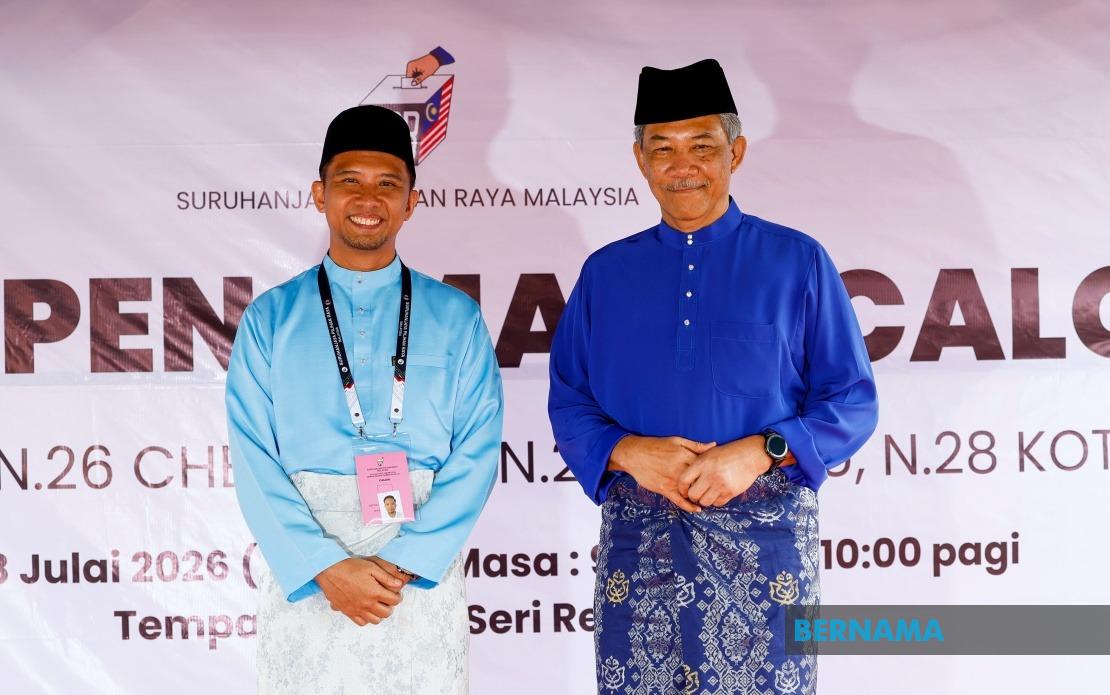
The Rantau state seat in Negeri Sembilan will be contested as a straight fight in the upcoming 16th state election, pitting state Barisan Nasional chairman and Foreign Minister Datuk Seri Mohamad Hasan directly against Pakatan Harapan candidate Dr Azizul Hakim Mahdi. The returning officer, Mohd Zamri Mohd Esa, confirmed the two-candidate race following the completion of the nomination process at Dewan Sri Rembau on July 18, officially setting the stage for what analysts expect to be one of the state's most closely watched contests.
Modhamad, who holds the dual positions of UMNO deputy president and Rembau Member of Parliament, has represented the Rantau constituency since 2004, establishing himself as an entrenched incumbent with nearly two decades of electoral dominance. His retention of the seat in 2023 was emphatic, securing 16,957 votes against Pakatan Harapan challenger Rozmal Malakan's 6,677 votes—a commanding majority of 10,280 votes that underscored his political standing within the state. The straight fight configuration removes any possibility of vote-splitting that might have benefited either camp, creating a binary choice for voters between the established BN machinery and an opposing force seeking to challenge the coalition's control in this traditionally competitive state seat.
Following the nomination announcement, Mohamad outlined Barisan Nasional's campaign strategy, emphasizing the coalition's intention to systematize its grassroots operations and leverage organizational strengths. He stated that the official campaign period would focus on articulating the BN manifesto and securing voter approval on polling day, reflecting confidence in the coalition's ground presence and voter outreach apparatus. The messaging strategy appears calibrated toward consolidating existing support among rural and semi-urban constituencies within Rantau while expanding appeal among urban professionals and swing voters concerned with economic stability and development continuity.
Dr Azizul Hakim, at 35 years old, represents a generational shift in Pakatan Harapan's candidate selection, positioning himself as a younger, professionally accomplished alternative to the incumbent's decades-long political career. His credentials as a medical practitioner with a decade of healthcare experience and ownership of three medical clinics across Senawang, Puncak Alam, and Melaka ground his campaign messaging in tangible community engagement and professional expertise. This biographical profile is designed to appeal to younger voters and professionals who may feel disconnected from traditional political narratives, while his healthcare focus speaks directly to post-pandemic concerns about medical accessibility and service quality—issues that resonate across socioeconomic lines in Malaysian constituencies.
Dr Azizul's campaign positioning emphasizes healthcare accessibility and local issue resolution, carving out a thematic niche distinct from broader partisan messaging. His framing as a "different choice" attempts to redefine the electoral contest beyond binary coalition mathematics, instead presenting voters with a fresh representative committed to sector-specific development and community-focused problem-solving. This approach reflects broader Pakatan Harapan trends of deploying professional and technical expertise to challenge BN incumbents, particularly in constituencies where service delivery and professional competence carry electoral weight.
Beyond Rantau, the broader Negeri Sembilan electoral landscape reveals multi-candidate contests that complicate the BN-PH binary. The Paroi state seat will feature a three-way contest between Pakatan Harapan's Ahmad Shahir Mohd Shah (Menteri Besar press secretary), Perikatan Nasional's Kamarol Ridzuan Mohd Zin, and Bersatu's Mohd Nazree Mohd Yunus, fragmenting opposition votes across competing alternative blocs. Similarly, the Kota seat presents a three-cornered race with incumbent BN candidate Suhaimi Aini opposing both Pakatan Harapan's Muhammad Allif Ibrahim and Bersatu's Akmal Noradzmi Abdul Rahim, suggesting that vote splits rather than direct contests will characterize several constituencies.
The Chembong state seat maintains a straight fight configuration between incumbent BN candidate Datuk Zaifulbahri Idris and Pakatan Harapan's Danish Nazran Murad, creating a second direct contest that will test BN's ability to retain state seats against consolidated opposition challenge. These varied contest formats across the 36 legislative assembly seats indicate that overall state election outcomes will depend not merely on aggregate vote performance but on tactical positioning and the degree to which opposition fragmentation benefits or hinders individual candidacies in different constituencies.
Negeri Sembilan's electorate of 889,490 registered voters comprises 867,151 ordinary voters alongside 16,884 military and police personnel eligible for early voting on July 28, with the general election scheduled for August 1. The early voting mechanism reflects security sector representation that traditionally leans toward incumbent BN support, potentially providing the coalition a small but measurable voting advantage from military and paramilitary constituencies. The overall voter base represents a cross-section of urban, semi-urban, and rural constituencies that collectively determine whether BN maintains its grip on state government or whether fractured opposition forces can consolidate sufficient ground support for a historic power transfer.
The Rantau contest specifically encapsulates the broader electoral dynamics at play in Negeri Sembilan, where established BN dominance faces pressure from both a unified Pakatan Harapan challenge and fragmented Perikatan Nasional-Bersatu competition. Mohamad Hasan's positioning as a national figure doubling as state party chairman grants him organizational leverage and media prominence, yet his national commitments potentially create constituency-level engagement challenges that a full-time local representative might avoid. Conversely, Dr Azizul Hakim's local professional credentials and healthcare sector focus may resonate among constituencies increasingly concerned with service quality and younger leadership representation, though his electoral inexperience presents obvious challenges against an incumbent with two decades of institutional knowledge.
The campaign period beginning after nomination completion will test whether either candidate successfully mobilizes voters around their distinct propositions or whether broader state-level partisan trends overwhelm localized candidate-specific appeals. Mohamad's considerable 2023 majority suggests substantial consolidated support, yet Dr Azizul's professional positioning and healthcare emphasis represent potentially effective counter-narratives in constituencies where service delivery frustrations have accumulated. The straight fight configuration eliminates tactical complexity, reducing the contest to fundamental choices about political representation, governance record, and competing visions for constituency development—a framework that typically favors either clear incumbent advantage or decisive challenger momentum, leaving little room for ambiguous outcomes.

