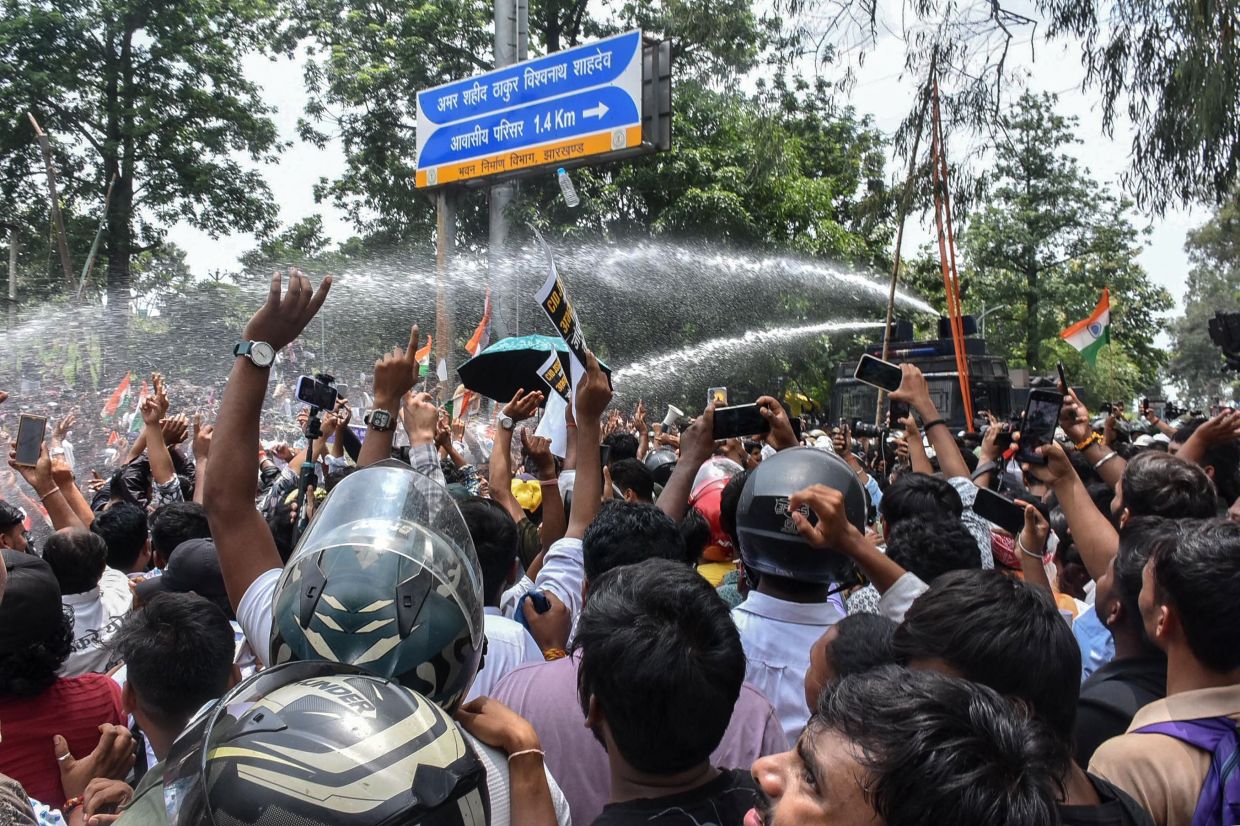
Prime Minister Narendra Modi's Bharatiya Janata Party has launched a direct challenge to the Cockroach Janta Party, a pressure group that achieved prominence through orchestrating major student demonstrations in the capital last month, questioning its commitment to activism by highlighting its limited involvement in escalating unrest sweeping through Jharkhand, a state governed by opposition-aligned parties. BJP spokesperson Keya Ghosh articulated the ruling party's criticism on Tuesday, suggesting that the group's restraint in Jharkhand reveals the underlying political calculation behind its earlier New Delhi campaign.
The party's argument hinges on a fundamental inconsistency: the Cockroach Janta Party mobilised substantial resources and public attention to drive demonstrations in New Delhi over administrative failures in national-level examinations, ultimately securing the resignation of Education Minister Dharmendra Pradhan. However, with student agitation now gripping Jharkhand—a mineral-rich eastern state where opposition parties control the government—the same group has remained conspicuously quiet. Ghosh suggested this differential engagement indicates that the New Delhi protests were fundamentally designed to undermine the Modi administration rather than emerge from authentic concern for educational reform or student welfare.
The Cockroach Janta Party originated as a satirical online movement before evolving into an organised pressure group capable of marshalling substantial street mobilisation. Its trajectory reflects a broader pattern within Indian civil society where digital-native organisations leverage social media platforms to translate online sentiment into offline protest movements. The group's successful orchestration of the New Delhi demonstrations introduced a new actor into India's political landscape, one that positioned itself as independent from traditional partisan structures while addressing genuine grievances about examination standards and administrative competence.
In Jharkhand, however, the protest narrative has developed differently. Students and job aspirants there are demanding a comprehensive federal investigation into examination irregularities at the state recruitment level, indicating concerns about institutional integrity in employment pathways. Unlike the centralised and media-savvy New Delhi demonstrations, the Jharkhand agitation has emerged organically from local communities directly affected by these alleged administrative failures. The absence of the Cockroach Janta Party's characteristic organisational apparatus and media presence has not weakened the protests; instead, they have retained grassroots authenticity while maintaining similar strategic objectives.
The BJP's accusations contain an implicit acknowledgment of the Cockroach Janta Party's political significance. By calling out the group's limited engagement in Jharkhand, the ruling party simultaneously recognises the group's capacity to mobilise constituencies and shape narrative frameworks. Ghosh's pointed questions about why group founder Abhijeet Dipke has not visited Jharkhand student protesters mirrors tactics often employed in Indian politics where opposition parties are questioned for selective activism based on which governments they wish to target. This rhetorical strategy attempts to reframe activist engagement as opportunistic rather than principled.
Some nuance complicates the BJP's straightforward hypocrisy narrative. Members of the Cockroach Janta Party have actually participated in Jharkhand demonstrations, with national coordinator Akshay Shinde telling media outlets that activists were contributing substantively to the agitation. Dipke himself issued statements condemning police use of water cannons and batons against demonstrators, framing the violence as inconsistent with democratic principles of peaceful assembly. This involvement, however limited compared to the New Delhi campaign's intensity, suggests the group has maintained some engagement while declining to position itself as the movement's primary driver.
The political context undergirding the Jharkhand protests provides crucial understanding for why the Cockroach Janta Party might calibrate its involvement differently. Jharkhand operates under a coalition government led by the Jharkhand Mukti Morcha, with partnership from the Indian National Congress, while the BJP serves as the state's principal opposition. This configuration means that unlike the New Delhi situation, where protests targeted a national government the group may view critically, Jharkhand agitation occurs in a context where opposition parties control executive power. Engaging maximally in such circumstances creates different political implications and complications for a group presenting itself as non-partisan.
Opposition Congress leader Rahul Gandhi has adopted a measured position on both the New Delhi and Jharkhand student movements. Rather than joining street protests, Gandhi issued statements affirming students' rights to peaceful demonstration and calling for dialogue-based solutions to underlying grievances. His absence from both protest sites mirrors the Cockroach Janta Party's selective engagement, yet the BJP has specifically questioned Gandhi's presence in Jharkhand, suggesting partisan advantage shapes his political choices. This dynamic illustrates how Indian politics frequently frames activism through sectarian lenses, questioning motivations based on which government faces scrutiny.
The allegations of hypocrisy levelled by the BJP operate within a broader pattern of Indian political contestation where civil society organisations face accusations of partisan bias regardless of their stated non-partisan positioning. The Cockroach Janta Party's emergence represented an attempt to transcend traditional Left-Right divides by focusing on administrative competence and institutional accountability. However, the group's disproportionate impact on a national government led by one party inevitably creates perceptions of political selectivity, even when the group's core concerns about examination administration remain genuinely urgent across contexts.
For Malaysian observers, the Jharkhand situation offers insights into how student movements and civil society organisations navigate complex political landscapes in federal systems with competitive multi-party democracies. India's decentralised governance structure means that similar institutional failures occur across different states governed by different parties, yet activist organisations must navigate carefully to maintain credibility as non-partisan forces while operating within inherently political contexts. The tension between principled activism and perceived partisan selectivity remains perpetually fraught in majoritarian democracies where elections create high stakes and zero-sum competitive dynamics between ruling and opposition coalitions.
The fundamental question animating these controversies concerns the legitimacy and consistency of protest movements across geography and partisan context. Can activist organisations claim principled non-partisanship while necessarily engaging more intensively with some state actions than others based on which governments control particular territories? India's Jharkhand dispute suggests that civil society organisations attempting to transcend partisan categories face persistent challenges in maintaining such positioning, particularly when their most visible campaigns have targeted specific national governments. This dynamic carries implications for how emerging activist movements in Southeast Asia navigate similar terrain between authentic social grievances and apparent political selectivity.

