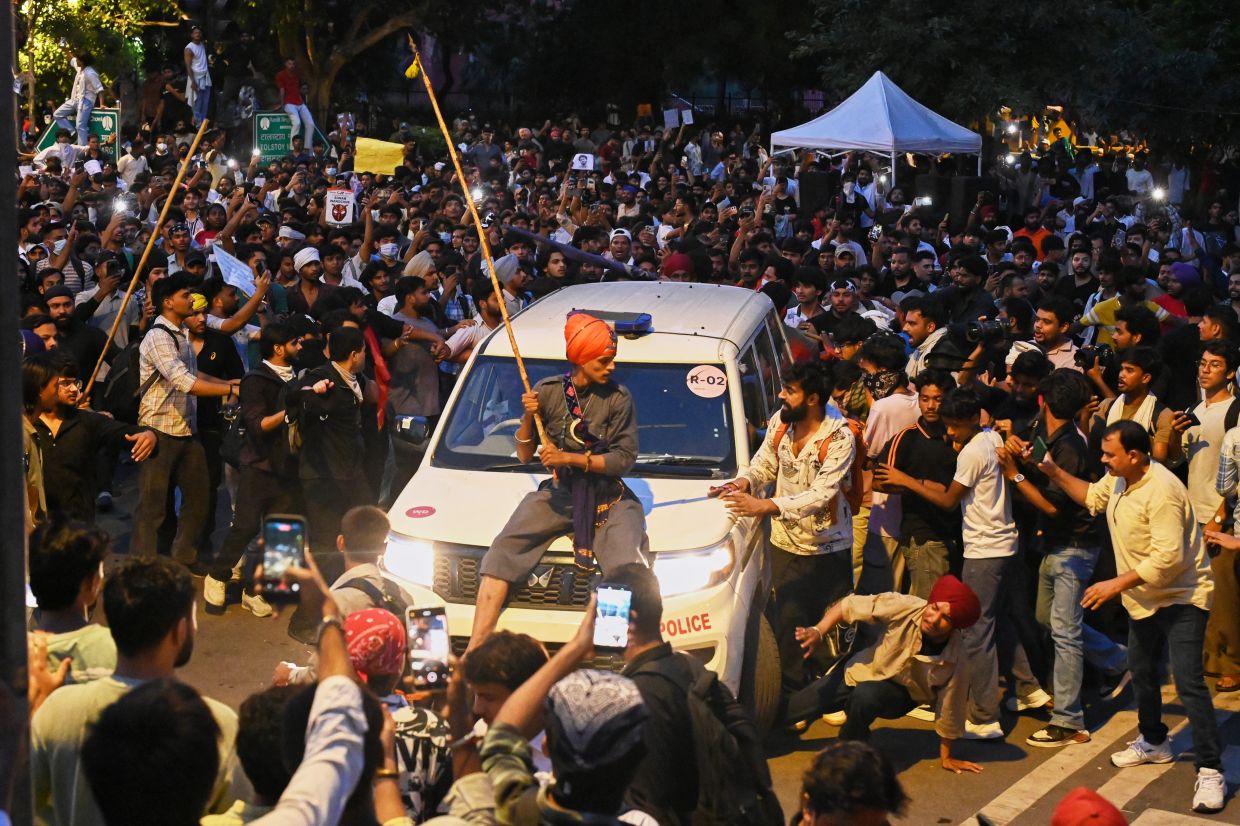
Prime Minister Narendra Modi has pledged "stringent punishment" for those behind exam fraud, breaking his silence on the escalating student demonstrations that have rocked India's capital. The assurance, delivered through a social media post on Thursday, marks his first substantive response to what has evolved into one of the most significant protest movements since his re-election for a third term in 2024. Modi's commitment to establish fast-track courts for prosecuting examination paper leak conspirators reflects the gravity with which the government now views the unrest that has captured the nation's attention and sparked growing solidarity movements across South Asia.
Thousands of demonstrators, predominantly university and college students mobilised through the social media-driven Cockroach Janta Party (CJP) movement, converged on New Delhi on Wednesday evening in one of the capital's most substantial street rallies in half a decade. The protests, which intensified following Monday's police response to initial demonstrations outside parliament, have exposed deep fractures in public confidence regarding the integrity of India's examination systems and, more broadly, the government's stewardship of the education sector. The moniker "Cockroach Janta Party" originated as a satirical rejoinder to Chief Justice Surya Kant's reported characterisation of young people as "cockroaches" and "parasites" during court proceedings in May, though the movement has since metamorphosed into a comprehensive critique of governance, employment opportunities, and what participants view as increasingly authoritarian policy directions.
Monday's violent confrontation between security forces and students attempting to march toward parliament on the opening day of the monsoon session set the template for subsequent encounters. Police deployed tear gas canisters and conducted baton charges against tens of thousands of assembled protesters, prompting demonstrators to respond with stone-throwing that resulted in injuries to at least 178 individuals, encompassing both security personnel and civilian participants. This escalation occurred despite the ostensible focus of initial demonstrations being examination system malfeasance, suggesting deeper grievances regarding democratic space and government responsiveness had animated the mobilisation.
Wednesday's clashes at the Jantar Mantar protest site in central Delhi extended into late evening hours, with reports from CJP spokesman Ashutosh Ranka documenting what he characterised as brutal police responses including internet shutdowns. Delhi Police countered these allegations by asserting that demonstrators perpetrated aggression against officers, deploying stones and plastic bottles that occasioned serious injuries among law enforcement contingents. These competing narratives reflect the polarisation surrounding the protests, with the government and security apparatus viewing the demonstrations as potentially destabilising, while youth organisers and opposition figures frame the state response as disproportionate and politically motivated.
The examination system failures that catalysed the original protests encompass multiple high-profile incidents that have cumulatively eroded public trust in educational institutions and assessment mechanisms. A leaked medical entrance examination question paper forced more than two million candidates to undertake retest procedures, representing an unprecedented disruption to the medical education pipeline. Separately, controversies surrounding online marking systems for examinations administered to nearly two million secondary students have compounded public frustration and reinforced perceptions of systemic rot within India's testing infrastructure.
Opposition political forces have seized upon the protest momentum to intensify scrutiny of Modi's government, with Congress Party leader Rahul Gandhi using social media platforms to accuse the prime minister of personally orchestrating the education system's deterioration through protective patronage toward corrupt administrators. Parliamentary proceedings have been disrupted by opposition legislators demanding a formal government apology for Monday's police actions against demonstrators. This convergence of street mobilisation and legislative pressure has created a dual challenge for the administration, forcing it to respond simultaneously to organised youth activism and coordinated political opposition.
The CJP movement, which mobilises millions of social media followers, has expanded its protest agenda substantially beyond examination fraud concerns. Platform posts and demonstrations increasingly emphasise unemployment crisis among youth, scarcity of meaningful economic opportunities, and alleged authoritarian governance tendencies within Modi's administration. This broadening of grievances reflects the movement's evolution from single-issue activism to a more comprehensive generational critique, positioning it as qualitatively distinct from previous ad-hoc student agitations that have periodically emerged in Indian politics.
Geographic dissemination of protest activities beyond the national capital signals growing resonance with the movement's messaging. Wednesday demonstrations in metropolitan centres including Mumbai, Bengaluru, and Patna extended the protest footprint and suggested that examination system anxieties and broader youth frustrations regarding economic opportunity represent pan-Indian rather than Delhi-specific phenomena. This spatial expansion complicates government containment efforts and indicates potential for sustained rather than ephemeral mobilisation.
International dimensions have emerged, with Bangladeshi student groups organising a solidarity "torch rally" on Thursday evening to express support for Delhi protesters. This cross-border gestures carries particular resonance given Bangladesh's own recent experience with youth-led protests during 2024, when student demonstrations against examination irregularities and employment prospects catalysed the political upheaval that ultimately removed Prime Minister Sheikh Hasina from office. The parallel trajectories of youth activism across the subregion suggest that examination system integrity and youth employment prospects represent critical pressure points in contemporary South Asian governance, with potential implications for regime stability across multiple countries.
Modi's invocation of youth welfare as a governmental priority must contend with structural realities regarding education system oversight and examination administration. The prime minister's pledge of fast-track courts for fraud prosecution addresses procedural accountability but does not directly confront systemic vulnerabilities that enabled question paper leaks and marking irregularities to occur. Whether enhanced criminal sanctions will satisfy demonstrators demanding broader institutional reform, or whether the government perceives such measures as sufficient to restore confidence and de-escalate street mobilisation, remains uncertain. The coming weeks will likely determine whether Modi's response mechanisms prove adequate to containing what has emerged as the most substantial challenge to his political standing since returning to office.

